
Words Matter: Why Colombia’s Correction on Operation Sindoor Is a Big Deal

Paromita Das
GG News Bureau
New Delhi, 2nd June: In the fast-evolving world of global diplomacy, statements made in moments of crisis often carry weight far beyond their original intent. In such a scenario, Colombia’s recent decision to officially withdraw a statement that had expressed condolences for lives lost in Pakistan—following Bharat’s counter-terrorism response, Operation Sindoor—stands as a significant gesture. More than a simple diplomatic correction, this moves signals a deeper alignment between two democratic nations, and highlights how international perception and political sensitivity play a crucial role in shaping geopolitical partnerships.
A Misstep Acknowledged, A Relationship Rebalanced
The original Colombian statement, made in the aftermath of Bharat’s precise and measured military operation in Pahalgam, was seen in New Delhi as troubling. It had equated terrorists neutralized during Operation Sindoor with victims of a terror attack—effectively creating a false equivalence between aggressors and the innocent. This was not just diplomatically tone-deaf, but potentially damaging at a time when Bharat has been striving to build global consensus against terrorism, especially cross-border militancy emanating from Pakistan.
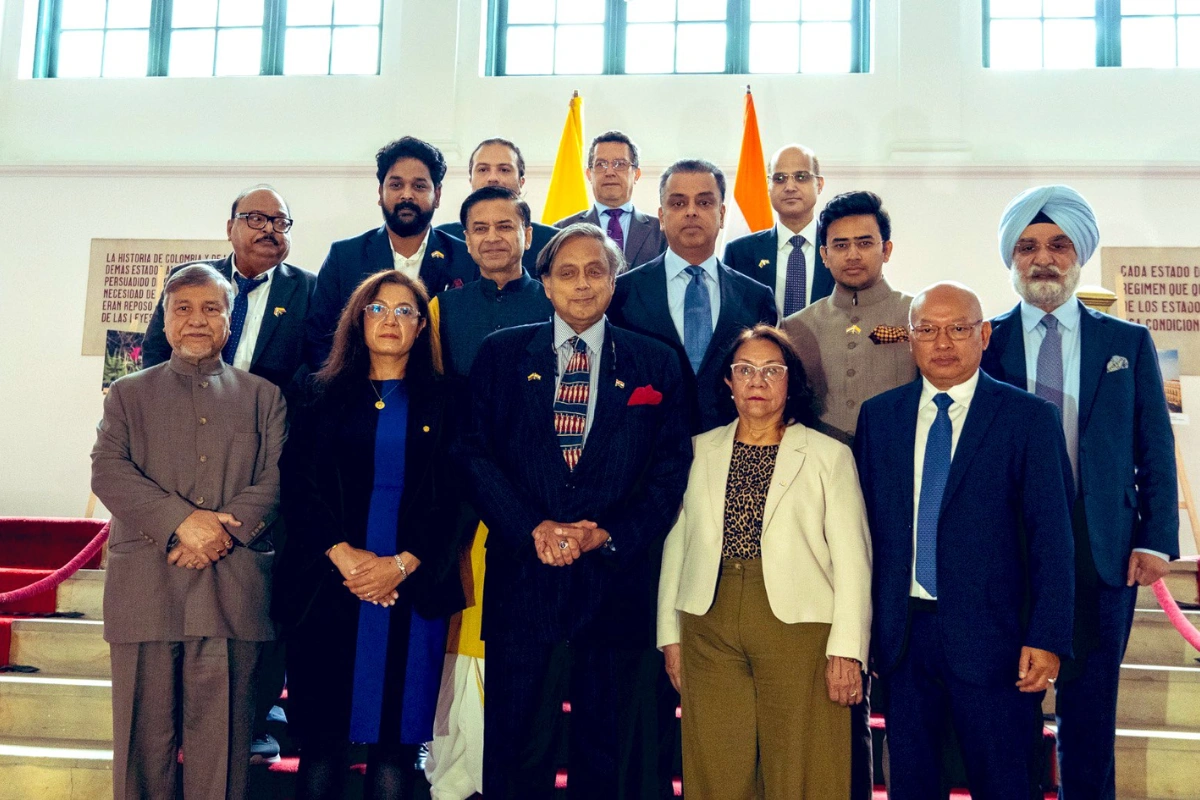
What makes Colombia’s retraction significant is not merely the content, but the context and speed of response. Vice Minister of Foreign Affairs Rosa Yolanda Villavicencio’s clarification, offered during an official meeting with an Bharatiya parliamentary delegation led by Congress MP Shashi Tharoor, reflected a mature, responsive, and respectful attitude. “She assured us that Colombia fully understands Bharat’s perspective on the matter, which we greatly appreciate,” Tharoor said after the meeting.
This apology, if one can call it that, was not driven by compulsion but by comprehension. As Bharatiya MPs explained the chronology and implications of the Pahalgam terror attack and the objectives of Operation Sindoor, Colombian officials chose understanding over defensiveness. This willingness to engage in dialogue rather than take offense is increasingly rare in international diplomacy—and hence, it must be acknowledged as a significant step forward.
Strategic Timing in a Changing Global Order
This clarification is not happening in a vacuum. Colombia is poised to take up the Latin American seat on the United Nations Security Council next year. As the only candidate for that position, its voice will carry weight on the global stage in deliberations concerning peace, security, and international responses to terrorism.
Bharat, which has long advocated for reform in the UN Security Council and a greater voice for emerging powers, is engaged in active diplomatic outreach across Latin America. The Bharatiya parliamentary delegation’s broader mission—to visit Guyana, Panama, Colombia, Brazil, and the United States—reflects this effort to build a network of allies and informed partners who understand Bharat’s geopolitical constraints and security imperatives.
Colombia’s course correction also sends a message to other countries that might be quick to issue generic statements without appreciating regional dynamics. Bharat’s operation in Kashmir was not a war, but a precise counter-terror strike against groups like The Resistance Front—known proxies of Lashkar-e-Taiba, a UN-designated terrorist organization. By retracting its statement, Colombia has acknowledged this distinction.
Operation Sindoor: A Symbol of Sovereignty and Security
Operation Sindoor was not just a military maneuver; it was a calculated and intelligence-led mission launched in response to a brutal terror attack that shook Bharat. In Pahalgam, The Resistance Front targeted civilians and security personnel in a heinous act of violence. Bharat’s swift response through Operation Sindoor—named after the traditional red powder symbolizing protection and marital sanctity—was designed to communicate not just retaliation but moral clarity.
By targeting specific terrorist hideouts with minimal civilian harm, the operation underscored Bharat’s emphasis on precision and responsibility in its counter-terror strategy. The symbolism behind the operation’s name served as a cultural assertion of the sacredness of national unity, while also honoring those who lost their lives.
Colombia’s initial statement, interpreted as a gesture of condolence for those killed in the Bharatiya strikes—some of whom were active terrorists—ran the risk of undermining Bharat’s right to self-defense. The correction now sets the record straight.
A Broader Message on Terrorism and Democratic Solidarity
Perhaps the most compelling part of this episode is not the correction itself, but the solidarity that has emerged from it. Former Colombian President César Gaviria’s statement—”Colombia stands in solidarity with Bharat. We oppose terrorism in all forms”—goes beyond damage control. It affirms a shared value system between two democracies that have faced different kinds of internal conflicts, yet remain committed to peace through justice.
Colombia, with its long history of fighting guerrilla warfare and drug cartels, understands the challenges of state-sponsored or ideologically driven violence. Bharat’s experience with cross-border terrorism, especially in Jammu and Kashmir, is grounded in similar complexities. The two nations, despite geographic distance, share a language of resilience.
This evolving relationship is also buoyed by the fact that the Bharatiya delegation included MPs across the political spectrum, from BJP to Congress to regional parties. This bipartisan approach reinforces that Bharat’s stance on terrorism and its defense mechanisms are not partisan positions but national imperatives.
A Diplomatic Correction That Matters
In a world too often divided by knee-jerk diplomacy and political posturing, Colombia’s measured withdrawal of its earlier statement stands out. It reflects not just diplomatic sensitivity, but a respect for facts and an openness to engagement. For Bharat, this is more than a win in public relations—it is a reinforcement of its global narrative: that counter-terrorism is a moral obligation, not a political choice.
As Colombia prepares to step onto the UN Security Council stage, this episode could mark the beginning of a more informed, empathetic, and constructive partnership between two important voices of the Global South. In an age of disinformation and ambiguity, clarity—especially on terrorism—matters. And Colombia, by aligning with truth and justice, has chosen the right side of history.
