
Will Trump’s Tariff Threat Hurt Bharatiya Rice? Experts Say No

Paromita Das
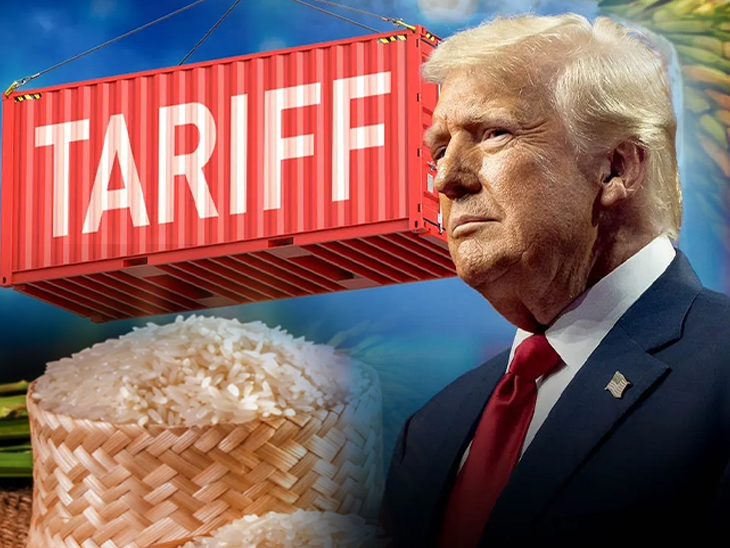
New Delhi, 11th December: In the long and often dramatic theatre of US trade politics, rice has unexpectedly taken centre stage. When President Donald Trump warned that his administration might impose additional tariffs on Bharatiya rice exports—accusing Bharat of “dumping” rice into the American market—it wasn’t just a comment tossed casually across a White House table. It revealed how deeply domestic political anxieties can shape global trade rhetoric. Trump’s remarks came during a roundtable with farmers, right after he announced a massive $12 billion federal aid package for them. In that setting, his message was unmistakable: he is prepared to use tariff threats as campaign ammunition, even when the economic reality tells a far more nuanced story.
The Tariff Threat: Loud Politics, Limited Economic Shock
Despite the dramatic tone, experts widely agree that further tariffs on Bharatiya rice would hardly dent Bharat’s agricultural trade. Bharat exported roughly $392 million worth of rice to the US in FY2024–25, representing only 3% of its global rice shipments. Most of this is Basmati—86% to be precise—sold primarily to diaspora communities and niche consumers who are willing to pay a premium.
Even before Trump’s fresh warning, Bharatiya rice had already been hit with a steep 50% tariff—among the highest Washington imposes on any imported product. Yet the exports continue. The reason is simple: authenticity cannot be substituted by policy. American-grown rice varieties do not replicate the signature aroma and texture of Bharatiya Basmati. And so, even when prices rise, demand barely shifts.
If Trump hoped to trigger economic panic in Bharat, the attempt missed its mark. The Global Trade Research Initiative (GTRI) rightly observed that this episode appears more about election-season theatre than real trade disruption. With Bharatiya exporters enjoying diversified markets across Europe, Africa, the Gulf, and Southeast Asia, the US is far from being a lifeline Bharat depends on.
A Rice Bowl the US Cannot Replace
The Bharatiya Rice Exporters Federation (IREF) has been equally clear: the US may be a valued market, but it is not an irreplaceable one. What is irreplaceable, however, is Basmati itself. Its long-grain structure, delicate aroma, and post-cooking elongation simply cannot be reproduced by American rice varieties. For millions in the South Asian and Middle Eastern diaspora, biryani without Basmati is not biryani at all.
In FY2024–25, Bharat shipped Basmati worth $337 million to the US—making America its fourth-largest export destination for this premium grain. Non-Basmati exports, at $55 million, are comparatively negligible. This imbalance clearly tells us something: Bharatiya rice thrives in the US not because of trade privileges, but because of cultural and culinary necessity.
Which raises a simple question: even if tariffs rise, who truly suffers?
The Real Cost: Higher Grocery Bills for American Consumers
The answer, ironically, is not Bharatiya farmers or exporters. Market data shows that while tariffs have increased sharply—from 10% earlier to nearly 50–53% now—the financial impact has been absorbed largely by American consumers. Grocery store prices for Bharatiya rice have climbed, but the export receipts for Bharatiya producers remain steady.
This mirrors a familiar pattern in global trade wars: punitive tariffs often boomerang on the domestic population. In trying to protect American farmers, tariff hikes on niche imported products like Basmati end up becoming a tax paid by America’s multicultural households rather than by foreign exporters.
The Politics Beneath the Policy
Trump’s rhetoric, therefore, must be understood less as a precursor to a trade war and more as a political signal. Surrounded by farmers—one of his core support bases—he attempted to present himself as a defender against foreign “unfairness.” His questions to Treasury Secretary Scott Bessent about Bharatiya trade exemptions were designed to sound confrontational, even though officials confirmed none exist.
The reference to an ongoing WTO case against Bharat added drama but no real substance. No new measures were announced, and no immediate escalation followed. In other words, the threat was performative, not policy-driven.
This is classic Trumpism: loud statements that shape perceptions, even when the underlying economics tells a subtler truth.
When Trade Becomes a Stage for Domestic Drama
Looking at the broader picture, Trump’s warning reflects a deeper trend in global politics—the increasing use of trade narratives as tools for nationalist mobilisation. Whether it’s steel, solar panels, or, in this case, a bag of rice, economic issues are often reframed into political messaging. Bharat is merely a backdrop in this narrative; the real audience is the American farmer and voter.
Bharat, however, stands on firmer ground than before. With a diverse export portfolio and growing global demand for its agricultural products, it no longer responds to tariff threats with defensiveness. Instead, it relies on economic logic and market resilience—something that temporary political posturing cannot undo.
A Storm That Won’t Shake Bharat’s Rice Bowl
Trump’s tariff warning may have generated headlines, but its real-world impact appears minimal. Bharat’s rice exports to the US are niche, resilient, and culturally embedded. American consumers, not Bharatiya producers, bear the brunt of higher tariffs. And the political motivations behind Trump’s remarks are too transparent to be mistaken for a serious trade confrontation.
In the end, the episode reveals far more about America’s domestic political anxieties than about Bharat’s economic vulnerabilities. Bharat’s rice bowl is not rattled—and the world continues to savour Basmati, tariffs or not.
