
Why the Opposition Says the Election Commission Isn’t Independent Anymore
“A deep dive into the heated debate over the Election Commissioner appointment process, political power, public trust, and the rising tension between the government and the opposition.”

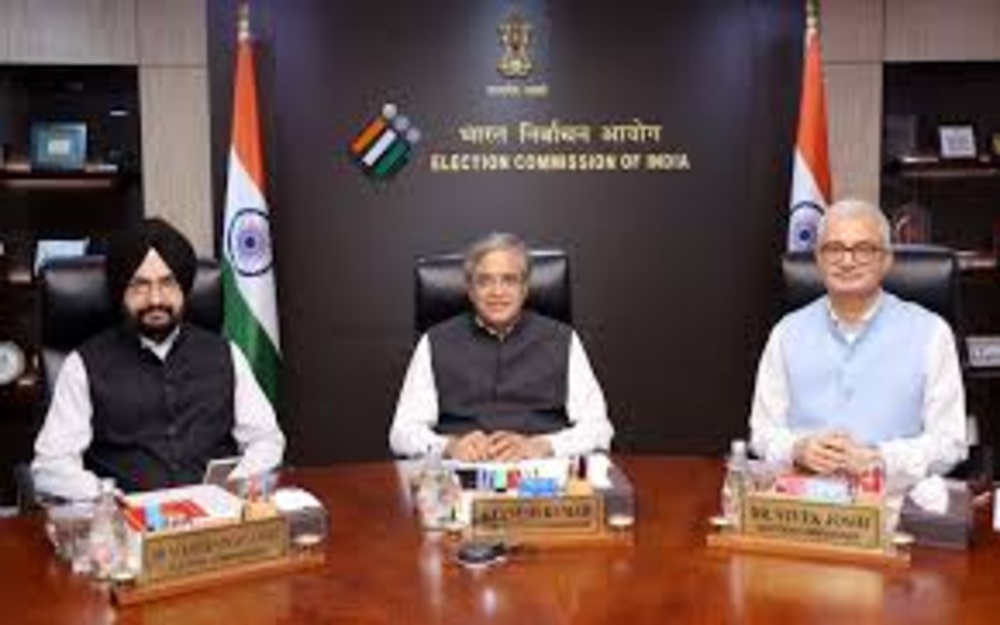
New Delhi, 11th December: In the thick fog of Delhi’s winter session of Parliament, the political temperature has been running hotter than ever. Rahul Gandhi’s recent remarks in the Lok Sabha—delivered in his familiar rhythm of accusation, emotion, and flourish—sparked yet another national debate. His claims, wrapped in dramatic statements about “vote theft” and the government’s alleged control over the Election Commission, pulled everyone’s attention back to an old but persistent question:
Why does the selection of Election Commissioners matter so much in Bharatiya politics?
The introduction may sound theatrical, but the issue underneath is anything but trivial. The independence of the Election Commission of India (ECI) is tied to the health of the world’s largest democracy. Any insinuation—whether exaggerated or politically motivated—that it risks becoming an extension of the ruling party triggers deep public concern. And this is exactly what makes the current political showdown so significant.
Why the Government’s Role in Selecting Election Commissioners Raises Questions
At the heart of Rahul Gandhi’s argument was a simple but provocative question: Why were the rules changed so the Chief Justice of India (CJI) is no longer on the panel that selects Election Commissioners?
Until recently, the selection committee included:
· The Prime Minister
· The Leader of Opposition
· The Chief Justice of India
However, Parliament passed a new law replacing the CJI with a Union Cabinet Minister chosen by the Prime Minister. Critics say this tilts the balance toward the executive. Supporters argue that elected representatives—not judges—should hold appointment authority in a democracy.
Rahul’s rhetoric asked what motivation the government might have for removing judicial presence. But the government has defended the move as a “constitutional correction,” not a political capture. The Supreme Court, too, has repeatedly declined to intervene, insisting that no evidence has been presented showing election misconduct on a scale that warrants judicial interference.
This judicial restraint undercuts the charge of grand conspiracies, even if politics continues to amplify them.
The Old Specter of “Vote Theft”
Gandhi’s speech wove dramatic historical analogies, invoking early post-independence political episodes. While much of it was delivered in the heat of debate—at times exaggerated by his own admission—it reflects a real anxiety shared by many voters: Can the Election Commission truly remain neutral when political polarization is so deep?
Bharat’s elections are massive. They require:
· Millions of polling workers
· Layers of administrative checks
· Security forces
· Digital and physical processes
Any accusation of vote manipulation, whether rooted in fact or political theatre, can shake public trust. But here is where the argument becomes complicated: the Supreme Court has consistently said there is no verifiable evidence of systemic vote theft in recent elections. Gandhi’s emotional claims therefore sit at the intersection of political messaging and institutional reality.
The Bureaucracy Question: Can Officials Be Prosecuted for Election-Related Actions?
A significant part of the debate touched on whether government employees—including Election Commission officials—can be prosecuted without government sanction.
Here’s the legal reality:
· Any government servant performing duties related to governance, including election administration, is protected under provisions that prevent frivolous prosecution.
· Sanction from the government is required before any court can initiate action.
· This safeguard is not new—Bharat has kept it for decades to prevent political harassment of civil servants.
Rahul Gandhi and his supporters argue this shield allows the government to protect Election Commission officials even when allegations arise. But the law also has a bypass: a complainant may approach a court with evidence, and the court can demand prosecution if the complaint appears credible.
This is where critics argue Gandhi’s case weakens: he has not pursued judicial remedies despite claiming to possess evidence. Public press conferences, however loud, cannot substitute for due legal process.
The CCTV Controversy: An Echo, Not a Proof
The opposition’s repeated allegations over CCTV footage—echoed emphatically, almost theatrically in Parliament—represent the broader fear that digital systems could be tampered with. Gandhi’s repetition in the House showed his intent to hammer the point into public memory.
But again, the Supreme Court and various independent reports have stated that no systemic malpractice has been proven. Concerns may be genuine, but evidence remains thin. In this sense, the CCTV issue symbolizes the broader problem of modern political narratives: repetition creates perception, but perception is not proof.
The Real Issue Is Trust—Not Technology
If we strip away the drama, one truth remains: Bharat’s democratic institutions survive on public trust.
When opposition leaders exaggerate, they risk undermining this trust. When governments alter long-standing procedures unilaterally, they also risk appearing overreaching.
The Election Commission must not only be neutral—it must be seen to be neutral.
A transparent, bipartisan appointment process could help restore confidence. Bringing back a judicial voice, or incorporating non-partisan experts, could strengthen the institution. Democracy thrives when institutions rise above political suspicion.
A Debate Bigger Than Individuals
Ultimately, the question is not about Narendra Modi, Amit Shah, or Rahul Gandhi. It is about the system that will outlive all of them. Bharat’s democracy deserves institutions that cannot be doubted every election cycle.
Until reforms calm this storm, the debates will continue—heated, emotional, and often exaggerated. But beneath the noise lies a genuine national concern: safeguarding the integrity of Bharat’s elections for generations to come.
