
Why Minta Devi Case Became A Political Blunder For Congress

Paromita Das
New Delhi, 15th August: In politics, desperation often leads to reckless moves. For the Indian National Congress, the recent episode involving Minta Devi from Siwan, Bihar, has become a telling example of how blind opposition to Prime Minister Narendra Modi can spiral into a political and moral misstep. What was meant to be a striking protest against alleged voter fraud has now turned into a glaring instance of political overreach — one that not only failed to resonate but also deeply hurt the very citizen it claimed to champion.
The Spark That Lit the Fire: A Clerical Error Turned Political Weapon

The controversy began with a seemingly absurd error in Bihar’s electoral rolls: 35-year-old Minta Devi’s age was mistakenly recorded as 124 years. Instead of being born in 1990, as her Aadhaar records clearly show, her voter ID listed 1900 as her birth year.
Such clerical errors are hardly unheard of in Bharat’s vast electoral machinery. They are usually corrected without fanfare. But this time, the Congress seized the error as an opportunity to launch its “Voter Chori” (vote theft) campaign, holding it up as evidence of systemic manipulation in the electoral process — and, by implication, a failure under Modi’s government.
The Symbol They Never Asked To Be

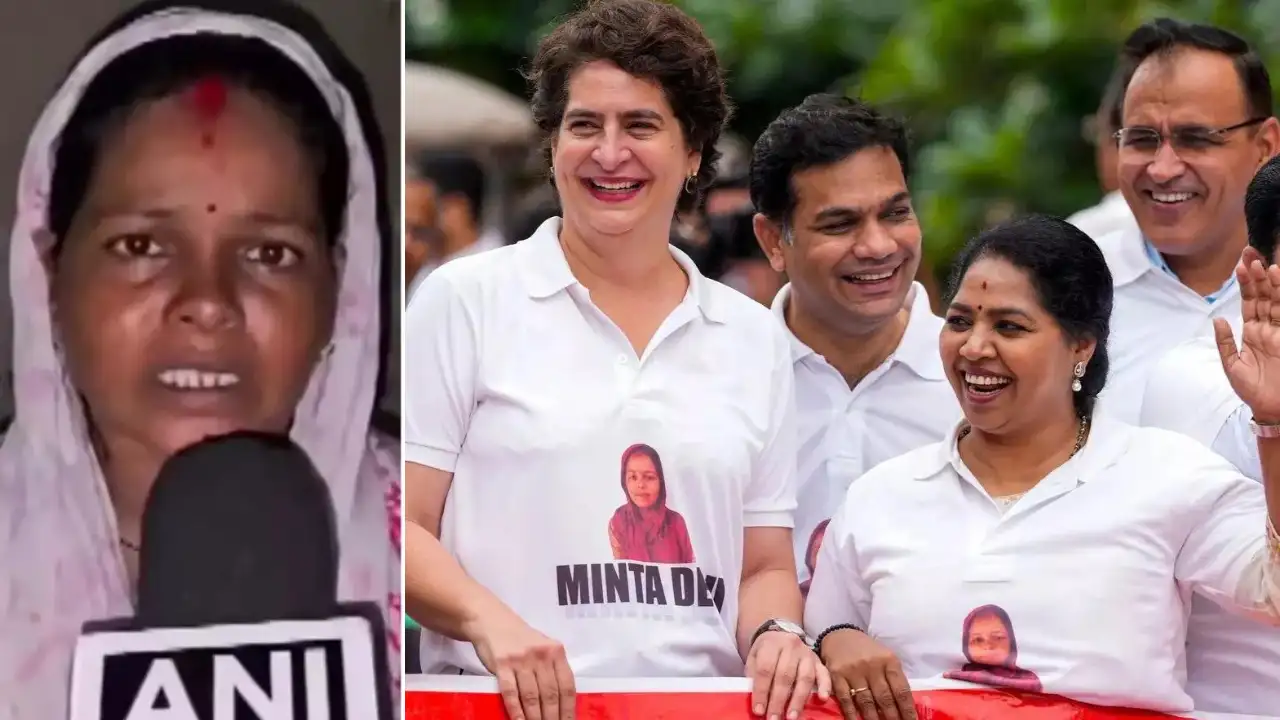
The turning point came when several Congress MPs, including Priyanka Gandhi Vadra, wore t-shirts emblazoned with Minta Devi’s face and name during a protest outside Parliament. Without her knowledge or consent, Minta Devi was turned into the poster child of the Opposition’s grievances against the Election Commission.
For Minta Devi, a housewife with no political ambitions, this sudden and unwanted fame was nothing short of a nightmare. She told reporters she was “sad to be used politically and made a pawn” in a cause she didn’t even understand. The phone calls, the reporters at her doorstep, the gossip in her neighborhood — all of it amounted to what she described as “mental torture” for her and her family.
Priyanka Gandhi’s Miscalculation

Priyanka Gandhi Vadra’s involvement was meant to amplify the Congress’ accusations, but instead it exposed a troubling approach: using the identity of a private citizen without permission to score political points. While Priyanka questioned the Election Commission’s credibility, Minta Devi herself questioned Priyanka’s right to use her face in a political protest.
In her own words: “Who is Priyanka Gandhi to print my face in a T-shirt and wear it? Why is she interfering?”
These words carried more weight than any counter-allegation from the BJP because they came from the very person Congress claimed to defend.
The Opposition’s Blind Spot

What this incident really underscores is a blind spot in Congress’ political strategy. In its relentless quest to portray Modi’s government as corrupt, incompetent, or authoritarian, the party has often failed to assess the moral and emotional cost of its tactics. In the Minta Devi episode, this meant disregarding an individual’s right to privacy and dignity for the sake of a headline-grabbing stunt.
This wasn’t about protecting voter integrity; it was about weaponizing a citizen’s mistake to attack the government. And that distinction hasn’t gone unnoticed by the public.
The Danger of Overplaying the “Victim Card”

By turning Minta Devi into a “victim” without her consent, Congress assumed the public would sympathize with their narrative. Instead, the backlash shows that voters are increasingly wary of political theatrics masquerading as activism.
The more Congress pushes such dramatics without tangible evidence or grounded context, the more it risks being seen as disconnected from real public sentiment — ironically, the very disconnect it accuses the Modi government of having.
The Election Commission’s Clarification

The Siwan District Magistrate’s office quickly clarified that the error was a “human error” in data entry, not a conspiracy. The correction process began almost immediately. The Election Commission also defended its Special Intensive Revision (SIR) exercise in Bihar, citing that periodic checks had not been done since 2004, allowing many ineligible entries to creep into voter rolls.
This official explanation not only diluted Congress’ accusations but also revealed the flimsy basis of their protest.
A Sign of Strategic Weakness

From an analytical perspective, this incident is symptomatic of a larger strategic weakness in Congress’ opposition to Modi. The party seems to operate under the assumption that any anti-government story, no matter how minor or unverified, can be turned into a damaging narrative. But in the age of social media, such gambles are high-risk. When the central figure in the story — like Minta Devi — openly rejects being part of their campaign, the political blowback is inevitable.
Congress’ inability to foresee this fallout shows not just desperation but also a failure to read the room. Public sentiment is less about political posturing and more about respect, fairness, and tangible issues.
When Desperation Becomes Self-Destruction
The Minta Devi episode could have been avoided with basic sensitivity and fact-checking. Instead, it became a case study in how not to do opposition politics. By ignoring the feelings of the very person they claimed to defend, Congress not only undermined their own credibility but also reinforced the perception that their anti-Modi stance is driven more by impulse than by principle.
If this pattern continues, their manipulation tactics — built on exploiting symbols rather than addressing substance — are bound to implode. In the end, voters can forgive mistakes, but they rarely forgive being treated like pawns in someone else’s political game.
And in this case, the pawn spoke louder than the player.
