
Why Millions Walk for Shiva: The Untold Story of Sawan Kanwar Yatra & Puramahadev

Paromita Das
New Delhi, 9th July: When the scorching plains of North Bharat tremble under the weight of summer, a different heat rises in the hearts of millions — the fervent devotion of Shiva’s devotees, who await the first droplets of the monsoon and the holy month of Sawan. This is the time when villages, towns, and entire highways turn saffron as streams of Kanwariyas — barefoot, resolute, chanting “Bam Bam Bhole” — set out on a journey that ties them not only to faith but to an ancient story whispered through generations: the legend of Lord Parashuram and the sacred Puramahadev Temple.
An Ancient Pilgrimage Etched in Faith
Long before Bharat knew expressways and neon-lit temples, the legend of the Kanwar Yatra took root under forest canopies and along the banks of sacred rivers. It is believed that Lord Parashuram — the fierce warrior sage and obedient son of Jamadagni and Renuka — was the first to carry holy Ganga water to perform Abhishek of Lord Shiva. Some tellings tie the roots even deeper to Shravan Kumar, the devoted son who carried his aging parents on a kanwar — a bamboo yoke balanced across the shoulders — and later brought Ganga water home, unknowingly setting an example of service and sacrifice that pilgrims emulate to this day.
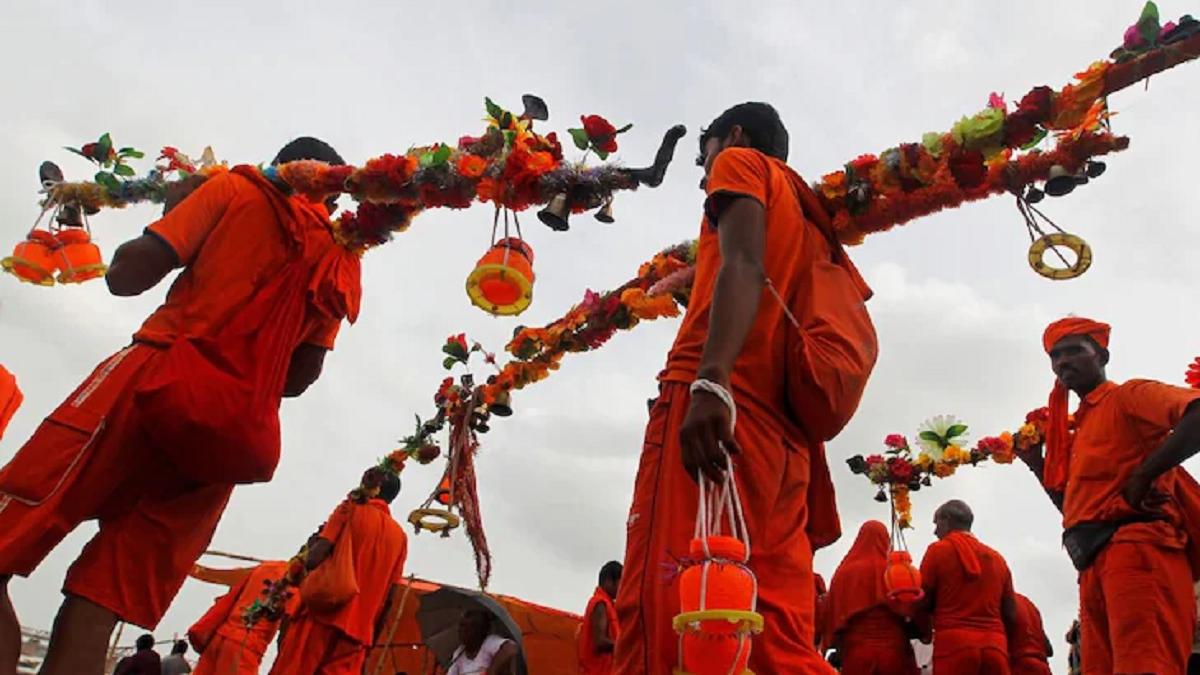
When the month of Sawan arrives, the air is thick with moisture and chants alike. Small groups of friends, entire families, and sometimes solitary wanderers — they all become Kanwariyas, travelling on foot to holy places like Haridwar, Rishikesh, or Garhmukteshwar. They bathe in the sacred Ganga, fill their clay pots with Gangajal, hoist it on their kanwars decorated with marigolds and trinkets, and walk back to pour it over Shiva’s lingam in their hometown temples. In western Uttar Pradesh, this journey often culminates at the revered Puramahadev Temple in Baghpat district, a shrine whose soil is woven with stories of sacrifice, penance, and divine grace.
Puramahadev: A Place Where Penance Shaped Destiny
Puramahadev is not just a temple — it is a portal into an age when legends shaped the morals of generations. According to local lore, this tranquil spot was once a dense forest called Kajri Van. Here, Sage Jamadagni lived with his virtuous wife Renuka and their sons. One fateful day, a king named Sahasrabahu, greedy for the divine Kamadhenu cow, forcibly abducted Renuka, triggering a chain of events that would cement Parashuram’s place in mythology forever.
It was here that a young Parashuram, torn between duty and heartbreak, obeyed his father’s unthinkable command and beheaded his mother to prove loyalty and uphold dharma. Overcome with remorse, Parashuram’s penance at this very site moved Lord Shiva to restore Renuka’s life. The young warrior was blessed with the divine axe — the Parshu — with which he would go on to avenge injustice and punish tyranny.
In time, the forest turned into a forgotten ruin until, as the legend goes, a queen’s stubborn elephant refused to step forward until the buried Shivling beneath its feet was unearthed. The queen ordered a temple to be built on that very spot — the Parshurameshwar Temple — where the faithful gather today to bow before a God who forgave and a son who dared.
A River of Devotion That Flows Every Sawan
The modern-day Kanwar Yatra is no longer a quiet walk in the forest. Highways are closed to vehicles to make way for human rivers draped in saffron, singing praises of Mahadev, carrying Gangajal on their shoulders. For the countless who arrive at Puramahadev each year — especially on the Mondays of Sawan and Sawan Shivratri — the act of performing Jalabhishek is more than ritual. It is a fulfillment of a promise whispered by Parashuram’s footsteps: that faith demands sacrifice, endurance, and surrender.
In the temple courtyard today, the clang of temple bells mingles with the slow swirl of incense smoke and the murmur of prayers. The ancient Hindon River, known in the Puranas as Panchatirthi or Harnandi, still flows nearby, reminding pilgrims that faith is a current — you can dip into it, quench your soul, but its source runs deeper than any one lifetime.
Why the Kanwar Yatra Endures
In an age when ancient traditions are often viewed through skeptical lenses, the Kanwar Yatra stands out for one reason: it is not a festival crafted by temples or governments. It is kept alive by common people — farmers, laborers, students — who abandon their daily struggles for a few days to walk barefoot with Gangajal on their backs. It is raw, noisy, sometimes chaotic — but it is real. In these miles of walking, one finds not just Shiva but one’s own resilience.
Where Faith Meets Forever
When lakhs of Kanwariyas gather at Puramahadev, they do not come just to pour water on a stone idol. They come to wash away burdens, to remember Parashuram’s devotion, Renuka’s innocence, and the timeless dance between faith and forgiveness. They walk the same path Shravan Kumar did for his parents, the same forest trail where Parashuram asked for his mother’s life back. In every drop of Gangajal offered here, a story survives — a story that says some rivers flow forever, not just through land, but through the hearts of those who dare to carry faith on their shoulders.
