
Dr. Mohammad Yunus : On Being taught In an Indian University ?
Against Incorporating Dr. Mohammad Yunus in Academic Curriculum .Why India Must Draw a Line

Poonam Sharma
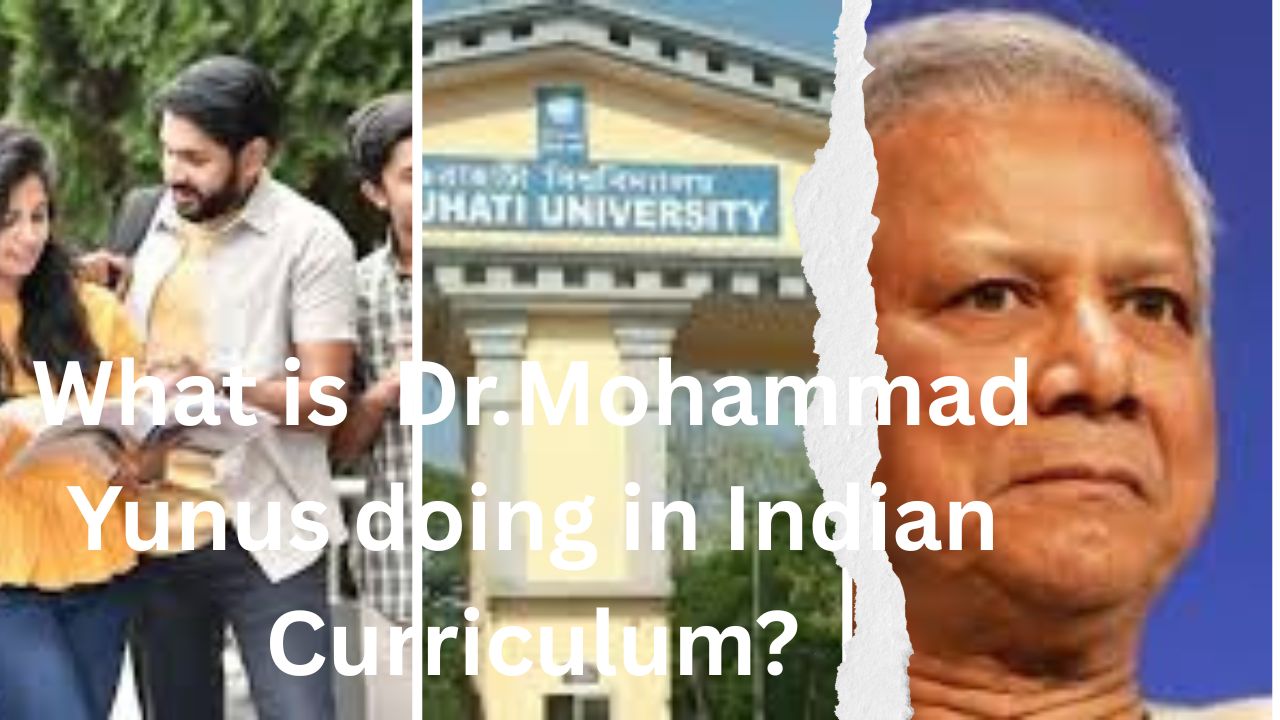
Education is not value-neutral. Every text prescribed, every thinker elevated, and every voice legitimized through a university curriculum sends a message—not just about knowledge, but about moral judgment, national priorities, and civilizational confidence. This is precisely why the reported inclusion of writings by Dr. Mohammad Yunus in the English AEC curriculum under Guwahati University has sparked deep concern and justified protest. Mohammad Yunus should not be legitimised in Indian academic curricula, especially in public universities .This objection is not rooted in blind hostility, nor is it a denial of intellectual debate. It is a question of legitimacy, timing, and national conscience.
Curriculum Is Not a Neutral Space
Universities are not libraries where every book merely exists. A syllabus is a stamp of approval. When an author is included in a compulsory curriculum, especially for undergraduate students, the institution implicitly endorses that author as worthy of academic respect and moral consideration that has been observed given to students of graduating class students in colleges under Guwahati University of Assam. This is where the issue begins.
Dr. Mohammad Yunus is not a distant historical figure. He is a contemporary political actor, deeply associated—rightly or wrongly—with one of the most turbulent and disturbing phases in Bangladesh’s recent history. At a time when serious allegations are being raised globally regarding democratic backsliding, political manipulation, and ideological influence in Bangladesh, the decision to elevate his writings in Indian classrooms appears, at best, tone-deaf, and at worst, irresponsible.
Allegations Cannot Be Academically Sanitized There are widespread accusations and suspicions—circulating in international political discourse—that Dr. Yunus has been linked to:
External political lobbying and funding networks
Undermining democratic processes in Bangladesh
Ideological proximity to forces hostile to India’s strategic and civilizational interests
Whether courts have adjudicated these matters or not is beside the academic question at hand. Universities are not courts of law; they are institutions of ethical discretion. When a public figure is surrounded by serious controversy involving democracy, sovereignty, and regional stability, academic caution is not censorship—it is responsibility.
Nobel Prize Is Not a Moral Shield
Supporters often invoke Dr. Yunus’s Nobel Prize as an unquestionable credential. But history teaches us a hard truth: awards are not absolution. Nobel recognition does not freeze a person in moral amber, immune from scrutiny forever.
Many critics have questioned:
The political ecosystem that promoted his global image
The international lobbying that amplified his work
The gap between global narratives of “poverty eradication” and the continuing socio-economic crisis within Bangladesh
These are legitimate questions—ones that remain unresolved. Until they are answered transparently, why should Indian students be compelled to treat his work as exemplary?
India Has No Shortage of Ethical Thinkers
This protest is also about academic self-respect.
India is home to an extraordinary lineage of thinkers—economists, social reformers, philosophers, and educationists—who worked for upliftment without ideological ambiguity or geopolitical baggage. From Deendayal Upadhyaya to Amartya Sen, from Mahatma Gandhi’s economic thought to contemporary Indian development models, the choices are vast.
Why, then, should Indian universities feel compelled to spotlight a figure whose legacy is actively contested, especially when his ideological positioning is perceived by many as hostile to Indian interests and Hindu civilizational security?
Academic Freedom Does Not Mean Academic Carelessness
This is not a call to ban books or erase names from history. Dr. Yunus can be studied in research contexts, debated critically, or examined as a case study with counter-arguments. But placing his writings in a general compulsory curriculum, without contextual disclaimers or balanced critique, risks uncritical glorification.
Students at the undergraduate level are not policy analysts. They absorb signals. And the signal here is deeply troubling.
A Question for Guwahati University
Guwahati University stands in Assam—a border state, culturally sensitive, geopolitically vulnerable, and historically aware of ideological infiltration. Decisions taken here carry symbolic weight. The question is simple, yet unavoidable:
Why must a politically controversial, ideologically disputed foreign figure be given academic legitimacy in Indian classrooms—at this moment, in this context? Reconsideration is not a weakness. It is wisdom.
Conclusion: This Is About Boundaries
Nations survive not only through armies and economies, but through intellectual boundaries. When those boundaries blur, erosion begins quietly—in syllabi, in classrooms, in normalized narratives.
India has every right to decide who deserves a pedestal in its education system. Intellectual capability alone is not enough. Moral clarity, national alignment, and civilizational sensitivity matter.
For these reasons, many believe that Dr. Mohammad Yunus—regardless of global recognition—should not be incorporated into India’s academic curriculum. At least not without rigorous context, open debate, and institutional accountability.
Reconsideration is not censorship. It is an assertion of academic sovereignty.
