
Why Do Bihar and Jharkhand Remain Deprived Despite Their Magnificent History?

GG News Bureau
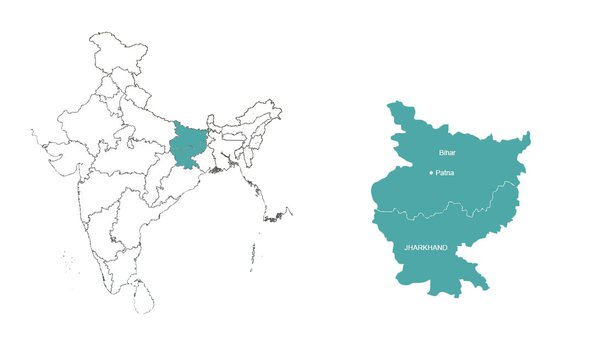
New Delhi, 6th Feb. When Bihar and Jharkhand was one state, they were extremely proud of their rich history and saw the unfortunate events of modern history as merely a blip on an otherwise stellar record.
But, at present, these eastern Bharatiya states of Jharkhand and Bihar struggle with various developmental issues. Their high rates of poverty and illiteracy, along with inadequate infrastructure, have further impeded their progress. The fact that these states record the highest number of IAS, IPS, or PCS officers cannot be disputed, though. Governance-related obstacles are posed by political instability and corrupt practices. States such as Gujarat, Maharashtra, Madhya Pradesh, and Uttar Pradesh, on the other hand, have demonstrated strong economic growth, better social development, and improved infrastructure. Comprehending the various elements at work, recognizing the distinct advantages and difficulties of every state, and highlighting the continuous endeavors towards inclusive and sustainable growth are all crucial.
Current status of other states as compared to Jharkhand and Bihar?
The economic environment in these Bharatiya states as of 2024 shows both convergence and divergence. With their thriving urban economies, strong infrastructure, and dynamic industrial sectors, Gujarat and Maharashtra continue to be growth leaders. They continue to grow their gross state domestic product (GSDP) faster than the national average due to factors like high FDI and highly skilled labor forces.
Agriculture and services play a major role in the moderate growth seen in Madhya Pradesh and Uttar Pradesh. Even with its large population, Uttar Pradesh faces bureaucratic roadblocks and inadequate infrastructure. Notably, in an effort to spur future growth, both states have started large-scale skill development and infrastructure projects.
The picture presented by the Human Development Index (HDI) is comparable. Still holding first place are Maharashtra, Gujarat, and Madhya Pradesh. Lower HDI scores for Uttar Pradesh and Bihar are a reflection of issues with healthcare, literacy, and living standards.
In all states, the battle against poverty is still an important one. Even though Jharkhand and Bihar have the highest rates of poverty, all states are still working to lower them even more. Significant progress has been made in Gujarat, Maharashtra, and Madhya Pradesh thanks to programs like microfinance and rural electrification.
Maharashtra and Gujarat have excellent infrastructure, including large road networks, productive ports, and dependable electricity production. Uttar Pradesh and Madhya Pradesh are catching up by making significant investments in the development of infrastructure. But closing the distance with the leaders is still a work in progress.
Whereas, Maharashtra and Gujarat are thought to have comparatively better governance, which draws in capital and promotes development? But problems still exist in every state. The governance quality varies across Madhya Pradesh and Uttar Pradesh, which affects the rate of development.
Although differences still exist, these states share a common goal. For inclusive and sustainable development to benefit everyone, on-going efforts in the areas of governance, infrastructure, education, and poverty alleviation are essential. To ensure that no one is left behind and to speed up progress, cooperation, knowledge sharing, and learning from each other’s experiences are essential.
What, therefore, are the reasons impeding the development of these prosperous states in Bharat?
Two adjacent eastern Bharatiya states, Bihar and Jharkhand, have similar developmental challenges and a complicated past. Notwithstanding recent improvements, both still have a difficult road ahead of them. To realize their full potential, it is imperative to comprehend the historical, socioeconomic, and governance barriers to their advancement.
Past Cracks
An enduring shadow is left by British rule. Both regions’ development trajectory was hampered by the lack of investment in infrastructure and education. Millions of people were displaced and economic activity was disrupted, especially in Bihar, by the 1947 partition, which made the situation even worse. Inadequate infrastructure, restricted access to high-quality education, and a protracted poverty cycle are all results of this past neglect.
Density of Population is High and Resources Are Limited
Due to their dense populations, both states face severe strain on their water and land resources. With more than 1,100 people living in each square kilometer, Bihar has severe difficulties in ensuring food security and delivering essential services. Even though it is less populous, Jharkhand nevertheless has comparable problems, especially in its tribal regions.
A Roadblock to Advancement
The poverty cycle is prolonged and job opportunities are restricted by low literacy rates and limited access to high-quality education. Language and cultural barriers present additional challenges for the tribal population in Jharkhand. In order to improve employability and draw in investments, both states must implement skill development initiatives that are in line with industry demands.
Hunger and Deprivation
Malnutrition and widespread poverty are major roadblocks to development. Over 30% of people in Bihar and slightly better than 25% in Jharkhand, respectively, live below the poverty line, according to World Bank data. Malnutrition stunts cognitive growth and feeds the poverty cycle, especially in children.
Problems with Governance
The two states’ frequent political changes and corruption are thought to be the main contributing factors. It may interfere with the long-term planning and execution of development projects. Investment can be discouraged and effective resource allocation hampered by perceived or actual corruption. Effective governance and development depend on enhancing bureaucratic capacity, fostering transparency, and fortifying institutional frameworks.
The Resource Dilemma of Jharkhand
The abundance of natural resources in Jharkhand offers both possibilities and difficulties. Conflicts over territory and resources and environmental degradation present serious risks, even though they can draw investments and money. Inclusive development requires equitable benefit distribution and sustainable resource management.
Bihar’s Development and Continued Challenges
In recent times, Bihar has made noteworthy strides towards enhancing law and order and drawing investments. Social indices like healthcare and education, however, continue to be problematic. Enhancing the availability of high-quality educational and medical resources is essential for sustainable development.
In order to overcome common challenges and achieve sustainable development, cooperation between states and support from the central government are essential. Bihar and Jharkhand can realize their full potential and give their people a better future by successfully tackling these problems.
To conclude, the narrative of Bihar and Jharkhand is one of enduring difficulties stemming from past disregard, demands placed on the population, and obstacles related to government. Development in both states is hampered by problems with poverty, poor infrastructure, and poor governance. Bihar has made impressive strides, but problems with social indicators still exist. States like Maharashtra and Gujarat, on the other hand, have excellent infrastructure and are leaders in governance and economic growth. Coordinated efforts in the areas of infrastructure, poverty alleviation, healthcare, education, and healthcare are necessary for Bihar and Jharkhand to achieve inclusive and sustainable development. Working together, picking up ideas from successful models, and tackling common problems can lead to a better future and guarantee that no state in India falls behind in its pursuit of development and prosperity.
