

Anjali Sharma
GG News Bureau
UNITED NATIONS, 9th Jan. UN humanitarians on Monday issued new reports of “significant casualties, particularly among women and children” and pleaded for overwhelmed medical teams to be allowed to continue their lifesaving work after reports of relentless and heavy Israeli bombardment in Gaza.
World Health Organization warned on Sunday that medics at the only hospital in Deir al Balah governorate “had been forced to cease lifesaving and other critical activities and leave” after an evacuation order issued amid “increasing” Israeli military activity.
WHO team delivered medical supplies to support 4,500 dialysis patients for three months and 500 patients requiring trauma care and only 5 doctors reportedly remain at Al-Aqsa Hospital in the Middle Area of Gaza, it stated
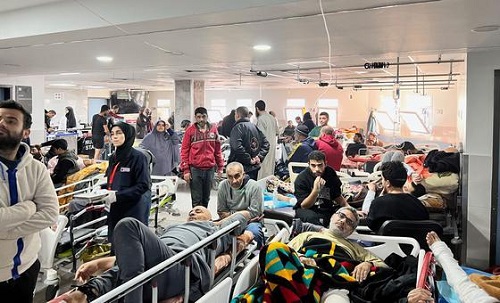
WHO Health Emergency Officer Sean Casey posted a video on X social media platform on Sunday evening from Al-Aqsa, showed chaotic scenes as medics treated patients on the blood-streaked floor, some of the “hundreds” being brought in for urgent treatment.
Mr. Casey said that “They are seeing in some cases hundreds of casualties every day in a small emergency department,”. “So, they’re treating children on the floor.”
WHO Director-General Tedros Adhanom Ghebreyesus in a post on X reported “immense needs” at the hospital, “especially health workers, medical supplies and beds. But staff said their greatest need was for their hospital, and its staff, patients and families there, to be protected from strikes and hostilities.”
Tedros said that over 600 patients “and most health workers” had reportedly been forced to leave the facility, added that it was “inconceivable” that the protection of health care could not be counted on.
According to the UN health agency, no hospitals are “fully functioning” in northern Gaza.
WHO mission had to be cancelled to the north on Sunday, Tedros said, “due to dangers and lack of necessary permissions”. Elsewhere in Gaza, “a mere handful of health facilities operate”, he said.
Tedros said that in recent days casualty numbers have “increased markedly” with “over 120 trauma cases and dozens of dead arriving per day due to increased shelling, gunshot wounds, crush injuries from collapsed buildings, and other war-related trauma”.
WHO is involved in plans to deploy an emergency medical team to support medical teams at Al-Aqsa. “This will only be possible in a secure environment,” he noted.
OCHA reported on Sunday evening that Israeli forces “struck targets in Gaza city, Jabaliya Camp, Tal Az Za’atar, and Beit Lahiya” causing “a very large number of fatalities” in the Al Fallouja area of Jabaliya Camp in a separate update on the emergency confirmed “intense” Israeli strikes “across (central) Deir Al Balah governorate and the southern cities of Khan Younis and Rafah”.
OCHA said rocket fire into Israel by Palestinian armed groups also continued after “ground operations and fighting across much of the Gaza Strip, resulting in additional fatalities”.
The latest data from the Gazan health ministry cited by the OCHA indicated at least 22,835 fatalities since Israeli military strikes began, in response to Hamas-led terror attacks in southern Israel on 7 October that left some 1,200 dead including at least 33 children and around 250 taken hostage.
OCHA noted reports of 225 Palestinian fatalities between Friday and Sunday and 300 injured, with 174 Israeli soldiers killed in Gaza and over 1,000 injured since ground operations began, according to the IDFs. .
UNICEF estimated that there are 3,200 new cases of diarrhoea per day among under-fives beore the escalation in hostilities, the average was 2,000 per month.
The agency said that there is dire concern for nine in 10 children under two years old who are now in “severe food poverty” and “only getting grains (including bread) or milk” to eat.
UNICEF Executive-Director Catherine Russell said“Time is running out. Many children already face severe acute malnutrition in Gaza,”
“As the threat of famine intensifies, hundreds of thousands more young children could soon be severely malnourished, with some at risk of death. We cannot allow that to happen.”
OCHA updated the information on the number of aid trucks entering Gaza indicated that on 6 and 7 January, a total of 218 trucks carried food, medicine and other supplies through the Rafah and Kerem Shalom crossings.
Some 500 trucks carried aid into Gaza every day before the conflict, some 60 per cent passing through Kerem Shalom.
Sigrid Kaag the new Sr. Humanitarian and Reconstruction Coordinator for Gaza began her role on Monday.
She will facilitate monitor and verify relief shipments coming in to Gaza in line with the Security Council resolution 2720 passed last month.
Ms. Kaag has held a number of senior humanitarian jobs within the UN recently served as finance minister for the previous administration in the Netherlands.
She will have the challenging task to establish a mechanism for accelerating aid into Gaza through States which are not party to the conflict.
Ms. Kaag met with the UN Secretary-General Antonio Guterres on Monday her first day in office and will be heading to Washington DC later in the week before travelling to the Middle East.
