
WHO says hospitals, healthcare facilities attacked 600 times in Gaza so far

Anjali Sharma
GG News Bureau
UNITED NATIONS, 6th Jan. UN health agency said on Friday that hospitals in Gaza and other vital medical infrastructure have been attacked 600 times since war erupted in response to the Hamas-led terror attack in southern Israel.
According to latest data on healthcare attacks from the WHO some 613 people have died within facilities as a result since 7 October last year and more than 770 have been injured.
WHO spokesperson Christian Lindmeier condemned the continuing fighting and bombardment, said that the “ongoing reduction of humanitarian space plus the continuing attacks on healthcare are pushing the people of Gaza to breaking point”.
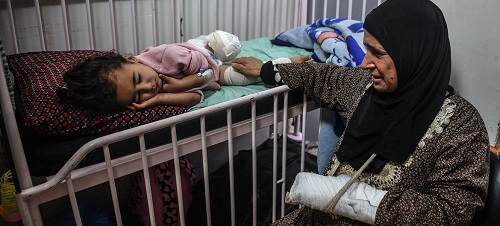
Children in the Gaza Strip face a deadly triple threat to their lives, as cases of diseases rise, nutrition plummets and the escalation in hostilities reached 14th week, WHO stated.
WHO noted thousands of children have died from the violence, while living conditions for children continue to rapidly deteriorate, with increasing cases of diarrhea and rising food poverty among children, raising the risk of mounting child deaths.
WHO online platform covering attacks on healthcare indicated that over 550 medical facilities and vehicles had been impacted in100 days since the Israeli airstrikes began in Gaza.
The agency has reported that attacks have affected 94 healthcare sites including 26 hospitals damaged out of a total of 36 in Gaza.
Head of the UN UNICEF Catherine Russell said in a statement on Friday that children in Gaza “are caught in a nightmare that worsens with every passing day”.
Catherine Russell noted young lives are “increasingly at risk from preventable diseases and lack of food and water. All children and civilians must be protected from violence and have access to basic services and supplies.”
The cases of diarrhoea in children under five rose from 48,000 to 71,000 in just one week starting 17 December, equivalent to 3,200 new cases of diarrhea per day, UNICEF stated.
Ms. Russell said the significant increase indicated child health in Gaza is “fast deteriorating”. Before the escalation in hostilities, an average of 2,000 cases of diarrhea in children under five were recorded per month.
Eri Kaneko, Spokesperson for aid coordination office OCHA said that humanitarians made clear on Thursday that the speed and volume of relief is being continually hampered by conditions on the ground.
“The UN and our humanitarian partners are committed to and continue to do all they can to meet the growing needs in Gaza. However, the operating environment and response capacity continues to be hindered by security risks, mobility constraints, delays and denials”, she said.
She said “Multiple inspections, long queues of trucks and difficulties at crossing points continue to hamper operations. Inside Gaza, aid operations face constant bombardments, with aid workers themselves killed and some convoys having been shot at.
Ms. Kaneko said other challenges include poor communications, damaged roads and delays at checkpoints.
“An effective aid operation in Gaza requires security, staff who can work in safety, logistical capacity and the resumption of commercial activity.”
UNRWA said that the total number of staff killed since the beginning of hostilities stands at 142.
UN Relief and Works Agency for Palestine Refugees reported that since 7 October last year, up to 1.9 million people have been displaced across the Gaza Strip, some multiple times.
UNRWA said that this number represents over 85 per cent of the population of the Gaza Strip, added that families have been forced to move “repeatedly in search of safety”.
Over 1.4 million internally displaced persons now shelter in 155 UNRWA facilities across all five governorates of the Gaza Strip.
The agency said the figure includes 160,000 in the north and Gaza City according to data last revised shortly after the escalation began.
UNRWA said in an update that 500,000 people “are in close vicinity of these installations and receiving assistance” from.
UN migration agency IOM launched an urgent appeal on Friday for $69 million to support its response to rising and critical humanitarian needs in the Occupied Palestinian Territories.
The appeal also covers neighboring countries affected by the ongoing hostilities in Gaza, IOM stated.
IOM said in a statement issued that hundreds of thousands of civilians need aid desperately. But getting help to them continues to be hampered by “long clearance procedures for humanitarian aid trucks at the border and the intense ground operation and fighting”.
“Frequent disruption” to communication networks has also prevented humanitarian aid coordination, the UN agency said “along with insecurity, blocked roads and scarcity of fuel”.
IOM noted that deteriorating security situation along border areas between Israel and Lebanon has forced some 76,000 people from their homes in southern Lebanon outside Gaza, it concluded.
