
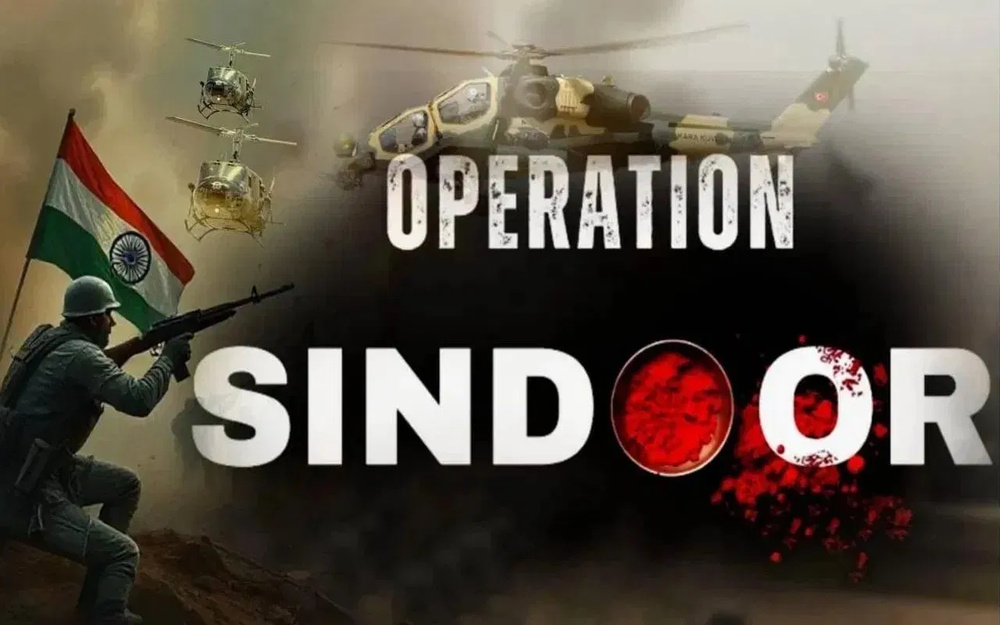
When War Goes Virtual: How Operation Sindoor Became South Asia’s First AI-Made Battlefield
“Operation Sindoor: When a Real Conflict Fought on Land, Air and Sea Was Hijacked by a War Happening on Screens.”

Paromita Das
New Delhi, 10th December: No one expected that a regional confrontation in South Asia would become a global masterclass in digital deception. Yet the 2025 Bharat–Pakistan standoff—later known as Operation Sindoor—evolved into something far more complex than a traditional military escalation. It became a strange hybrid of two parallel wars: one taking place in the real-world battlespace, and another unfolding in the lawless arena of social media, fuelled by artificial intelligence, deepfakes and recycled war footage.
For the first time in the subcontinent’s history, the most intense artillery fire came not from cannons or missiles, but from algorithms. And while Bharatiya forces moved confidently across land, sea and air, much of Pakistan’s strength appeared only in the digital universe—crafted, curated and amplified to simulate victories that never occurred.
Operation Sindoor was not only a military event; it was a warning shot for the future of warfare.
A Flood of Fake Explosions: When AI Became a Combatant
The first sign that this crisis would break with the past was not a missile launch but a video clip. A flaming warship, labelled as an Bharatiya naval destroyer sinking in the Arabian Sea, went viral within minutes. Emotion ran high—until fact-checkers discovered that the clip was stitched together from a 2015 Middle-East conflict and an AI-generated explosion overlay.
It was the beginning of a flood.
Within hours, social media was brimming with “breaking news” visuals: Bharatiya aircraft supposedly shot down in aerial duels, Bharatiya submarines ablaze under the waterline, and massive missile barrages destroying naval bases. None of them occurred. What did occur was a coordinated digital campaign that blended:
- old Syrian footage,
- gaming engine simulations,
- AI-generated clips mimicking drone feeds,
- and deepfake news broadcasts designed to appear legitimate.
This was the first Indo-Pak confrontation where AI was not an observer—it was a combatant. The objective was clear: convince domestic and international audiences that Pakistan was performing far better militarily than reality suggested.
And at sea, that gap between reality and virtual projection became stark.
Out at Sea: Bharat’s Real Naval Dominance vs Pakistan’s Online Phantom Fleet
While social media was scripting dramatic naval battles, the maritime reality told another story. Bharatiya warships operated freely across the Arabian Sea, visible in satellite imagery and shipping databases. The Bharatiya Navy moved with confidence, maintaining full operational readiness.
Pakistan, by contrast, kept most of its naval assets inside harbour. It was a deliberate, cautious move—an attempt to avoid escalation and protect limited resources. But domestic pressure demanded signs of action, and that’s where digital illusion stepped in.
NAVAREA warnings, routine maritime advisories issued by the Pakistan Navy, were spun online as signs of imminent missile launches. Around these notices, an ecosystem of manipulated clips exploded—Pakistani missiles annihilating Bharatiya vessels, Bharatiya docks left in ruins and underwater explosions supposedly disabling submarine fleets.
Reality was calm. Online war was chaos.
The Pakistani Navy’s physical caution contrasted so sharply with the virtual victories claimed on social media that analysts began calling it “the world’s first naval battle fought almost entirely on screens.”
The World’s First AI-Accelerated Indo-Pak Infowar
Propaganda in Indo-Pak crises is nothing new. But Operation Sindoor pushed disinformation to a level that experts described as unprecedented. With generative AI freely accessible, anyone could create:
- missile strike visuals in minutes,
- fake drone surveillance views,
- cockpit-cam dogfight videos,
- and even deepfake officers issuing statements.
These clips spread not because they were accurate but because they were emotionally charged—perfect fuel for nationalist fervour on both sides.
At one point, a deepfake “nuclear alert” video, edited to resemble an official broadcast, triggered panic across cities. For several hours, even mid-level political figures reacted as if the alert was genuine. It took official clarification to calm nerves.
Operation Sindoor showed that the fog of war has evolved into a fog of algorithms, where truth suffocates under the weight of viral deception.
When Fiction Starts Dictating Reality
The greatest danger of this digital war was not the misinformation itself but its potential consequences. When millions believe that air bases have been bombed or naval ships destroyed—even when they haven’t—governments face emotional pressures that can push them toward miscalculations.
A false explosion, if believed by enough people, becomes a political reality.
This is the new frontier of warfare: where psychological overreactions can escalate faster than physical deployments, and where leaders must battle not only enemy forces but also digital illusions crafted to provoke their citizens.
The New Face of Power: Who Controls the Narrative Controls the Conflict
Operation Sindoor revealed an uncomfortable truth: in the 21st century, power is measured not just by warships, aircraft or missiles, but by narrative dominance. Pakistan, lacking maritime parity, tried to reclaim the narrative through aggressive digital projection. Bharat relied on transparency—real deployments visible to analysts and satellites.
Two wars unfolded side by side: the physical one that Bharat clearly dominated, and the virtual one where Pakistan attempted to create parity through pixels.
Millions consumed the conflict not through official briefings but through manipulated visuals—turning misinformation into a strategic asset.
A Turning Point South Asia Cannot Ignore
Operation Sindoor should be remembered as the moment when Bharat and Pakistan entered a new phase of rivalry—not defined by weapon systems alone, but by the ability to shape perceptions. The crisis exposed how deeply artificial intelligence can distort truth, shape public opinion and even influence strategic calculations.
South Asia now has to confront a sobering reality: future conflicts may be decided less by firepower and more by who controls the battlefield of perception.
The Next War Will Be Fought on Screens Before It Is Fought on Borders
Operation Sindoor’s legacy will not be the number of ships deployed or aircraft scrambled, but the realization that digital deception has become a permanent part of modern warfare. It was a conflict where physical calm at sea was overshadowed by virtual battles online, where AI-generated illusions travelled faster than truth, and where public belief often diverged wildly from reality.
The world must absorb the lesson:
in the next crisis, the war on screens may erupt long before the first shot is fired.
