
When Followers Fade: Haley and Musk Set Trump’s Stage on Fire
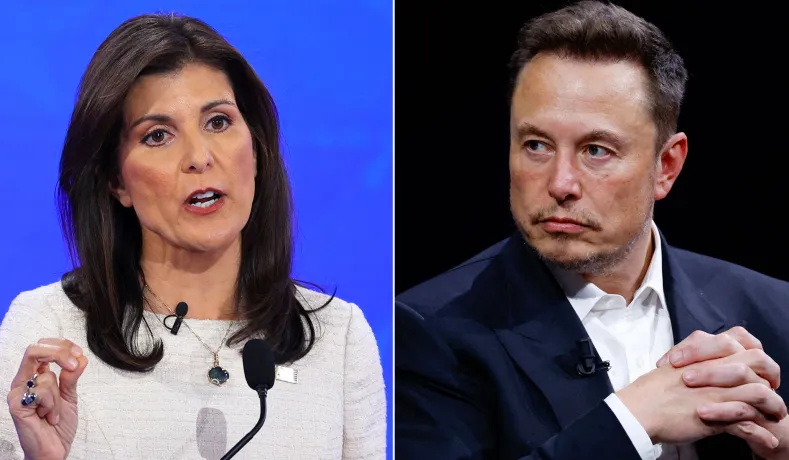
As cracks widen in Trump’s conservative stronghold, Nikki Haley boldly challenges his foreign policy while Elon Musk distances himself—signaling a brewing rebellion within the GOP elite.

Paromita Das
New Delhi, 8th August: A tide is turning within the American political landscape—and it’s turning against Donald Trump. The former president, once the undisputed figurehead of the GOP, is now facing growing dissatisfaction not only from the electorate but from powerful allies within his own ranks. First came Elon Musk, who didn’t hold back his disdain. Now, Nikki Haley, former U.N. Ambassador and a seasoned Republican voice, has dealt Trump a striking blow—challenging him head-on over his latest foreign policy gaffe involving Bharat.
What makes this moment so significant is not just the content of Haley’s rebuke, but the rare courage it represents. In a party often marked by silence in the face of Trump’s tirades, her words carry a message: enough is enough.
A Blow from Within: Haley Strikes at Trump’s Hypocrisy
Nikki Haley has long been viewed as a staunch defender of American interests, especially when it comes to challenging authoritarian regimes. Her latest comments are a clear deviation from Trump’s combative style. When Trump threatened to slap Bharat with high tariffs for its ongoing purchase of Russian oil, Haley didn’t hold back. She sharply reminded the public that while Bharat may buy oil from Russia, China—America’s top geopolitical rival—continues to import far greater volumes of Russian and Iranian crude. And yet, Trump granted China a 90-day reprieve from new tariffs.
Haley’s criticism zeroed in on the glaring inconsistency in Trump’s approach. Punishing a democratic ally while going soft on an authoritarian adversary? That’s not diplomacy—it’s dangerous favoritism. Her message was as strategic as it was symbolic: “Don’t give China a pass and burn a relationship with a strong ally like Bharat.”
India should not be buying oil from Russia. But China, an adversary and the number one buyer of Russian and Iranian oil, got a 90-day tariff pause. Don’t give China a pass and burn a relationship with a strong ally like India.
— Nikki Haley (@NikkiHaley) August 5, 2025
When Politics Overrules Principles
This episode reflects a deeper issue with Trump’s worldview. His foreign policy remains largely transactional—heavy on optics and light on strategy. On one hand, he accuses Bharat of profiting from Russian oil sales, while on the other, he stays eerily silent about China’s much larger role in funding Moscow’s war economy.

Haley wasn’t alone in her concerns. Many in Washington—quietly or otherwise—recognize the strategic importance of Bharat. As a democratic powerhouse and a bulwark against China’s expansionism in the Indo-Pacific, Bharat is more than a trade partner; it’s a pillar of regional security.
Trump’s tariff threats, seen as politically motivated and tone-deaf, risk upending this critical alliance at a time when the U.S. needs dependable partners more than ever.
Bharat Pushes Back—and Hard
Bharat, refusing to bow to pressure, responded swiftly and bluntly. Its Ministry of External Affairs dismissed Trump’s statements as unreasonable and politically charged. More importantly, it highlighted a key reality Trump chose to ignore: Bharat’s energy policy is not a game of loyalty; it’s a matter of survival and national interest.

After Western energy supplies were rerouted to Europe following the Ukraine war, Bharat turned to Russia—not out of allegiance, but necessity. And unlike China, Bharat maintains transparent and strategic relations with the West, balancing diplomacy with pragmatism.
Bharat also reminded the world of a critical truth: the U.S. itself continues trade with Russia in several key sectors.
Behind the Curtain: What the U.S. Imports from Russia
Trump’s attempt to shame Bharat fell apart the moment America’s own trade records came into view. While the rhetoric may suggest otherwise, the U.S. remains a significant importer of Russian goods. In 2024 alone, American imports from Russia totaled between $3.0 and $3.3 billion. This was a steep drop from pre-war levels but remains telling.

Fertilizer imports led the pack—worth over $1.3 billion. These included nitrogenous, phosphatic, and potassic variants essential to America’s agricultural economy. Even more striking was the import of uranium, amounting to $624 million, vital for the U.S. nuclear sector. Palladium imports for industrial and EV manufacturing topped $878 million.

In just the first five months of 2025, those numbers surged: fertilizers up by 21%, uranium by 28%, and palladium by 37%. These aren’t luxury items—they are foundational to America’s infrastructure and energy independence. And they stand in sharp contrast to Trump’s claim of moral high ground.
The Walls Are Closing In
What’s becoming increasingly clear is that Donald Trump’s brand of diplomacy—brash, erratic, and often hypocritical—is beginning to wear thin. The cracks are showing, not just from across the aisle, but within his own party. Elon Musk distancing himself, and now Haley’s direct challenge, reflect a deeper exhaustion in conservative circles.

America can no longer afford a foreign policy dictated by ego and theatrics. The global order is shifting, and with it comes the need for reliable, coherent leadership. That means respecting allies like Bharat and holding adversaries like China accountable—not the other way around.
The world is watching. And America’s moral credibility can’t survive on soundbites and slogans alone.
Time for Grown-Up Governance
As Nikki Haley reminded the nation, diplomacy isn’t a reality TV show. It’s about principles, partnerships, and protecting national interests without burning bridges. Bharat isn’t just another country on a trade chart—it’s a strategic partner that shares democratic values and geopolitical goals.
Trump’s behavior, increasingly out of sync with the realities of global politics, is pushing the GOP—and America—toward an inflection point. His era of unchallenged dominance is waning, replaced by leaders demanding substance over spectacle.
If America truly wants to lead in the 21st century, it must outgrow Trump’s antics and embrace a leadership style that’s strategic, not theatrical; inclusive, not impulsive.
And judging by the voices now speaking up—Elon Musk, Nikki Haley, and perhaps many more to come—the time for that change has already begun.
