
What Trump’s Possible Return to the White House Means for India and Other Countries

GG News Bureau
New Delhi, 16th Jan. When Estonia’s highly regarded prime minister, Kaja Kallas, visited Washington in November, she not only met with White House officials but also made a point to engage with key allies of Donald Trump.
A month earlier, Estonia’s foreign minister visited a Lockheed Martin Corp. factory in Arkansas, located in a conservative state, to express gratitude for their contribution to Estonia’s security through the production of HIMARS multiple rocket launchers. Margus Tsahkna, the foreign minister, emphasized the importance of reaching out to various parts of American society, not just Washington.
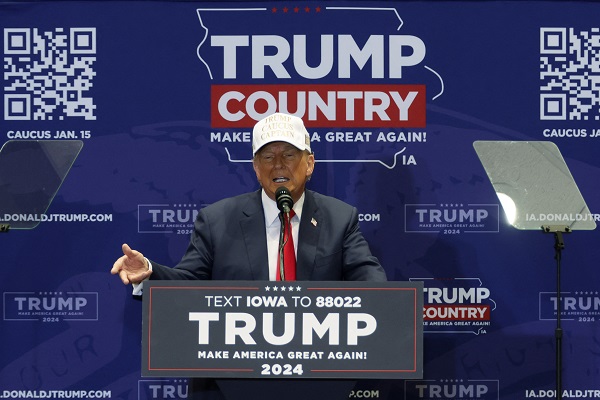
This outreach is just one example of how countries worldwide are cautiously and urgently preparing for the possibility of Trump’s return to the White House. This reality is expected to be a topic of discussion at this week’s meetings in Davos, as Trump’s convincing win in the Iowa caucuses strengthens his hold on the Republican nomination, setting up a likely rematch with Joe Biden, who currently lags in national polls.
In 2016, Trump’s election surprised both US allies and rivals. This time, leaders are not taking any chances.
Residents of Washington’s Embassy Row have been actively seeking out former officials and individuals close to Trump to gain insight into his foreign policy plans. Some have even directly reached out to Trump, either to flatter him or, in Estonia’s case, to address his concerns about Europe’s defense spending.
Others are publicly expressing their concerns. European Central Bank President Christine Lagarde recently stated that Trump’s return is clearly a threat, citing the lessons learned from his first term.
While few in power openly discuss their fears, interviews with government officials from Europe, Asia, Africa, and Latin America reveal their concerns and hopes regarding the impact of a Trump reprise on security, trade, climate action, and the global balance of power. Most officials requested anonymity due to the ongoing US campaign and its expected tight race.
Fears and Hopes
Many US allies are worried about Trump’s “America First” rhetoric, threats to withdraw from NATO, and his protectionist trade policies. Some European Union leaders are even afraid to mention the possibility of his return, fearing it may increase the likelihood. A senior diplomat stated that with Putin’s invasion of Ukraine entering its third year, 2024 could be a critical moment for Europe’s security. In the Middle East, Trump’s unwavering support for Israel has EU diplomats concerned that the Gaza conflict may worsen, leading to an influx of refugees into Europe.
However, some countries in the Global South see opportunities in Trump’s transactional approach. Indian Prime Minister Narendra Modi had a good relationship with Trump and preferred his administration over Biden’s, which has criticized India’s human rights record while seeking its support against China. Brazil, which took over the G-20 presidency from India, believes that Trump’s return could jeopardize President Luiz Inacio Lula da Silva’s plans for climate action, poverty reduction, and IMF reform.
Italy’s G-7 presidency agenda is also affected by the possibility of Trump’s return. Prime Minister Giorgia Meloni faces a personal and political dilemma, as she praised Trump while in opposition but has cultivated a close relationship with Biden since taking office.
Surprisingly, Beijing believes that the fundamental trajectory of China-US relations would remain largely unchanged. Wang Yiwei, director of Renmin University’s Institute of International Affairs, noted that the tariffs imposed during Trump’s presidency are still in place, and the US containment of China, which he claims has caused significant harm, has not changed.
Trade Concerns
Ironically, China’s economy would benefit slightly from one of Trump’s signature initiatives: the imposition of across-the-board tariffs on imports. Bloomberg Economics estimates that while China would experience modest gains, US growth and employment would slow. Canada and Mexico, fellow signatories of the USMCA trade deal, would be disproportionately affected.
Canada sees the USMCA as an existential issue, especially as it is due for a joint review in 2026. Prime Minister Justin Trudeau maintained a positive public relationship with Trump while his senior aides built connections behind the scenes. Mexican officials, having successfully dealt with Trump on trade and migration issues in the past, are confident they can handle him again. Additionally, the focus on migration at the US-Mexico border is expected to be a relief after the Biden administration’s increased emphasis on democracy, human rights, and the environment.
The EU, which engaged in retaliatory sanctions with the Trump administration, aims to safeguard agreements with the US against a potential Trump return. However, the success of these efforts remains uncertain. One senior EU diplomat, who believes there is a 50-50 chance of Trump’s return, acknowledges the bloc’s energy and raw material dependencies and the need to address them. The topic of Trump’s possible return has been raised in official meetings.
Defense and Security
Many people in Europe are concerned about the potential impact of a second Trump presidency on Russian relations, the Ukraine war, and the future of NATO. European delegations have been visiting Washington to engage with Trump’s representatives and the Heritage Foundation, which is working on his policy platform. The goal is to understand who might be part of his administration and to get a better idea of what to expect. They also want to convey the message that Europe is contributing to defense efforts.
Personal relationships are seen as crucial, as former Japanese Prime Minister Shinzo Abe understood. He played golf and spent a lot of time with Trump to build a connection. However, Trump still demanded more money from Japan for US bases, which worries many governments. To mitigate risks, Sweden, Finland, and Denmark have signed defense cooperation agreements with the US. Finland is purchasing fighter jets, and investments have been made to increase artillery shell production.
German Chancellor Olaf Scholz, who has been targeted by Trump in the past, prefers Biden. There is anxiety in Berlin about what a new Trump administration could bring. However, Germany is taking defense spending seriously and has provided military assistance to Ukraine while deploying troops to the Baltic states. Scholz has stated that Germany should be prepared to step in if the US reduces aid to Kyiv.
Opportunities
Some see opportunities in a second Trump presidency. France, which advocates for a more independent Europe in terms of industry and defense, believes that Trump’s return may provide a chance for European unity. The UK sees the possibility of restarting negotiations on a free trade deal with the US, which was considered a benefit of leaving the EU. Trump’s support for Brexit may offer better prospects than under Biden.
Trump is not concerned about his European critics. Chris LaCivita, a senior adviser to Trump, dismissed their opinions, stating that they are not a priority. Trump had close ties with Saudi Arabia, and his son-in-law Jared Kushner has maintained business relations in the United Arab Emirates. However, Gulf states are becoming accustomed to volatility in US foreign policy and are increasingly solving problems independently.
The unpredictability of US foreign policy is a concern for all governments, including Russia. With the war in Ukraine at a standstill, Russian attention is focused on the US election. There is a belief that Putin and his associates will fare better in 2024 if Trump is re-elected, but there is also caution due to disappointment over Trump’s previous term. Regardless, the Kremlin is looking forward to the spectacle of the election.
