

By Anjali Sharma
UNITED NATIONS – UN World Food Programme and partners on Thursday warned that most families in the Gaza are surviving on one meal a day and one-third go entire days without eating as a result of Israel’s continued bombardment of Gaza.
WFP said that the meals which families are able to obtain are nutritiously poor thin broths, lentils or rice, one piece of bread or sometimes just a combination of herbs and olive oil known as duqqa.
Adults are skip meals in order to leave more for children, the elderly and the ill. And on average 112 children have been admitted on a daily basis for acute malnutrition, WFP stated.
Due to these extreme food shortages, people in Gaza are forced to risk their lives on a daily basis to access small amounts of food.
According to the Ministry of Health in Gaza over 549 Palestinians have been killed and 4,066 have been injured trying to access food.
Johnathan Whittall, head of office for the UN humanitarian affairs agency, OCHA, in the Occupied Palestinian Territories said “The majority of casualties have been shot or shelled trying to reach US-Israeli distribution sites purposefully set up in militarized zones.”
US-Israeli backed Gaza Humanitarian Foundation has been distributing aid in Gaza, bypassing the UN and established NGOs.
UN has said Palestinians who seek aid from the GHF face threats of gunfire, shelling and stampedes.
WFP stated that protracted conflict and bombardment have pushed all service systems in Gaza to the brink.
The fuel shortages, only 40 per cent of drinking water facilities are functional and 93 per cent of households face water insecurity.
The fuel shortage is also negatively affecting the provision of medical services with medical equipment and medicine storage reliant on electricity.
Some 19 trucks containing medical items offloaded supplies on the Israeli side of the Kerem Shalom crossing on Wednesday.
Due to the resumption of Israeli bombardment in Gaza on 18 March after a 42-day ceasefire, over 684,000 Palestinians have been displaced over and over again.
Over 82 per cent of Gaza either designated as an Israeli militarized zone or under a displacement order, there are few places much less safe places that the newly displaced can go.
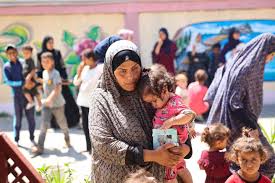
They have been forced to take shelter in overcrowded displacement camps, makeshift shelters, damaged buildings and sometimes just on open streets. Schools are no longer buildings of learning but of shelter.
UN spokesman Stéphane Dujarric, in New York said that all of these shelters are experiencing rapidly deteriorating conditions as a result of insufficient shelter materials.
“No shelter materials have entered Gaza since 1 March, before the Israeli authorities imposed a full blockade on aid and any other supplies for nearly 80 days,” he said.
“While some commodities have subsequently been allowed in small quantities, tents, timber, tarpaulins and any other shelter items remain prohibited.”
UN and its partners have 980,000 shelter items prepared to dispatch into Gaza once authorization is granted by the Israeli authorities.
UNRWA has been working tirelessly to provide displaced and injured Palestinians with many types of support.
“Despite all this, the eyes and hopes of our community remain fixed on us. UNRWA staff are not merely service providers. In the eyes of people in Gaza, we are pillars of resilience, lifelines of stability and symbols of hope,” said an UNRWA worker in Gaza City.
But as fuel shortages continue and only small amounts of humanitarian aid — food, medicine, shelter materials — trickle through the Kerem Shalom border crossing, the job of UNRWA workers and other humanitarians in Gaza is increasingly untenable.
“We have lost all the tools needed to work, so we have had to adapt,” said Neven, a psychosocial UNRWA worker in Khan Younis.
Despite their best efforts, the bombardment and devastation of Gaza continues with children going hungry and some even expressing suicidal thoughts.
