

Poonam Sharma
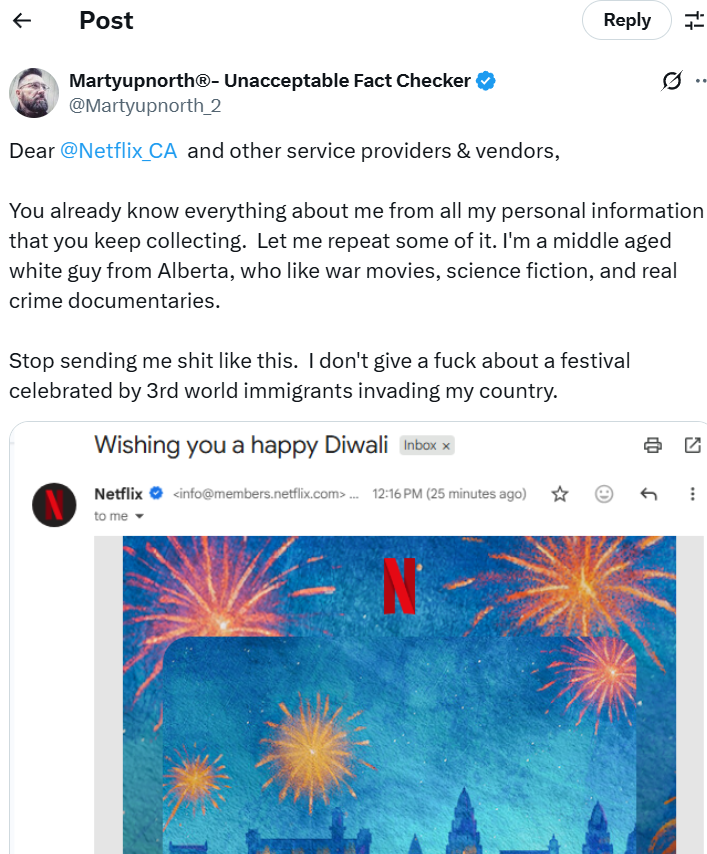
When an Alberta engineer in Canada chose to vent on social media following a basic “Happy Diwali” email, it was not just an individual breakdown. It was a reflection of a perilous and increasing trend — that cultural intolerance and racial bias are being gradually normalized in nations that previously boasted of being “liberal,” “inclusive, migrants taking over my country,” he wrote, after Netflix had sent him a Diwali greeting. A greeting — simply a string of warm festive text — was enough to fuel a hurricane of rage. Ironically, it wasn’t the greeting that was insulting; it was his refusal to accept cultural diversity without bitterness.
The Selective Hypocrisy
Canada, as much of the West, likes to present itself as a paragon of tolerance and diversity. Governments hail multiculturalism. Multinational corporations tout “inclusion” on corporate brochures. Cities proudly host Pride parades, multicultural events, and charity galas to demonstrate how “progressive” they are.
But tolerance, it appears, has boundaries. Christmas wishes are standard. Easter is mainstream. Halloween is a national tradition. But Diwali? That instantly turns into “a festival of Third World immigrants.”
This discriminate tolerance reveals the shallowness of the rhetoric. If one festive welcome on a streaming platform can elicit racist abuse, then the society that prides itself on inclusion evidently has profound fissures running beneath its surface.
Diwali Is Not an Invasion
Diwali is a light festival, which is not only celebrated by Hindus but also Sikhs, Jains, and Buddhists globally. In Canada, the UK, the US, Australia, and other nations, it is welcomed as a cultural bridge, a time of victory over darkness and ignorance. For the millions of Canadian Indians, Diwali is not a matter of “conquering” anyone’s territory — it is a matter of maintaining identity, tradition, and belief while participating fully in their new country.
To describe it as a “Third World immigrant festival” is not only ignorant of fact but an ugly bias — an attitude that treats immigrants as inferior beings rather than as guests who are welcome because they serve a purpose, and should “know their place.”
And the irony of this lies here: how many Indians or Hindus have ever complained about “Merry Christmas” greetings from corporations? None. Even non-Christians join in Christmas bazaars, share greetings, and join in the celebration mood. Tolerance, in this instance, is unilateral.
The Normalisation of Cultural Racism
Incidents like this are not isolated. In recent years, we’ve seen debates over Diwali fireworks bans in Canada, vandalism of Hindu temples, targeting of Indian businesses, and online campaigns mocking Hindu traditions.
Language hides behind “environmental concerns” or “noise restrictions,” but underneath lurks something riskier — an effort to drive immigrant identities to the fringes. It’s cultural gatekeeping that insists: “Your festivals are loud, foreign, and don’t belong.”
It begins with an email tirade, but it goes on to lead to division, mistrust, and aggression on the streets.
The Silence of the ‘Tolerant’
And the most disturbing thing is the silence of the self-proclaimed progressives. Had someone sent a racist tirade against Hanukkah, Christmas, or Eid, there would have been an uproar. Politicians would have made statements, companies would have condemned it, and newsrooms would have bannered the item as “hate speech.”
But when the target is Hindu culture, silence is the usual response. A few individuals ridiculed the Canadian engineer on the internet, yes, but no official denunciation, no introspective national debate as to why this mentality prevails. This double standard needs to be challenged.
Immigrants Are Not Visitors — They Build Nations
Canada, the United States, Australia, and the UK are not “pure” countries. They were constructed by immigrant waves bringing their skills, culture, cuisine, and festivals. Indian-origin Canadians are some of the most educated, economically productive groups of Canadians. They are physicians, engineers, shopkeepers, scientists, teachers, and legislators.
To treat their culture as an alien irritant and not as a national treasure is not merely bigotry — it is self-destructive. A nation that cannot stand those who construct it, will ultimately undermine its own ethical foundation.
Intolerance Is Not Strength
Those who believe they are preserving their culture by closing doors to others are not safeguarding it — they are diminishing it. Cultures expand when they meet, borrow, and rejoice together. They decay when they construct walls.
An email greeting is not a threat. It is a moment of contact. It is an opportunity to learn, to share warmth, to build bridges. Meeting it with anger doesn’t make a nation powerful — it exposes its vulnerability.
A Message Beyond Diwali
What was done to that engineer has nothing to do with one man’s bigotry. It’s a symptom of a greater tension in the world today, where parts of Western culture are resisting multicultural realities. Rather than viewing diversity as strength, some view it as invasion.
But history teaches: intolerance never triumphs in the end. Civilizations which shut their doors rot. Civilizations that open them, thrive.
So the question isn’t whether individuals like Marty Belanger are offended by Diwali. The real question is — how long liberal societies will continue to look the other way from their own rising intolerance?
