
Water at War: The Indus Waters Treaty and Pakistan’s Looming Agricultural Collapse

Paromita Das
New Delhi, 23rd June: In a world where water is swiftly becoming the new oil, any disruption in its flow carries seismic geopolitical and humanitarian consequences. The Indus Waters Treaty (IWT), signed in 1960, has long been a quiet pillar of South Asia’s fragile peace, especially for Pakistan. But with Union Home Minister Amit Shah’s recent declaration to suspend the treaty, Pakistan now finds itself facing an existential crisis that extends far beyond diplomacy—threatening its agriculture, economy, and internal stability.
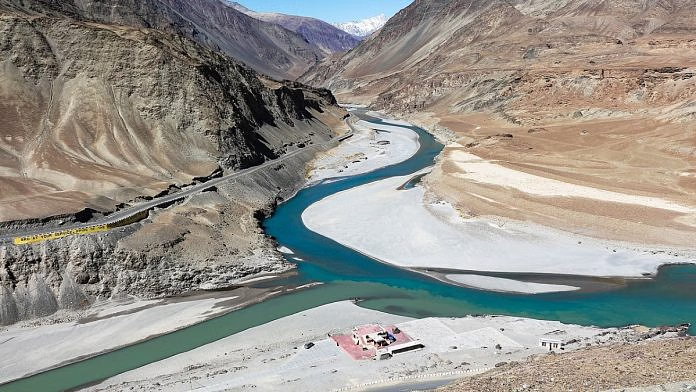
Unlike political skirmishes or military standoffs, this crisis hits Pakistan at its roots. Agriculture forms the backbone of Pakistan’s economy, contributing over 20% to its GDP and employing nearly 40% of its labour force. At the core of this system lies the Indus River, the lifeline of Pakistan’s breadbasket provinces like Punjab and Sindh. Without the steady flow of water from the Indus and its tributaries, the country’s capacity to feed itself and earn crucial export revenue could unravel.
A Treaty Born from Turmoil
The Indus Waters Treaty was born out of necessity rather than trust. In the aftermath of the 1947 partition, water disputes flared almost immediately between Bharat and Pakistan. Recognizing the potential for catastrophic conflict, the World Bank stepped in to mediate a long-term solution. The result was the Indus Waters Treaty, signed in 1960 by then Bharatiya Prime Minister Jawaharlal Nehru and Pakistani President Ayub Khan.
The agreement allocated the three eastern rivers—Ravi, Beas, and Sutlej—to Bharat, while the three western rivers—Indus, Jhelum, and Chenab—were reserved for Pakistan. Importantly, although Bharat retained certain rights for development and non-consumptive uses on the western rivers, over 80% of the total water flow from the Indus Basin was earmarked for Pakistan.
This was an extraordinary concession by Bharat, especially considering the tense bilateral relations that persisted after multiple wars. For Pakistan, the treaty was not just a diplomatic win—it was an economic and agricultural lifeline. In the decades that followed, massive canal systems, dams like Tarbela and Mangla, and irrigation networks were developed based on the predictable flow guaranteed by this treaty.
Why the Treaty Is Critical for Pakistan Today
In 2024, the importance of the IWT to Pakistan cannot be overstated. Its farming system—already under stress due to climate change, outdated irrigation infrastructure, and poor water management—remains heavily dependent on consistent water flows. Crops like wheat, cotton, and sugarcane, essential not only for food security but also for export earnings, rely on the river system governed by the treaty.
Furthermore, the social fabric of rural Pakistan is intricately tied to agriculture. A reduction in water flow could trigger not just food shortages but also massive rural unemployment, social unrest, and internal migration toward already overburdened urban centers.
With recent data from the Indus River System Authority (IRSA) showing a 20% decline in water flows across key provinces, the warning signs are flashing red. In Punjab, Sindh, and Khyber Pakhtunkhwa, water shortages are beginning to severely impact Kharif crop cultivation. As the monsoon delays, the specter of famine-like conditions looms larger.
Bharat’s Strategic Pivot and Its Implications
Amit Shah’s remarks about diverting water “unjustifiably flowing to Pakistan” reflect a fundamental shift in Bharat’s policy stance. No longer is Bharat content with symbolic gestures; this move redefines water as a strategic tool of diplomacy and deterrence.
From Bharat’s perspective, the treaty has long been upheld in good faith despite repeated provocations, including state-sponsored terror. Shah’s declaration—”India’s patience has limits, and those limits have been crossed”—is not just rhetoric. It is a signal that traditional peace frameworks like the IWT are no longer immune to geopolitical realities.
For Pakistan, the ramifications are twofold. First, it faces a humanitarian and agricultural disaster. Second, it must confront its dependency on a treaty that Bharat now views as outdated and exploitable. Calls to upgrade water infrastructure, invest in desalination, and reform irrigation are louder than ever, but financially and logistically, Pakistan may be ill-equipped for such a transformation in the short term.
Time for Self-Reflection in Islamabad
The suspension of the Indus Waters Treaty should serve as more than a diplomatic jolt—it should be a moment of national introspection for Pakistan. A country that has historically leveraged terror as a strategic tool must understand that such actions carry costs. The IWT was always based on mutual goodwill, not legal rigidity. Bharat could have revoked or reinterpreted it multiple times in the past, but chose not to. That patience, evidently, has run out.
Rather than viewing this as an act of aggression, Pakistan would be wise to see it as a wake-up call. Water security, national integrity, and international credibility are interconnected. Sustainable development cannot be built on fragile treaties while state-sponsored violence continues unchecked.
A Treaty on the Brink, a Nation at a Crossroads
The Indus Waters Treaty is not merely a legal document—it is Pakistan’s agricultural backbone and a silent enabler of regional stability. Its potential collapse would hurt Pakistan far more than Bharat, underscoring the asymmetry of dependence.
Shah’s statement represents more than a hardline policy—it is a marker in the sand, signifying that peace without reciprocity is no longer an option. For Pakistan, the choice is clear: evolve, cooperate, and prioritize sustainability, or risk watching its fields dry and its diplomacy falter.
As water becomes the defining issue of the 21st century, the fate of the Indus Waters Treaty may well determine not just food on the table in Pakistan, but the future of peace in South Asia.
