
Voter List Purification in West Bengal Triggers a Political Storm
“As the Election Commission launches a major voter list purification drive in West Bengal, a fierce political battle erupts between the Trinamool Congress and the BJP, testing the boundaries of Bharat’s democracy and institutional independence.”

Paromita Das
New Delhi, 13th October: In the heart of Bharat’s democratic machinery, the Election Commission (EC) stands as the final guardian of electoral integrity. Its ongoing mission—to cleanse voter lists of fraudulent entries—may sound procedural, yet it’s turning into one of the fiercest political battles in contemporary Bharat. After a successful Special Intensive Revision (SIR) in Bihar, the EC’s next target, West Bengal, has become a flashpoint of accusations, threats, and political drama.
At first glance, the Commission’s initiative appears purely administrative—designed to ensure that every name on the voter roll belongs to a genuine, eligible citizen. Yet, as the EC’s teams moved to replicate the Bihar model in West Bengal, Chief Minister Mamata Banerjee’s reaction was anything but administrative. Her fiery rhetoric and threats of unrest have cast a political shadow over what should have been a nonpartisan exercise in electoral hygiene.
The Bihar Precedent: A Mirror for Bengal

The SIR drive in Bihar was a landmark success for the Election Commission. Despite intense resistance and allegations from the I.N.D.I. Alliance of “vote theft” and “disenfranchisement,” the exercise ultimately exposed and removed thousands of fake entries. The irony was sharp—while opposition leaders denounced the process in public, their own party representatives at the booth level expressed confidence in the EC’s transparency.
The pattern is now repeating in West Bengal. Here too, the same allegations resurface—this time from the All India Trinamool Congress (AITC)—accusing the Commission of acting under the “direction of the BJP.” Yet, unlike Bihar, Bengal’s stakes are far higher. The state has long been haunted by allegations of illegal immigration and inflated voter lists, both politically sensitive and electorally consequential issues.
Mamata Banerjee’s Offensive and the BJP’s Counterattack
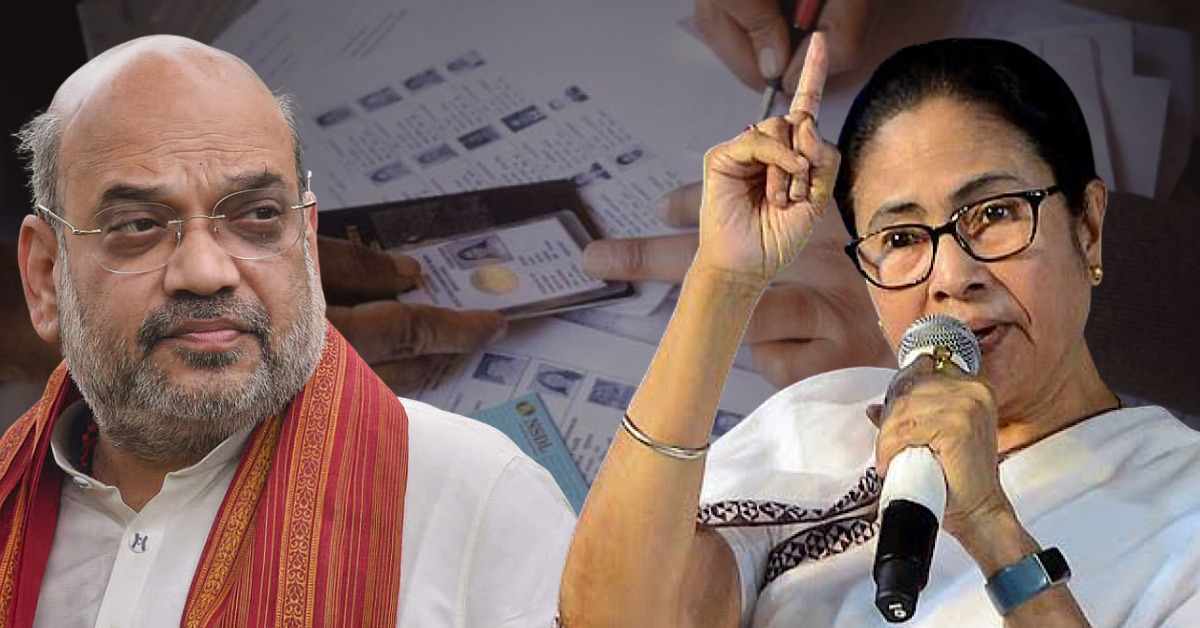
Chief Minister Mamata Banerjee’s statements have added fuel to the already charged atmosphere. Recently, she accused Union Home Minister Amit Shah of behaving like the “acting Prime Minister,” even labeling him “Mir Jafar”—a historical symbol of betrayal. Her outburst questioned not only the SIR process but the autonomy of the Election Commission itself.
Crossing all limits of political and constitutional propriety, West Bengal Chief Minister Mamata Banerjee today, while sitting in the state secretariat, Nabanna, openly threatened that if SIR is conducted in Bengal, it would lead to riots and “many other things.” She went even… pic.twitter.com/sRNikOLEtm
— Amit Malviya (@amitmalviya) October 9, 2025
In response, BJP leaders unleashed a sharp counterattack. Amit Malviya, the party’s national executive member, condemned Banerjee for “crossing all limits of political and constitutional propriety,” claiming she had threatened riots if the voter revision went ahead. West Bengal BJP chief Samik Bhattacharya alleged that the TMC thrives on the votes of illegal immigrants, asserting that “if the voter list becomes transparent, no genuine Bharatiya will vote for the Trinamool.”
Other BJP voices, including Locket Chatterjee and several Lok Sabha MPs, have accused Banerjee of “deliberately misleading minorities” and “shielding fake voters” to preserve her political base. They maintain that the SIR, much like the earlier NRC debate, is about ensuring fair elections—not communal polarization.
Fake Voters: The Hidden Crisis in Bengal

The controversy gains deeper context from recent findings. A study by Dr. Milan Kumar (IIM Visakhapatnam) and Dr. Vidhu Shekhar (SPJIMR) estimated a 13.69% inflation in West Bengal’s electoral roll—amounting to nearly one crore excess voters. The data, based on demographic reconstruction and migration records, paints a worrying picture: the integrity of Bengal’s voter lists may have been compromised for decades.
In August, the Election Commission had already flagged several instances of forged voter application forms (Form 6) being approved by district Electoral Registration Officers. The discovery prompted the suspension of four state officers. Yet instead of aiding the cleanup, the TMC government demanded a “clarification” from the CEO, questioning the need for the exercise itself.
The tension escalated when Mamata Banerjee warned Booth Level Officers (BLOs) not to delete names “arbitrarily,” reminding them that they are employees of the state government, not the EC. Her remarks were interpreted as an attempt to intimidate officials engaged in the verification process.
A Deeper Struggle: Political Power vs. Institutional Credibility

Beneath the surface, this clash represents more than just a dispute over voter rolls—it reflects a battle between political survival and institutional independence. For the Election Commission, the SIR is a constitutional duty to ensure free and fair elections. For the ruling party in Bengal, it threatens to expose a long-standing undercurrent of electoral manipulation.
It’s no secret that illegal infiltration from Bangladesh has been a persistent issue in the border districts. For decades, it has subtly altered demographic compositions, influencing both constituency boundaries and political loyalties. The SIR process, by eliminating ineligible names, could dramatically reshape Bengal’s electoral arithmetic—a reality that explains the Trinamool’s deep anxiety.
Transparency Cannot Be Political

In a democracy, transparency is not a political choice—it’s a constitutional obligation. The Election Commission’s credibility rests on its neutrality and its resolve to uphold electoral fairness. Political protests, even if legitimate, must not blur this principle.
The BJP’s assertiveness, while politically motivated in tone, also echoes a valid democratic concern—that fake voters dilute genuine voices. On the other hand, Mamata Banerjee’s fierce defense of her voter base reveals a troubling conflation of political interest with democratic representation.
If the SIR process is conducted under strict legal oversight, with avenues for appeals and corrections, there is no justification for violent rhetoric or threats of unrest. The real test is not whether fake names are deleted, but whether the system remains transparent, accountable, and inclusive.
The Battle for a Cleaner Democracy
West Bengal today stands at a crossroads. The Election Commission’s SIR initiative may appear technical, but its implications are profound. It challenges entrenched political structures, tests institutional autonomy, and underscores the fragile balance between state and central powers.
Mamata Banerjee’s apprehension is understandable—her political capital depends heavily on consolidated vote banks. Yet her reaction—marked by inflammatory language and attacks on constitutional authorities—undermines the very democratic ideals she claims to defend.
As CEO Manoj Kumar Agarwal assured after a recent meeting, “No valid voter’s name will be excluded. Whatever is stated in the law will be followed.” That assurance, if honored, must put an end to the fearmongering.
Ultimately, democracy cannot be strengthened by rhetoric but by truth in numbers. Purifying voter lists isn’t an act of partisanship—it’s an act of faith in the people. And it’s time all political forces respect that faith.
