

Anjali Sharma
GG News Bureau
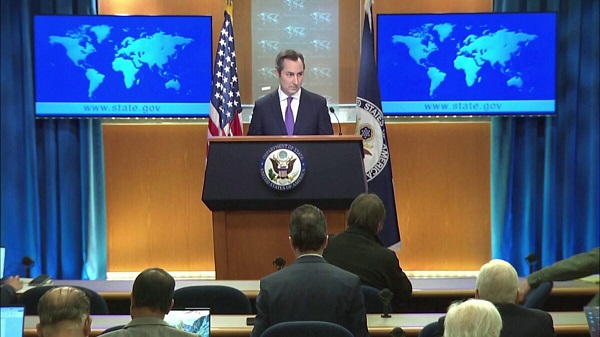
WASHINGTON DC, 20th Jan. US Department of State Spokesman Matthew Miller said on Friday urges restraint from both Iran and Pakistan after tensions flared up and said that the US is concerned about the escalating tensions in the region.
Miller in a press conference said there is no need for escalation in the matter.
He said that the US has noted the Pakistani government’s comments about the importance of “cooperative relations between Pakistan and its neighbours.
Miller said, “We are concerned about escalating tensions in the region. It’s been something we have spoken number of times, we’ve focused on. We’ve been incredibly concerned about the potential for escalation since October 7,” when asked on how the US administration reads the situation between Iran and Pakistan.
“That’s why we have engaged in intense diplomatic efforts to try to prevent escalation. We noted the comments from the government of Pakistan, about the importance of cooperative relations between Pakistan and its neighbors. We thought those were productive useful statements, and certainly, there’s no need for escalation and we would urge restraint on all sides in this case,” he added.
Miller said, “I do not have anything private conversations to read out,” when asked about media reports claimed that Pakistan consulted the US before conducting strikes in Iran.
“We don’t believe this should escalate in any way, shape or form. Pakistan is a major non-NATO ally of the United States, that will remain the case, but we would urge restraint in this case.”
Miller called Iran a major funder of Hezbollah and a principal supporter of Hamas for years.
He said, “I think I made pretty clear yesterday what we think about Iran’s attacks, not just the strikes that were launched in the past three days against three of its neighbours but its long history of funding terrorism, funding instability and sowing discord in the Middle East. That’s something we have seen contribute to conflict in Gaza.”
Iran’s strikes in Pakistan came after Iran’s Islamic Revolutionary Guard Corps launched missiles into Kurdistan region at what it called an Israeli “spy headquarters” and at alleged ISIS-linked targets in Syria, Al Arabiya News reported.
“You have seen Iran as the principal supporter of Hamas for years. They are the major funder of Hezbollah. They are one of the major funders of the Houthis. We have seen the consequences of the actions that Iran has taken to add to regional instability and that is why we continue to take actions to hold Iran accountable and also send clear very messages to Iran that we don’t believe this should escalate in any way, shape or form. Pakistan is a major non-NATO ally of the United States, and that will remain the case, but we would urge restraint in this case. We do not want to see escalation and don’t think there’s a need for escalation,” he added.
National Security Council Coordinator for Strategic Communications at the White House, John Kirby said that the US is monitoring the situation regarding Iran and Pakistan “very very closely” and they do not want to see escalation.
He was speaking in a press Gaggle en route Morrisville, John Kirby said, “You’ve all seen the reports out of Pakistan that they fired some missiles into Iran. We’re monitoring this very, very closely. We don’t want to see an escalation, clearly, in South Asia – South and Central Asia. And we’re in touch with our Pakistani counterparts, as you might expect.”
He added “We’ll let the Pakistanis speak to their military operations. I’m not going to parse that or do any or try to, you know, operationalize it here from Air Force One,”.
On possible risks of escalation, Kirby said, “I mean, these are two well-armed nations. And again, we don’t want to see an escalation of — of any armed conflict in the region, certainly between those two countries.
“I want to let Pakistan speak to their military operations. I want to be careful about that. As you know, they were struck first by by Iran, which was obviously another reckless attack, another example of Iran’s destabilizing behaviour in the region.”
Pakistan said that it has launched missile strikes into Iran and that “a number of terrorists were killed during the intelligence-based operation,” codenamed “Marg Bar Sarmachar”.
Pakistan’s Ministry of Foreign Affairs in a statement said that it had undertaken a series of “highly coordinated and specifically targeted precision military strikes against terrorist hideouts” in the Siestan-o-Baluchistan province of Iran.
“A number of terrorists were killed during the intelligence-based operation codenamed “Marg Bar Sarmachar,” it said. Pakistan’s military action comes after it condemned Tuesday’s strike by Iran, which it said killed two children.
Iran attacked the headquarters of a terrorist group opposed to Tehran with drones and missiles in Pakistan, Al Arabiya News reported cited Tasnim news agency.
Two “important headquarters” of Jaish al-Adl (Army of Justice) in Pakistan were “destroyed,” Al Arabiya News reported citing Tasnim News Agency.
The news media reported that the strikes were concentrated in an area in Pakistan’s Balochistan where “one of the largest headquarters” of Jaish al-Adl was located.
Jaish al-Adl, was formed in 2012 designated as a “terrorist” organization by Iran, a Sunni terrorist group that operates in Iran’s southeastern province of Sistan-Baluchistan, Al Arabiya News reported.
Jaish al-Adl has launched numerous attacks on Iranian security forces, Al Arabiya News reported. In December,
Jaish al-Adl took responsibility for an attack on a police station in Sistan-Balochistan that claimed the lives of at least 11 police personnel, according to news media reported.
