

Poonam Sharma
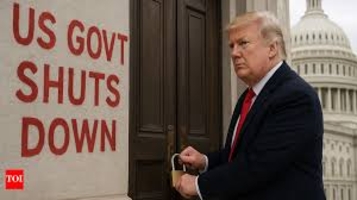
The United States was under the third day of its latest government shutdown on Thursday, with slim chances of an instant resolution as partisan gridlock remains to envelop Capitol Hill.
The shutdown, prompted by the Senate’s inability to approve a vital spending bill ahead of the Jewish religious holiday of Yom Kippur, now partially closes big sections of the federal government. As talks remain stalled, members of Congress and millions of Americans impacted by the shutdown are facing an uncertain and lengthy weekend.
A Deadlock in the Senate
The Senate met briefly Thursday, but with Yom Kippur observances being prioritized, no vote was cast. The chamber is set to again consider the issue on Friday, but chances are low.
Senate Majority Leader John Thune (R-SD) informed journalists that the chances of a winning vote this week are “low,” leaving open the possibility of the shutdown lingering into next week or beyond.
Both parties have fallen short of the 60 votes needed to push a spending package forward. Widespread partisan differences, along with election-year politics, have made the two sides stuck.
The Republican-led Senate has 53 members, and Democrats have 45. Two independents — Senator Angus King of Maine and Senator Bernie Sanders of Vermont — usually caucus with Democrats but are not always in line with them on spending matters. Last week, King and a small group of Democrats defected and voted for a Republican compromise, stating that extending the shutdown would be more destructive than any short-term concessions.
House Republicans Float a New Bill
House Speaker Mike Johnson (R-LA) has signaled that the House is preparing to introduce its own version of a spending bill. In an interview with CBS News, Johnson said, “The House will be back next week. Hopefully, the Senate sends us something to work with, but if not, we’re working on a bill of our own.”
Republicans also started aggressive behind-the-scenes arm-twisting to chip off Democratic support in the Senate. With margins thin as a razor and political stakes on high, even a few defections can tip negotiations.
Trump’s Shadow Over the Shutdown
Aiding to the theatrics is the specter of former President Donald Trump, who publicly has endorsed the shutdown as a political weapon. On his Truth Social site, Trump posted that he had spoken with Office of Management and Budget Director Russell Vought to discuss how the shutdown can be used to “permanently reduce the size of the federal workforce.”.
“Numerous of these Democrat-controlled agencies are nothing more than political stunts,” Trump wrote, leaving open the possibility that some budget reductions might be made permanent instead of temporary.
The White House confirmed Thursday that exactly that was in active consideration, with Press Secretary Caroline Levitt conceding they could run into the “thousands.” Already, $26 billion worth of federal programs in Democratic strongholds such as California, New York, and Illinois have been shelved.
For Trump, who has long complained about what he refers to as the “deep state,” the shutdown presents a chance to reorganize the federal bureaucracy — but one that threatens to drive government services and millions of federal workers further into uncertainty.
The Healthcare Battle
At the center of the stalemate is an intense battle over healthcare funding. In the early part of the year, Trump signed his self-described “One Big Beautiful Bill,” which implemented sweeping reductions in healthcare programs. Democrats are now resorting to the spending bill as a bargaining chip to recapture some of those savings.
In particular, they are urging Republicans to agree to subsidies for the Affordable Care Act (ACA) and roll back reductions in Medicaid benefits for foreigners. For Democrats, these are not negotiables; for Republicans, they are political red lines.
The standoff has rendered compromise elusive. Although some moderate lawmakers from both sides have proposed temporary spending extensions, hardliners are resistent, believing that any concessions would undermine their bargaining power.
Economic Toll Mounts
Outside of Washington, the shutdown is already looming over the U.S. economy. Early last month, consulting firm Ernst & Young estimated that for each week of a government shutdown, economic output would be reduced by around $7 billion.
Federal employees across the board are preparing for unpaid furloughs, while contractors are expecting stalled projects. Public-facing services, ranging from passport processing to national parks, are seeing disruptions. For regular Americans, the longer the shutdown lasts, the more real its impact will feel.
Markets have thus far been relatively subdued, but experts caution that sustained uncertainty would undermine investor confidence, especially if the shutdown starts to impinge on wider supply chains and consumer spending.
A Political Showdown with No Easy Exit
The current standoff is an expression of deeper fault lines in the American political system. On one hand, Republicans — emboldened by Trump’s presence — are pushing for across-the-board cuts in federal programs. On the other hand, Democrats are trying to protect healthcare and social safety nets.
The standoff is now a proxy fight not only about spending priorities, but about the role of government. With neither willing to back down, the danger increases that the shutdown will extend into weeks, not days.
Moderate voices on both sides called for compromise, noting that public tolerance for shutdowns has always been thin. Previous instances often resulted in political fallout against the party seen as being at fault.
But in this era of hyper-partisanship, the normal political incentives may not be valid anymore. Both parties seem to believe that being resolute will work better with their bases — even if at the expense of long-term dysfunction.
The Road Ahead
As the weekend draws near, the United States continues to be trapped in a political gridlock with no resolution at hand. Legislators plan to return to the negotiating table Friday, but with little hope of a compromise.
For now, federal workers, contractors, and millions of citizens must wait and watch as Washington’s gridlock continues to paralyze the government. Whether the shutdown lasts a few more days or stretches into weeks may ultimately depend not on quiet negotiations, but on a political breakthrough that seems increasingly out of reach.us-government-shutdown-october-2025-third-day
