

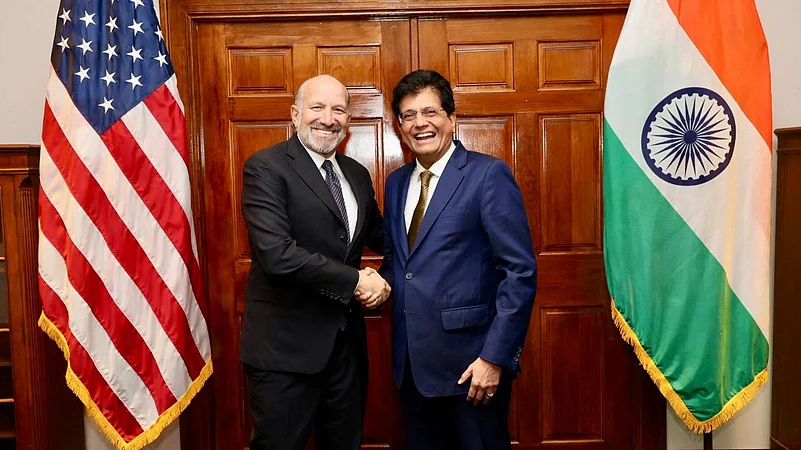
- Countdown to August 1: US–Bharat race to seal interim trade pact before looming tariff deadline.
- Tariff Tug-of-War: Bharat seeks protection for dairy and textiles, US pushes for digital and industrial access.
- Strategic Stakes Rise: Trade deal seen as test for broader Indo-US geopolitical alignment.
- $500 Billion Ambition: Talks could lay groundwork for doubling bilateral trade by 2030.
Paromita Das
New Delhi, 26th July: As the calendar inches toward August, a high-stakes trade encounter is poised to unfold in New Delhi. Following a recent meeting in Washington, a senior U.S. delegation is scheduled to arrive for negotiations aimed at forging an interim deal before the looming August 1 deadline—after which tariffs threaten to disrupt burgeoning bilateral commerce. The pressure is palpable on both sides to craft a temporary framework that halts tariff escalation and lays a blueprint for more comprehensive negotiations later this year
What’s on the Table: Tariffs, Market Access, and Sensitive Sectors
The heart of the discussion is unmistakably tariff cuts. On one side, U.S. officials are seeking reduced duties across industrial goods, automobiles, and digital services. On the other, Bharat is pressing for exemptions from proposed retaliatory tariffs—especially in textiles, gems and jewelry, leather, seafood, and petrochemicals, which form the backbone of its export strategy.

Yet not everything is negotiable. Bharat remains firm on safeguarding its agricultural and dairy sectors—a longstanding political red line. In parallel, regulatory issues, intellectual property norms, and digital trade rules are being actively negotiated, as stakeholders from both nations push for clarity and fairness in emerging trade arenas.
Economic Stakes: Mutual Gains Amid Growing Trade Tension
Bharat and the U.S. already share a trade relationship exceeding $130 billion, with Bharat enjoying a substantial surplus nearing $41 billion last year. A successful interim agreement promises to significantly reduce trade friction, enhance investment confidence, and give a lift to sectors on both sides.
Bharatiya exporters, particularly in labor-intensive industries such as apparel and gems, see tariff relief as a chance to grow market share in the U.S. Meanwhile, U.S. manufacturers are eager to protect domestic markets while gaining better access to Bharat’s rapidly expanding consumer base.
Strategic Signals: Beyond Economics to Geopolitics

More than just numbers, these talks symbolize a deepening strategic alignment between Bharat and the U.S. Prime Minister Narendra Modi and U.S. leadership have increasingly framed economic ties as integral to broader regional and global coordination—from supply chains to climate collaboration to defense logistics. A failure to reach even a provisional deal by August 1 risks not only tariffs but also a symbolic setback at a time when both nations desire continuity and trust in relations.
Pragmatic Partnership Over Rigid Bargaining
Although sensitive sectors pose negotiation hurdles, the urgency of an interim agreement demands flexibility from both sides. For Bharat, partial tariff concessions could unlock more robust exports and reaffirm its market power. For the U.S., preventing retaliatory duties maintains stability for American firms already invested in Bharat.

A steadfast refusal to reach a provisional deal would be a missed opportunity, signaling rigidity in an atmosphere better suited to pragmatism. Both parties must view this not as zero-sum bargaining but as strategic partnership building—setting the tone for broader ambition.
A Pivotal Moment for Bilateral Trade Diplomacy
The upcoming U.S. delegation’s visit in August represents more than another round of trade talks—it’s a critical juncture. If both sides can secure a stopgap agreement before the deadline, it will prevent tariff imposition, boost investor confidence, and become a stepping stone toward a larger, more comprehensive pact.
In the realm of global commerce, timely compromise often outweighs prolonged confrontation. Should Washington and Delhi meet this moment with mutual intention and political will, they stand to transform bilateral trade dynamics—moving from transaction to strategic collaboration. For the two largest democracies and rapidly evolving economies, the result of these talks might well define their shared economic future for the decade ahead.
