
Urban Mandate, New Power Equation: BJP’s Rise Reshapes Maharashtra Politics
BJP dominates 29 corporations; Thackerays survive in Mumbai, NCP suffers major setback.

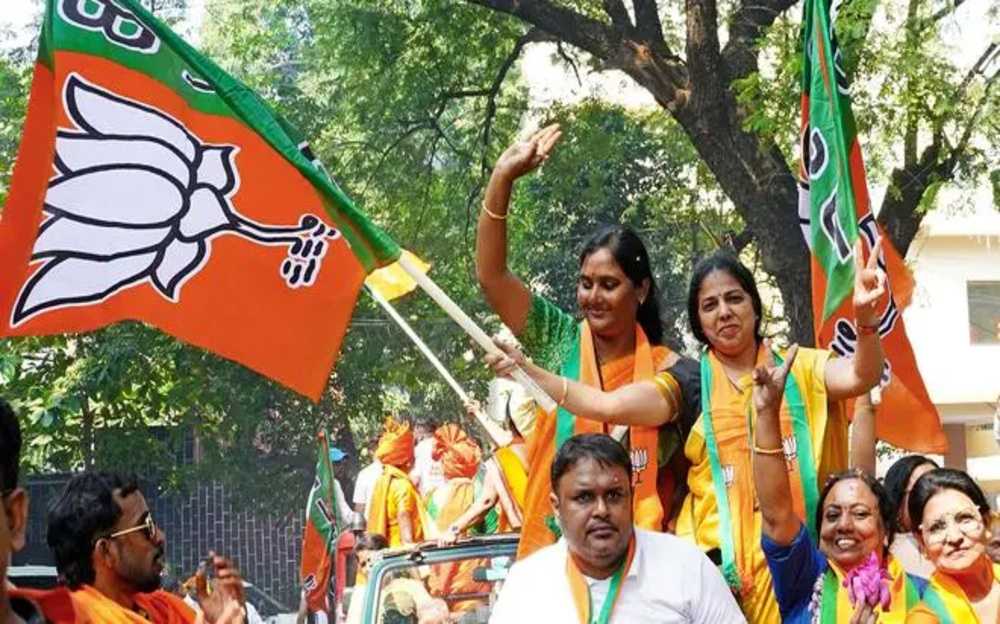
- BJP wins 1,425 of 2,869 wards across Maharashtra.
- Shiv Sena (UBT) retains dominance over Shinde Sena in Mumbai.
- AIMIM emerges as key Muslim vote player with 95 wins.
- Both NCP factions fail to reclaim Pune and Pimpri-Chinchwad.
GG News Bureau
Mumbai, 17th Jan: The elections to 29 municipal corporations in Maharashtra, including the high-stakes Brihanmumbai Municipal Corporation (BMC), have delivered a decisive mandate in favour of the Bharatiya Janata Party (BJP), which emerged victorious in 1,425 of the 2,869 wards across the state. While the BJP stands as the clear winner, most major political players have found some silver linings — except the two factions of the Nationalist Congress Party (NCP), which failed to reclaim their traditional bastions of Pune and Pimpri-Chinchwad despite contesting together.
For the BJP, the results cement its urban supremacy in Maharashtra. The party is poised to get its first mayor in Mumbai and has emerged as the single-largest force by a massive margin — winning over 1,000 more wards than its nearest ally, the Eknath Shinde-led Shiv Sena. Hard-fought victories in Pune and Pimpri-Chinchwad have expanded its urban base and boosted Chief Minister Devendra Fadnavis’ political stature, as the polls were contested under his leadership.
For Shiv Sena (Uddhav Balasaheb Thackeray), the outcome in Mumbai shows that Uddhav Thackeray still commands the core Shiv Sena legacy despite a party split and mass defections. His faction secured 65 BMC wards — more than double the 29 won by Eknath Shinde’s Sena. Symbolically, Shiv Sena (UBT) also captured ward 13A in Thane, where Shinde’s residence is located. Meanwhile, Raj Thackeray’s Maharashtra Navnirman Sena (MNS), once considered politically weakened, won six BMC wards — just one short of its 2017 tally — aided by its alliance with Uddhav Thackeray.
Congress, contesting largely without its former allies, put up a respectable performance by winning 324 wards statewide and emerging as the third-largest party. Its 25 wins in the BMC, despite facing the BJP–Shinde Sena combine, provide a morale boost, though the division of Muslim votes remains a challenge.
For Eknath Shinde’s Shiv Sena, the primary objective of overtaking Shiv Sena (UBT) in Mumbai fell short. However, securing nearly 30 BMC seats gives Shinde bargaining leverage with the BJP, which lacks an absolute majority in the corporation. His faction’s strong showing in Thane further strengthens his regional clout, and his camp has already hinted at staking claim to the mayoral post.
Asaduddin Owaisi’s AIMIM recorded a significant breakthrough, winning 95 seats across 29 corporations — its best civic performance in Maharashtra. The party secured 24 seats in Chhatrapati Sambhajinagar and 20 in Malegaon, indicating a clear preference among sections of Muslim voters over the Samajwadi Party.
For both Ajit Pawar and Sharad Pawar’s NCP factions, the results were a major setback. Their last-minute reunion failed to secure control of Pune and Pimpri-Chinchwad, forcing a strategic rethink. The defeat is particularly damaging for Ajit Pawar, who is allied with the BJP in the state government, raising questions about his future influence within the ruling coalition.
Overall, while the BJP has emerged as the undisputed winner of Maharashtra’s civic polls, the results have reshaped urban power equations, set the stage for new political bargaining, and signaled shifting voter loyalties across the state.
