

By Anjali Sharma
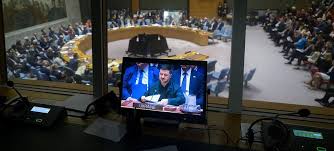
UNITED NATIONS – UN Security Council on Tuesday held a high-level meeting on Ukraine in New York on the sidelines of the UNGA session.
Council members and other Heads of State and Foreign Ministers discussed the situation on Ukraine.
UN chief António Guterres addressed the meeting and briefed the Council, and Ukrainian President Volodymyr Zelenskyy is expected to represent Ukraine at the meeting.
Mr. Guterres, noted that it had been over three years since the Russian Federation began its full-scale invasion of Ukraine.
He highlighted the immense humanitarian toll and continued violations of international law.
Despite some diplomatic efforts and limited progress such as prisoner exchanges and humanitarian discussions the fighting has intensified, with record-level attacks on Ukrainian cities causing widespread civilian casualties and destruction of vital infrastructure, he noted
He condemned all attacks on civilians and reiterated that such actions are prohibited under international law.
The humanitarian situation remains dire, with millions facing a harsh winter without reliable access to power, water or healthcare.
He also raised concerns about risks to nuclear safety, especially at the Zaporizhzhia plant.
Guterres urged all parties to ensure humanitarian access, protect civilians and respect international obligations and welcomed recent diplomatic efforts, but warned that the longer the war continues, the greater the risk of escalation and broader instability in Europe.
He concluded by calling for a comprehensive ceasefire that leads to a just and lasting peace, aligned with the UN Charter and international law, reaffirming the UN’s commitment to supporting all meaningful peace efforts.
President of Ukraine Volodymyr Zelenskyy said that the United Nations has less influence and there is often a lack of decisions on fundamental issues. The tools of the United Nations are not working.
He said that the Russian Federation, a permanent of the Council, is doing everything it can to prolong the largest war in Europe since the Second World War.
Zelenkskky added that Moscow only wants war and only pretends to seek diplomacy.
He stated that the Russian Federation figure who makes the real decisions “fears to sit face to face with Ukraine and the world, and openly admit he wants only war”.
Vladimir V. Putin sends delegates who “cannot and don’t want to stop the bloodshed” he added.
“Each day, Russia kills our people, destroys our cities and leaves no sign it will ever return to the principles of the UN Charter”, he said, further noting that China could compel Moscow to end the invasion”, as “without China, Putin’s Russia is nothing,” he asserted
South Korea representative spoke in his national capacity to recall that, three years since the invasion of Ukraine, the drone incident in Poland two weeks ago is a reminder that the battlefield is no longer confined to Ukraine, and poses a threat to the peace and security of neighboring States.
He called for an end to attacks on civilians and civilian infrastructure and renewed his call for an unconditional cessation of hostilities as a condition for dialogue, voiced hope that the ongoing discussion between the United States, Russian Federation, Ukraine and European partners will contribute to a peaceful settlement.
Minister for Foreign Affairs of Denmark, Lars Løkke Rasmussen, underlined that “whatever one Council member may claim, there is only one ‘root cause’ of the war in Ukraine Russia’s illegal invasion of a sovereign UN Member State”.
He condemned Russian Federation’s change in tactics to “terrorize Ukraine into submission.”
Foreign Minister Rasmussen added that such acts “have been declared war crimes and crimes against humanity by the UN and for which arrest warrants have been issued by the International Criminal Court”.
He rejected Russian Federations’ claims of seeking peace, he said its “actions speak louder”, pointed to July that was “the deadliest month for Ukrainian civilians in over three years, with more than 1,600 civilians killed or injured”.
US Secretary of State Marco A. Rubio underscored that the Ukraine war cannot end militarily the longer it lasts, the more people will die.
Generous offers have been made, including “a ceasefire at the current lines of contact”, he added.
“We have entered an era of what appears to be potential escalation, with historically some of the highest numbers of strikes we have seen over the last few nights,” he said.
He noted that “now we are watching incursions into neighbouring airspace with drones and airplanes”.
Rubio told the Member States that although the President of the United States, Donald J. Trump, is a very patient man, “his patience is not infinite”, he asserted.
He noted that he has before him the options of imposing additional economic costs on the Russian Federation if necessary to bring this war to an end.
Rubio also said that the US has option to sell defensive and potentially offensive weaponry so Ukraine can defend itself from the assault by purchasing that weaponry.
Alexandra Papadopoulou, Deputy Minister for Foreign Affairs of Greece, noted that her country has consistently backed all efforts to put an end to the war.
She welcomed the United States-led initiatives to stop the bloodshed in Ukraine.
Alexandra Papadopoulou expressed regret that Moscow has not yet agreed to a leaders’ meeting and shifted away from the path to peace, proceeding to reckless acts that affect European Union and NATO borders.
She unequivocally condemned any violation of internationally recognized territory, by land, air or sea.
Any change of borders as a result of the use of force is unacceptable and sets a dangerous precedent, she said.
Javier Martínez Acha Vásquez, Minister for Foreign Affairs of Panama, said that the recent violations of the airspace of Poland and Romania, along with the meeting convened on 22 September in response to the incursion of Russian Federation combat aircraft into Estonian airspace, are worrying signs of an escalation of the conflict.
He stressed that such actions undermine the recent diplomatic efforts promoted by the United States, with the support of European countries, to bring this war to an end.
Russian Federation representative said that the Council had been compelled to be present at a meeting initiated by European colleagues “purely to mark the latest New York stop on the tour of the well-known former actor”.
European sponsors of Kyiv want the Council “to live as they do in some kind of a parallel reality where Ukraine is not losing on the battlefield”, he stated while Ukrainian citizens are queuing “to die in the pointless slaughter for the advancement of Western geopolitical interests”.
Russia condemned the “neo-Nazi regime in Kyiv and its misanthropic ideology,
He noted that others do not recall pledge not to expand NATO eastwards, supplanting international law with a “so-called rules-based order”.
The Ukraine crisis is the direct result of their actions, he stressed.
Ukraine is using human shields and air defence systems in direct proximity to residential areas, resulted in tragedies linked to wreckage falling on homes from errant air defence missiles.
US is fanning the flames of war, mendaciously portraying the Russian Federation as an enemy that will attack others “as soon as it finishes off Ukraine”.
Petr Pavel, President of the Czech Republic declared that Russia for everyone to see, does not seek peace”.
He added “Let me state it loud and clear, that Russia continues to violate the basic principles of the UN Charter, territorial integrity and national sovereignty, through its naked attempt at land grab and expansion of sphere of influence.”
Moscow’s recent “land swap” proposals and continued military escalation highlight its disregard for peace and international law, while it systematically breaches the principles of peaceful coexistence and will continue to do so as long as the international community allows it, he said,
He deplored the recent incursion by Moscow of drones into Polish airspace. His country stands in solidarity with Ukraine.
Petr Pavel emphasized that “The aggressor cannot be rewarded for unlawful use of force; accountability and full reparations for the damage caused are essential for a just and lasting peace.”
Alexander Stubb, President of Finland noted that most in the Council “have had the experience throughout our history of war as a means of expansion we’ve either been the victims thereof or we’ve been the aggressor”.
He said many believed that after 1989 that lesson had been learned, when the international community does not nurture the international institutions that are the foundations of the peace, “we fail”.
Stubb noted that Ukraine has accepted a ceasefire proposed by the United States and supported by Europe, “there’s only one country that doesn’t want a ceasefire and that is Russia”.
However, “today could be a game changer”, he emphasized.
He cited that President Trump’s post on Truth Social “which I didn’t think left any space for interpretation – it was a clear message that it’s time to end this war”.
President of Finland urged all States directly or indirectly supporting the invasion to stop.
He quoted Martti Ahtisaari, former President of Finland who received the Nobel Peace Prize in 2008, stating: “What humans begin they can also end.”
President of Estonia, Alar Karis also spoke for Latvia and Lithuania, said that the scale of the human tragedy Moscow has inflicted on Ukraine is “unimaginable”.
The recent violations of Estonian, Polish and Romanian airspace are “yet another escalation” and “a stark reminder that Russia’s aggression threatens not only Ukraine, but the security of the entire region”, he stressed.
He noted that its objectives remain unchanged the subjugation of all of Ukraine and the reshaping of Europe’s security.
The only viable way forward towards a ceasefire, and ultimately towards lasting peace in Ukraine is to collectively increase international pressure to force Moscow to just and lasting peace in Ukraine, he stated.
