

Anjali Sharma
GG News Bureau
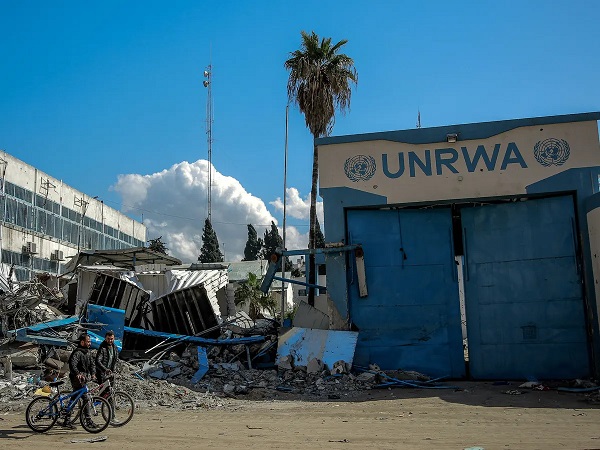
UNITED NATIONS, 27th Feb. UN agency on Palestine refugees UNRWA chief Philippe Lazzarini said on Monday that very little humanitarian aid has entered into Gaza this month, with a 50 per cent reduction compared to January.
Lazzarini said on social media X that “aid was supposed to increase not decrease” to meet the huge needs of Gaza’s two million people, who are living in desperate conditions.
He listed some of the obstacles to aid delivery, including lack of political will, the regular closing of the two crossing points into Gaza as well as insecurity due to military operations and the collapse of civil order.
Philippe Lazzarini said a ceasefire, along with “lifting the siege to allow meaningful lifesaving aid and commercial supplies, are long overdue”.
UNRWA said in its latest situation report, issued on Monday that on average, 98 aid trucks entered Gaza this month
The agency noted “significant difficulties” in bringing supplies through the Kerem Shalom and Rafah crossings due to security constraints and temporary closures.
“UNRWA has at times had to temporarily stop discharging supplies due to security concerns. Security to manage the crossing has been severely impacted due to the killing of several Palestinian policemen in Israeli airstrikes near the crossings recently.”
The agency reported that ground operations and heavy fighting continue across northern Gaza, Deir al Balah and Khan Younis.
UNRWA stated that people fleeing intense fighting in and around Khan Younis continue to head further south to overcrowded Rafah.
Some 1.5 million Palestinians are sheltering in the city, which remains a focus of international concern amid the threat of an all-out Israeli offensive.
“Increased airstrikes in Rafah, including in residential areas without prior warnings have heightened fears that they will further hamper overstretched humanitarian operations,” UNRWA said.
People have been moving out of Rafah towards Deir Al Balah and Nuseirat refugee camps in the Middle Area of Gaza, even though there are reports of further fighting and airstrikes in those locations.
It said that over 75 per cent of Gaza’s population up to 1.7 million people, have been displaced since the start of hostilities between Hamas Palestinian militant group and Israeli armed forces.
According to OCHA, UN agencies warned the deep hunger crisis in Gaza.
Over 2 million people are facing crisis or worse levels of food insecurity, according to the UN humanitarian affairs office.
Only 1 of the 3 water pipelines from Israel is operational, but at less than half capacity, 83 per cent of groundwater wells are not operating, all wastewater treatment systems are not working, and there is no access to clean water in the northern governorates.
OCHA and WHO has supported the Palestine Red Crescent Society in evacuating 72 critical cases from Nasser Hospital in Khan Younis.
The hospital still struggles to operate, with no electricity or running water, shortages of food and water supplies, the accumulation of solid waste, and the overflow of sewage.
UNFPA reported on Monday that newborns are dying in Gaza because their mothers are unable to attend prenatal or postnatal check-ups, while bombings and anxiety are leading to premature births.
The agency said there are only five beds for deliveries at the Al Helal Al Emirati maternity hospital in Rafah, one of the few remaining functioning hospitals in the enclave. Despite the lack of such basic supplies as sheets, the facility recently coped with 78 deliveries in one night alone.
The protection and safety of humanitarian workers and medical personnel continues to be a serious concern, amid widespread hostilities and attacks.
“We and our partners are doing all we can to provide food assistance across the Gaza Strip, despite major challenges, including ongoing airstrikes and heavy fighting,” OCHA said.
They reached 1.7 million people with food.
“To do more, we need safe and unimpeded routes in Gaza. We also need more trucks and fuel inside Gaza to ensure a consistent and dependable food supply,” the agency said.
Mr. Guterres noted the resignation of the Palestinian Prime Minister and Government, UN Spokesperson Stephane Dujarric said on Monday.
Prime Minister Mohammad Shtayyeh submitted the resignation in writing to Palestinian President Mahmoud Abbas earlier that day, according to media reports.
“The United Nations stands ready to continue supporting efforts aimed at overcoming the humanitarian, political, financial as well as security challenges facing the Palestinian people,” UN Spokesperson Stéphane Dujarric told journalists at the press briefing in New York.
He added that “a strengthened, empowered Palestinian Government, that can administer the whole of the occupied Palestinian Territory, is critical as part of a path to achieving the establishment of a fully independent, democratic, contiguous, sovereign and viable Palestinian State, on the basis of the 1967 lines, of which Gaza is an integral part, which remains the only way to achieve a lasting peace.”
