
UNESCO inscribed Durga Puja as element of intangible cultural heritage of humanity

By Anjali Sharma
UNITED NATIONS –UNESCO on Saturday said that the State of Bengal transformed this week into the world’s largest public art festival – an immersive blend of worship, artistic expression, and social message thanks to an annual Hindu festival known as Durga Puja.
UN agency inscribed Durga Puja as an element of Intangible Cultural Heritage of Humanity, Durga Puja isn’t just a festival, it’s a city-wide act of re imagination, one that resonates with the Bengali diaspora and others around the world.
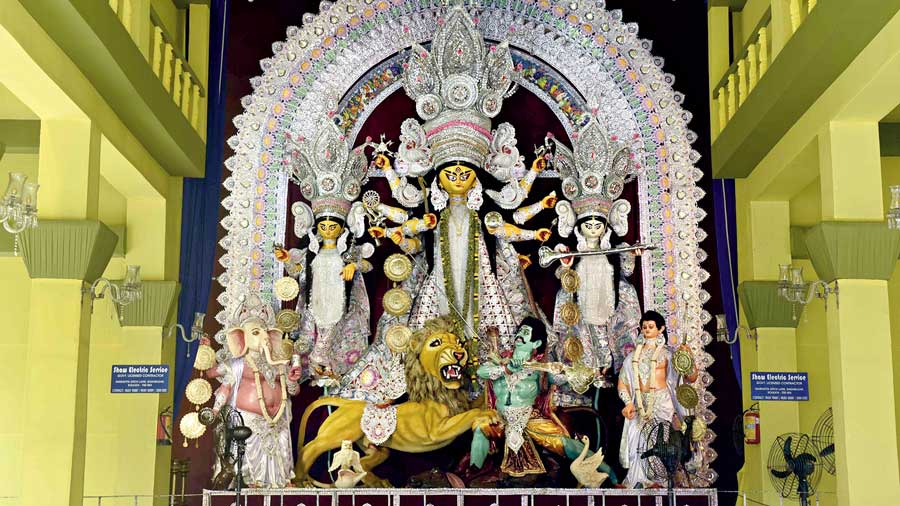
The city of Kolkata (and other parts of West Bengal) became an open-air gallery where local communities build dazzling temporary temples or pandals, artisans from Kumartoli sculpt the goddess from river clay, drummers (dhaakis) roll thunder through the streets, and millions wander from one illuminated dreamscape to the next.
The festivities drew to a close on Thursday.
UNESCO described the festivity a spectacle is actually a community in motion: local clubs raising funds, families volunteering, craftspeople collaborating, and entire local economies springing to life around food, lights, music, and art.
Families map their “pandal-hopping” routes, musicians set the rhythm, food stalls weave the city together, and the city itself becomes a stage. All kinds of divisions – class, caste, ethnicity – in this city of teeming millions, melt away.
UNESCO recognized the Durga Puja, named after the Hindu goddess Durga, in 2021 described it as “the best instance of the public performance of religion and art, and a thriving ground for collaborative artists and designers.”
Tim Curtis, UNESCO Representative in India, explained, “It embodies the Sarbojonin spirit – ‘for all people’ – that has defined community worship since 1926. From clay sculptors to drummers, designers to local organizers, the entire city contributes to one of the most vibrant cultural expressions in the world.”
This is heritage not locked away in monuments but alive in practice, passed hand-to-hand through craftsmanship, re imagined every year with new themes, and binding communities across class, faith, and language.
Durga Puja is also a creative economy powerhouse. A 2019 study estimated the festival’s industries generate $4.53 billion, 2.58 per cent of West Bengal’s GDP.
Shombi Sharp, UN Resident Coordinator in India said that this year marked his first visit to the century-old pandal spotlighting sustainable agriculture, highlighting the broader importance of the Sustainable Development Goals.
He said “Normally you see Goddess Durga defeating evil here the ‘evil’ is pesticides and unsustainable farming practices. Behind me stands a display with 280 rice varieties from eastern and northeastern India.
That’s 12-13 million visitors being exposed to powerful messages about organic agriculture, biodiversity, and sustainability.”
AI-themed pandal that fuses devotion with digital imagination. Goddess Durga appears in her traditional form – ten arms and a lion – while the backdrop bursts with circuit-board patterns, glowing data streams, and neon light.
The point is clear: faith and technology can co-exist; even in a futuristic frame.
Nupur Hajara a lab tech said “the more positively people receive AI, the better. If they take it negatively, that won’t help – right?”
IT professional, Sumitam Shom explained: “Durga Puja is our biggest, most special festival – and now AI is part of the conversation. It can do a lot of good, but there are risks too, especially fraud. Deepfakes and viral images are real concerns. Without safeguards, someone could misuse photos and deceive people. So, it’s crucial that we use these technologies responsibly.”
Another pandal with the theme of “Shabdo” (“Sound”) draws attention for its poignant focus on the vanishing sounds of nature chirping birds, rustling leaves, croaking frogs captured through immersive, sensory design.
It was a meditation on environmental loss and nostalgia, asking what it means for the sounds of nature within a city to grow quieter as habitats shrink.
Raja, a pandal visitor, put it simply: “You barely see birds anymore. My grandfather used to tell me how common they were; now they’re rare – partly, we believe, due to mobile network impacts. This pandal is our way to wake up the community, to learn how to bring the birds back and to start working on it together.”
Many other pandals echo urgent social themes. One honours acid attack survivors, not only raising awareness but celebrating their dignity and contributions. Another highlights water conservation.
The messages resonate to young visitors.
Tisa, an 18-year-old student at a pandal dedicated to water conservation, reflected that “groundwater is depleting day by day. This is the best way to spread awareness to the public.”
Durga Puja is also taking a step toward inclusivity.
UNESCO and the UN in India, working with organizations of persons with disabilities, launched comprehensive accessibility guidelines for festival organizers.
The results are visible on the ground. Ramps and barrier-free layouts ease mobility, Braille signage and sign-language interpreters expand communication, and quiet seating areas provide allow people to rest.
Shombi Sharp recalled, “We heard from a father who, for the first time in 17 years, was able to bring his daughter, a wheelchair user, to celebrate Durga Puja. That was an incredibly emotional moment.”
