

Anjali Sharma
GG News Bureau
UNITED NATIONS, 15th Feb. UN medics on Wednesday said that they feared a humanitarian disaster “beyond imagination” if a full-scale incursion by the Israeli military happens in Rafah.
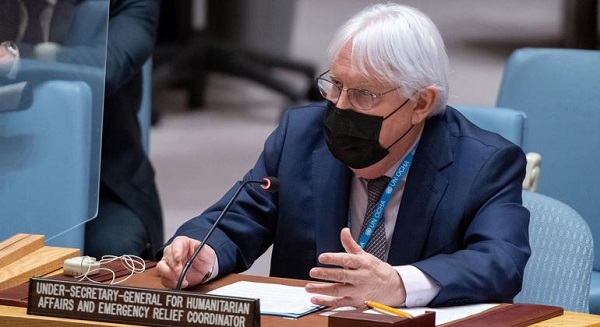
OCHA head Martin Griffiths echoed deep concerns that an assault on Rafah “could lead to a slaughter.”
WHO rejected allegations of years-long collusion with non-health partners either in or underneath Gaza’s hospitals.
Dr. Teresa Zakaria, WHO incident manager for the conflict in the Occupied Palestinian Territory said “We definitely cannot be louder in saying that no, there is no collusion between WHO and any other entities in the health sector, in the health partners, in the Ministry of Health who we are collaborating with.”
“We are not in a position to investigate any other activities taking place in hospitals or what is happening underneath hospitals. I’m sure you can also appreciate that in hospitals, where there are lots of patients, lots of displaced populations, when we focus on delivering services that is really what we are doing, we are not in a position to look beyond that service provision that we need to fulfill,” she added.
Dr. Rik Peeperkorn, WHO’s OPT representative, insisted that hospitals “should never be militarized” and that “all eyes” are on the hostilities and the feared large-scale offensive in Rafah.
“You see the fear people face,” he said. “People constantly come with questions (asking) ‘What can we do?’”
Dr. Peeperkorn said that the hospital facilities are “completely overburdened and under capacitated and close to the brink of collapse”, noted that 1.5 million Gazans are now crammed into makeshift tents and UNRWA shelters “all over the place” in Rafah.
WHO medic described the few partially functioning hospitals in Rafah as “completely overwhelmed, overflowing and undersupplied.”
They noted that since November, only 30 per cent of WHO missions to the north were facilitated by the Israeli authorities.
“Since January, the figure is much lower,” Dr. Peeperkorn said.
He added that only 45 per cent of mission requests for the south had been facilitated.
“That’s absurd, even when there is no ceasefire; humanitarian corridors should exist so that WHO, the UN and partners can do their job,” he emphasized.
“We need a complete deconfliction system to be able to do our work. UN, WHO, is ready to carry out more and more missions, to the north, to the centre, to the south,” he added.
UN emergency relief chief, Martin Griffiths said in a statement that humanitarian workers have been doing the “near-impossible to assist people in need, despite the risks”.
He warned that humanitarian workers continued to be in danger in the absence of safety guarantees and continued strikes in Rafah, the veteran aid official also urged Israel to heed repeated calls from the international community to step back from a ground invasion and its “dangerous consequences”.
Mr. Griffiths said that nowhere is safe in Gaza and people uprooted by the violence which includes rocket fire from northern Gaza towards Israel still have nowhere to go.
He highlighted a deterioration of living conditions, marked by “acute shortages of safe areas, shelters, clean water, food and medicine”.
UN aid coordinator noted that a short pause in heavy fighting in Khan Younis near Nasser and Al Amal hospitals allowed volunteers on Monday “to exit Nasser hospital and reroute sewage from a broken pipeline that was flooding the emergency room and threatens to shut it down.”
He said this was made possible after the OCHA, coordinated a local, three-hour pause, which was agreed by the Israeli military, while a permanent fix of the pipeline is still pending.
UNICEF latest data cited 162 school buildings have been directly hit in Gaza since 7 October.
The agency and Save The Children report said that “At least 26 of these buildings have been destroyed. Some 175,000 students and more than 6,500 teachers have had their schools directly hit in hostilities, represents 30 per cent of the total 563 school buildings in Gaza strip.
The report indicated that some 55 per cent of schools in Gaza will require either full reconstruction or major rehabilitation”.
