

GG News Bureau
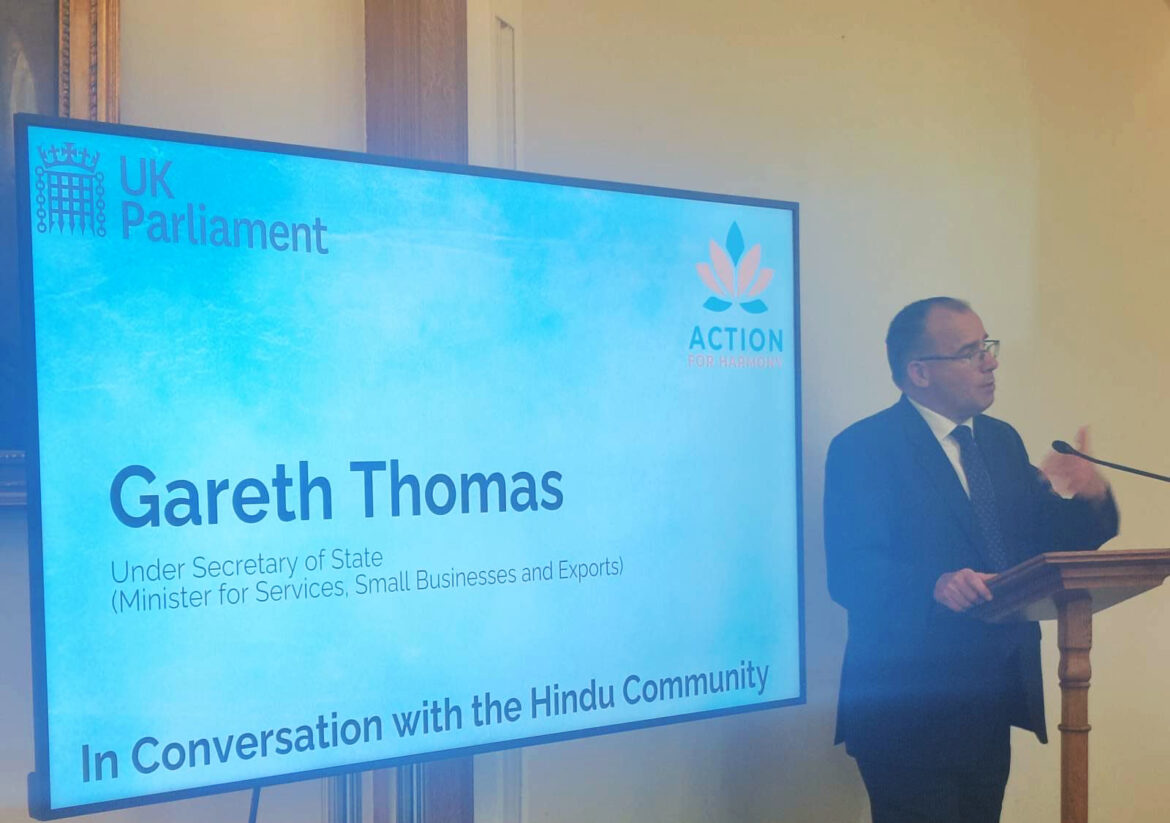
Westminster,2nd Sept: On 1st September, as the UK Parliament reconvened after its summer recess, British Hindu leaders and Members of Parliament came together for a landmark dialogue at Churchill Hall, Westminster. Hosted by Baroness Verma and organised by Action for Harmony, the first-of-its-kind event—In Conversation with the British Hindus—brought together MPs across party lines, peers, and over 60 Hindu organisations to address pressing community concerns, strengthen engagement, and set the stage for deeper collaboration between Westminster and one of Britain’s most vibrant faith communities.
Organised by Action for Harmony, an umbrella organisation dedicated to ensuring the voices of British Hindus are heard at the highest levels of government, the gathering combined the energy of a networking reception with the focus of a policy-driven conversation. Its aim was to foster long-term cooperation and understanding between policymakers and one of the UK’s most vibrant and successful faith communities.
The cross-party event saw the presence of numerous Members of Parliament, peers, and councillors. Attendees included MPs Dawn Butler (Labour, Brent East), Bob Blackman (Conservative, Harrow East), Tanmanjeet Singh Dhesi (Labour, Slough), Gagan Mohindra (Conservative, South West Hertfordshire), Seema Malhotra, Baggy Shankar, and Louie French, Susan Murray (Liberal Democrat), and Kirsty Blackman (Scottish National Party). The House of Lords was represented by Baroness Verma, Lord Jitesh Gadhia, Lord Popat, and Lord Sewell.
In total, over 40 community leaders—representing more than 65% of the British Hindu diaspora—participated, with more than 60 Hindu organisations in attendance. These included major national bodies such as BAPS Swaminarayan Sanstha, ISKCON UK, Hindu Swayamsevak Sangh UK, the Hindu Council Central England, and the Scottish Hindu Foundation. The All-Party Parliamentary Group (APPG) for British Hindus was strongly represented, reinforcing the event’s political significance and the shared intention to strengthen engagement between the community and Westminster.
Key Voices & Issues
The proceedings began with a warm welcome from Baroness Verma, who stressed the need for the community to stand together and for parliamentarians to be sensitive to its concerns. She highlighted that genuine engagement requires not only understanding cultural and religious practices but also recognising the British Hindu community’s role in the social, economic, and civic fabric of the nation.
Setting the tone for the discussions, Nitin Palan, founder of Action for Harmony, outlined the community’s agenda and presented a comprehensive list of issues requiring attention:
- Identity of British Hindus in public life and representation at policy-making levels.
⦁ Security and protection, including proper investigation and justice following the Leicester violence.
⦁ Education, with a focus on improved Hindu resources for Religious Education (RE) in schools.
⦁ Religious and cultural practices, including participation in consultations relevant to the community —for example, crematorium planning and policy.
⦁ Social concerns, ranging from generational integration to community welfare.
⦁ Stronger, sustained engagement between the community and Parliament.
Bob Blackman, Chair of the APPG for British Hindus, acknowledged the community’s considerable contributions to British society but pointed out that British Hindus remain underrepresented in the public sector. He praised the work undertaken by the APPG’s secretariat since its 2024 reorganisation, emphasising the progress made in amplifying the community’s voice within parliamentary processes.
Jack Rankin, also a member of the APPG, called for the community to present its concerns in a cohesive and coordinated manner, ensuring maximum impact when lobbying for policy changes. Lord Sewell focused on the high literacy rates and strong educational outcomes within the British Hindu community, noting that it serves as an example to other groups across the UK.
From the community side, Mr. Vinay Tanna, Trustee of ISKCON UK, highlighted the urgent need for better coordination between community leaders and parliamentarians to ensure constructive dialogue and timely responses to pressing issues. Nilesh Solanki of Action for Harmony gave an overview of the organisation’s recent work and strategic plans for the coming period, underlining the group’s commitment to both advocacy and partnership-building.
Throughout these speeches, there was a shared recognition that the British Hindu community’s concerns go beyond narrow lobbying; they encompass a desire to contribute positively to British society while ensuring that cultural and religious rights are respected and safeguarded.
Engagement and Next Steps
Following the formal presentations, the event transitioned into a vibrant networking session. Parliamentarians and community representatives engaged in candid conversations, exchanging views on both specific policy matters and broader questions of cultural understanding and social integration. The atmosphere was one of openness, with ideas freely shared on how to maintain momentum and keep the dialogue active beyond one-off events.
Attendees agreed that such direct engagement offers an invaluable opportunity to bridge any existing gaps between the community and policymakers. British Hindu leaders reiterated their readiness to engage constructively with government, not only to raise concerns but also to forge friendships and build partnerships that serve the nation’s long-term interests. MPs and peers expressed appreciation for the clarity with which the community articulated its priorities and for the unity of purpose shown across the various organisations represented.
The event also reinforced the role of platforms like Action for Harmony in ensuring that British Hindus are included in consultations and policy debates that directly affect them. By consolidating voices and aligning strategies, the community aims to secure tangible outcomes—whether in education reform, cultural accommodation, or public sector representation.
The underlying message was clear: dialogue must be ongoing, not sporadic. The In Conversation with the British Hindus gathering was not simply a ceremonial occasion; it was a statement of intent. The commitment from both sides—to keep talking, listening, and working together—suggests that the event could serve as a template for future engagement between faith communities and Parliament.
By the close of the evening, it was evident that this was more than a networking session; it was the beginning of a renewed relationship between British Hindus and the policymakers who shape the laws and policies of the land. With the momentum generated on 1st September, both community leaders and parliamentarians left with a shared understanding: building a stronger, more inclusive Britain is a collaborative effort, and this conversation is only the start.
credits: https://www.indianarrative.com/
