
Strategic Suspicion: Why Is the UK’s F-35B Still Grounded in India?
Trojan Horse ?

Poonam Sharma
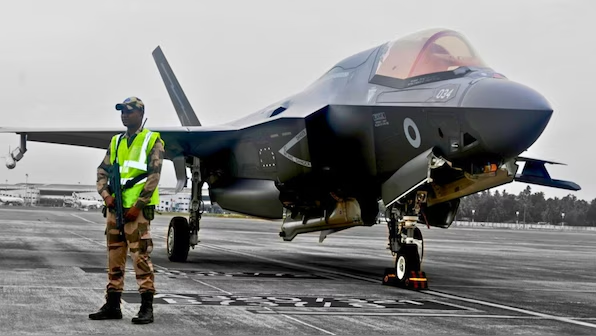
For more than ten days now, an advanced British F-35B Lightning II fighter jet—part of the world’s most expensive military aircraft programme—has been sitting grounded at Thiruvananthapuram International Airport in Kerala. The official explanation? A technical snag. But among India’s defense and cyber intelligence communities, serious questions are now being raised. Is this merely an engineering failure, or is something far more strategic and suspicious unfolding right under India’s nose?
On June 14, the American-built fifth-generation fighter jet made an emergency landing in India while returning to the HMS Prince of Wales, a British aircraft carrier that had just concluded joint maritime exercises with the Indian Navy. According to the British High Commission, the aircraft diverted due to bad weather. While it landed safely, the plane reportedly developed an engineering fault that has rendered it immobile since.
The Royal Navy initially dispatched its engineers aboard the HMS Prince of Wales to inspect the jet. However, a UK-based specialist engineering team was later called in, citing the need for “expert equipment.” The British government also declined Air India’s offer to house the fighter in their hangar, allegedly due to concerns over “protected technologies.”
But how protected are those technologies if the aircraft is sitting in an open space at a busy international airport, under constant satellite surveillance and amid routine Indian airport operations?
This isn’t an ordinary aircraft. The F-35B is a stealth fighter equipped with state-of-the-art electronic warfare systems, including ALIS (Autonomic Logistics Information System) and ODIN (Operational Data Integrated Network)—two ground-to-air integrated software systems designed to diagnose, repair, and upgrade the jet remotely. These systems are not just passive tools. They actively communicate with centralised U.S. and UK defense servers, and can even send or receive sensitive updates through encrypted channels.
Here’s where Indian intelligence experts have grown wary. The ALIS-ODIN suite allows two-way software patching—meaning the aircraft could technically be updated or remotely accessed even while on foreign soil. In fact, some experts suspect that the U.S. or UK could use this system to either monitor the Indian environment, exfiltrate local data, or insert strategic backdoors into nearby defense networks.
The possibility that this aircraft could be a Trojan Horse in stealth armor has not been dismissed by insiders. The F-35 series is designed to be constantly connected, sending data back to home servers—even mapping adversarial radar systems or signals intelligence (SIGINT) in real-time. If this aircraft were covertly gathering electromagnetic or satellite signature data from Indian defense installations during its grounded period, it could potentially compromise India’s future operations.
Moreover, the refusal to accept Indian technical assistance or even temporary hangar space raises another red flag. If this was just a mechanical failure, why not let allied engineers help? Why fly in dozens of UK-based technicians from Singapore instead? Unless the mission of this aircraft on Indian soil is far more complex than publicly acknowledged.
Adding to the intrigue, sources say the aircraft’s radar and communication systems were reportedly locked or jammed upon detection by Indian surveillance teams—suggesting it may have had unmonitored or unauthorized transmissions. Whether that included communication with foreign satellites or remote servers is a question still unanswered.
There are even reports that Indian Air Force and cybersecurity units had to shield surrounding systems once the aircraft landed. Several sensors and signal detectors were reportedly deployed to prevent any form of intrusive scans or data interception by the grounded jet.
Why hasn’t the Royal Air Force sent a C-5 or C-17 heavy-lift aircraft to simply pick it up? Why leave such an expensive and secretive asset exposed at an Indian civilian airport for more than 10 days?
And why is the Indian government maintaining such silence?
For those familiar with modern hybrid warfare—where cyber intrusion, stealth surveillance, and embedded software sabotage replace guns and bombs—this situation is too precarious to ignore.
Experts warn that if the F-35B’s software systems contain pre-installed malware or can be remotely activated, then the aircraft’s presence—even when grounded—poses a long-term technological espionage risk. It could be mapping India’s radar footprint, intercepting encrypted transmissions, or acting as a live node within an international data network.
Such concerns aren’t paranoia. It’s widely known that the U.S. and its allies have designed fighter jet software ecosystems to collect strategic intelligence during overseas missions—even if the mission was just an “emergency landing.” With autonomous connectivity and AI-based fault systems, such jets could also serve as covert relays for strategic surveillance.
There’s also the matter of India’s own response. If this aircraft is indeed a technical liability or a strategic Trojan, has India deployed its own cyber tools to inspect, isolate, or neutralize the threat? Reports suggest that Indian security personnel have maintained 24/7 surveillance and blocked any close-range access to the aircraft. But in a digital age, you don’t need to touch the aircraft to be compromised—you just need to be near its encrypted network radius.
This grounded plane is not just a story of aviation engineering failure. It is a geopolitical puzzle and potentially a digital intrusion event in the making. At nearly $200 million, the F-35B is more than a machine. It’s a flying supercomputer, a spy satellite in motion, and an enigma on Indian soil.
The British High Commission’s diplomatic tone and carefully curated statements offer no hint of concern. But for those who understand the nature of fifth-generation warfare, the jet’s unplanned stay on Indian soil could either be an unfortunate coincidence—or a calculated opportunity.
Until it leaves, India must treat this not just as a grounded aircraft, but as a potential strategic intrusion device, and handle it with all the skepticism and cybersecurity precautions that such a situation demands.
