

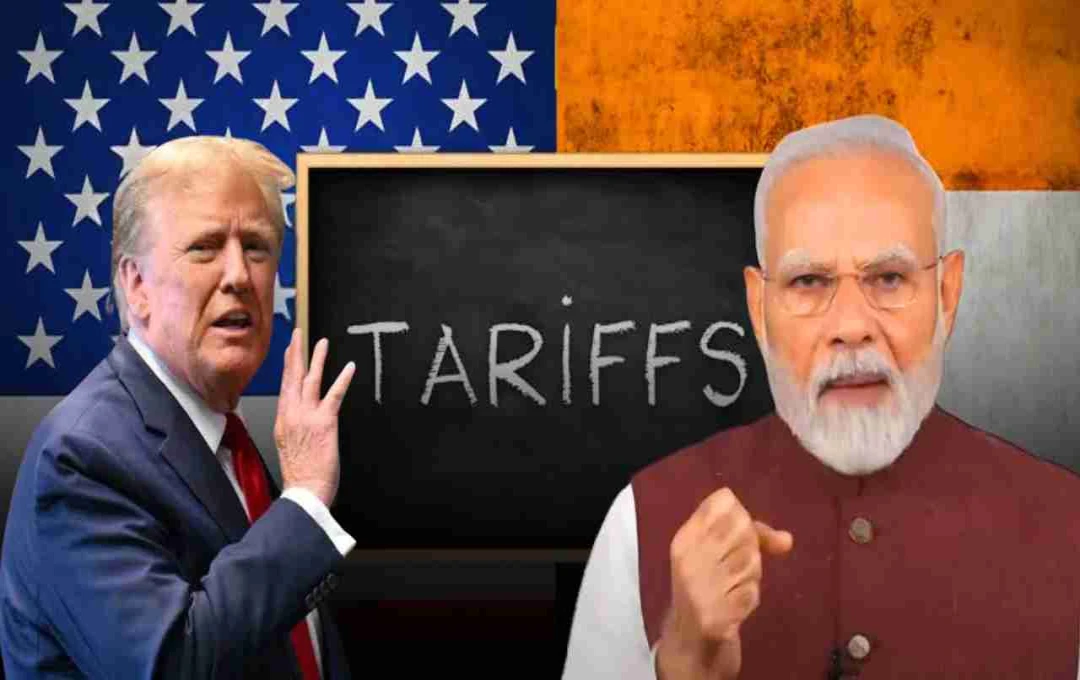

As Trump’s 25% tariff hammer slams Indian exports, Washington’s message is clear: “Submit or suffer.” But this isn’t about trade deficits or “national security.” I believe it’s a raw power play to fracture India’s strategic autonomy, and it will fail. US constitute a fundamental misreading of New Delhi’s strategic imperatives and risk dismantling two decades of carefully constructed partnership between the world’s oldest and largest democracies.
The weaponisation of trade policy is not novel. But targeting the world’s fastest-growing major economy, while exempting allies like Vietnam (20% tariffs) and the EU (15%), signals a failure of statecraft. As former U.S. Trade Representative Michael Froman noted, “Punishing partners who anchor supply chain diversification is self-sabotage.”
Let’s dissect US hypocrisy:
U.S. Trade Deficit with India: $45.7 Billion (2024), yet India faces tariffs double those imposed on Vietnam (20%) or the EU (15%).
Russian Oil “Penalty”: India saves $20 Billion/year buying discounted Russian crude. Meanwhile, the U.S. imported $1.2 Billion of Russian uranium this year alone.
Pakistan Coddling: While U.S. arms fuel Pakistan’s terror factories ($1.5B/year aid), India is punished for securing its borders.
It is clear that THE REAL TARGET IS INDIA’S RISE. Trump’s tariffs strategically attack sectors
lets have a look at these sectors categorically, The chart captures, sector by sector, the key “U.S./China Fear” and India’s “PLI (Production Linked Incentive)-Powered Counterstrike,” succinctly highlighting how India is proactively turning global economic challenges into opportunities for strategic advancement.
Hence, it is easy to conclude, this is economic warfare, and it appears Trump’s goal is to keep India a “junior partner” in the Quad.
It is important to look at the wider picture of geo-politics and geo-economics in this economical aggression by US, that also indicates THE PAKISTAN-CHINA LEVERAGE GAME. The tariff is a geopolitical trap, lets look at these points one by one:
Pakistan Card: U.S. Threat: “Drop Russian oil or we arm Islamabad further.” Though reality is, FATF blacklists Pakistan for terror financing, yet U.S. F-16s patrol its skies.
China Pressure: U.S. Whisper, “Be our China containment pawn.”, but India’s reply: our drones (PLI-powered) now guard Ladakh against PLA, using homegrown tech.
“The U.S. wants India to fight its wars but surrender its economy.”
While Trump tweets tariffs, India builds sovereignty, ₹1.97 Lakh Crore invested across 14 PLI sectors, million jobs created by 2026, $520B PLI-Driven Exports projected by 2030 (CRISIL).
Now, India can turn U.S. tariffs into massive opportunity, like in 2018 steel tariffs birthed India’s tank-armour-grade steel industry, 2025 tariffs will accelerate semiconductor self-reliance.
Some paths emerge from the current situation, and it is also clear that India’s stance is non-negotiable:
No Retreat on Russia: Energy security saved India $20B/year, equivalent to 3 Mumbai Coastal Roads.
No Surrender on Tariffs: India’s 39% avg. agri tariff protects 25 crore farmers, U.S. farm subsidies are 10x India’s budget.
No Compromise on Sovereignty: From Kashmir to QUAD, India decides – not Washington.
India position should be clear on this as Dhruva Kumar say, “India will talk as equals, not targets.”
The tariff thus becomes a lever: Drop Russian energy or face empowered adversaries. India’s response, accelerating drone manufacturing (200+ PLI-supported startups) and the India-Middle East-Europe Corridor (IMEC), signals it will not trade strategic autonomy for market access. Trump’s tariffs expose a decaying superpower clinging to 20th-century tools.
There are great opportunities ahead for India to accelerate PLI, Make India, the alternative supply chain to China, deepen Global South Ties, fasten-track IMEC corridor (India-Europe via UAE), and call U.S. Bluff, Quad needs India more than India needs Quad.
This tariff isn’t an end, it’s the birth cry of an Atmanirbhar Superpower, as Indian drones patrol borders, factories build iPhones, and farmers feed the nation.
Prof Dhruva Kumar says, “They tried to clip India’s wings, now they’re building jet engines.”
The U.S. faces a choice, treat India as an equal in reshaping Asian trade architecture or push it toward autonomous blocs.
