

By Anjali Sharma
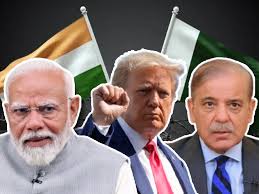
WASHINGTON – US President Donald Trump on Wednesday after a lunch hosted for a visiting Pakistan Army Chief Asim Munir said that he wanted to thank him and Prime Minister Narendra Modi for ending the conflict.
Trump shifted from his claims of having “stopped” the war between India and Pakistan, and gave credit to “two very smart people, (who) decided not to keep going with that war that could have been a nuclear” one without claiming a mediatory role for himself.
“I’m so happy there was a deal that two smart people, plus people on their staff too” worked out an end to the war, Trump said without repeating the claims he had made earlier of “stopping the war” and crediting the two sides for the truce.
“Two smart people, two very smart people, decided not to keep going with that war that could have been a nuclear” one, he said.
“Well, those are two nuclear powers, big ones, big, big nuclear powers, and they decided that” to not continue with the fighting.
He was speaking to reporters at the Oval Office, where Trump was meeting with members of the Juventus Football Club team.
He told reporters that “I stopped the war between Pakistan and India.”
Trump was watching a 30-metre-tall flagpole being erected on the White House lawn 10 a.m., he said repeatedly, “I got it stopped.”
And he lamented that he did not get credit for his role in ending the war.
India has maintained that there was no US mediation as Trump has claimed.
India Prime Minister Narendra Modi bluntly told the US President so, pointed out that Pakistan had directly initiated the talks to end the fighting, according to External Affairs Ministry readout of the call with Trump.
According to the External Affairs ministry “Due to India’s firm action, Pakistan was compelled to request a cessation of military operations,” PM Modi told Trump.
He also told him that India would never agree to any third party mediation in the matter with Pakistan, the readout said.
After his lunch with Munir on Wednesday, Trump said, “Reason I had him here, I wanted to thank him for not going into the war, just ending the war” between India and Pakistan.
“This man was extremely influential in stopping it from the Pakistan side, PM Modi from the India side, and others.”
In a ham-handed attempt at being evenhanded, Trump added, “And I want to thank, as you know, Prime Minister Narendra Modi,” with whom he said he had spoken a little while ago.
“And we’re working a trade deal with India,” he said.
Trump said that with Munir, he discussed Iran about which he knew “better than most”.
Pakistan’s Embassy in Washington represents Iran’s interests in the US which does not have diplomatic relations with it (Switzerland handles US diplomatic relations in Tehran).
Trump has served an opaque ultimatum to Iran to “surrender” and left the modalities and consequences open-ended.
He tried to play down the differences between the US, which strongly supports Israel, and Pakistan, a vehement supporter of Iran that has condemned Israel’s attacks on Tehran’s nuclear facilities.
“They (Pakistan) are not happy about anything,” Trump said.
“It’s not that they’re bad with Israel. They know about Iran, but they probably, maybe they know Iran better.”
In having Munir over, Trump recognizes the supremacy of the military in Pakistan, which keeps a show of democracy with a civilian government beholden to the Army.
During Operation Sindoor, Washington initially talked to Pakistan Prime Minister Shehbaz Sharif but switched to dealing with Munir when it realized where the power lay.
