
Trump, Sharif, and Munir’s Rare Earths Diplomacy at the White House
“Donald Trump met Pakistani PM Shehbaz Sharif and Army Chief Asim Munir at the White House, eyeing Pakistan’s rare earths and mining potential. What does this mean for bilateral ties?”

Paromita Das
New Delhi, 1st October: Diplomatic meetings often exchange symbolic presents — books, artworks, or cultural artifacts. But when Pakistani Prime Minister Shehbaz Sharif and Army Chief General Asim Munir met U.S. President Donald Trump at the White House, the gift they presented was anything but ordinary: a wooden box filled with rare earth minerals. The gesture, both symbolic and strategic, revealed the heart of a new chapter in Pakistan-U.S. relations — one anchored not only in diplomacy but in the critical minerals that power the global economy.
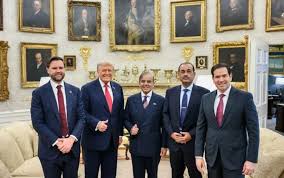
Standing in the Oval Office, General Munir pointed toward the minerals, while Trump, flanked by Vice President JD Vance and Secretary of State Marco Rubio, looked on. The meeting lasted over an hour and a half, marking the first White House visit by a Pakistani premier in six years. For Washington, it was more than a photo-op; it was an introduction to Pakistan’s vast untapped mineral wealth at a time when rare earths are increasingly seen as the lifeblood of future industries.
From Tenuous Ties to Strategic Talks
For much of the past decade, Pakistan-U.S. relations have been rocky, weighed down by disagreements over security and regional politics. But this meeting symbolized a noticeable thaw in bilateral ties, aided by July’s tariff deal that imposed a 19% duty on Pakistani imports while promising U.S. investment in Pakistan’s oil reserves.
Shehbaz Sharif, in his statement, described Trump as a “man of peace” for his global conflict resolution efforts. He also extended invitations for U.S. firms to invest in Pakistan’s agriculture, IT, mines and minerals, and energy sectors. His message was clear: Pakistan seeks a broader, investment-driven partnership, moving beyond transactional aid toward economic collaboration.
U.S. Eyes Pakistan’s Mineral Wealth
The symbolic mineral gift was not a one-off gesture. Just weeks earlier, Pakistan’s Frontier Works Organisation (FWO) — the country’s largest miner of critical minerals — had signed a memorandum of understanding with Missouri-based U.S. Strategic Metals. The deal included plans to build a poly-metallic refinery in Pakistan, a step that could integrate Pakistan into the global critical minerals supply chain.
U.S. Strategic Metals specializes in producing and recycling essential minerals — from cobalt and lithium to rare earths — all of which are crucial for advanced manufacturing, defense systems, and clean energy technologies. For Washington, which is actively seeking to reduce dependence on China for rare earths, Pakistan offers a potential new frontier.
Adding to the momentum, Pakistan’s National Logistics Corp inked a second agreement with Mota-Engil Group, a Portuguese engineering and construction giant. Talks with both delegations focused on copper, gold, rare earths, and other resources, with commitments to develop value-added facilities, boost processing capacity, and launch large-scale mining projects.
According to Sharif’s office, the partnerships will begin immediately, starting with the export of minerals like antimony, copper, gold, tungsten, and rare earth elements. The stakes are enormous: Sharif has claimed that Pakistan’s mineral reserves are worth trillions of dollars, and tapping this wealth could help the nation escape its chronic financial crises and reliance on foreign loans.
The Balochistan Factor
Yet, beneath the optimism lies a stark reality. Most of Pakistan’s mineral wealth lies in Balochistan, a southwestern province plagued by separatist insurgency. For decades, local groups have resisted both Pakistani and foreign extraction projects, arguing that the resources are exploited without benefitting local communities.
Any large-scale U.S. or international investment in Balochistan will need to navigate this complex political and security terrain. Without addressing grievances of the local population, foreign-backed mining ventures could face sabotage, protests, or political backlash, jeopardizing both investment and diplomatic goodwill.
An Opportunity and a Test
The White House meeting symbolizes opportunity, but it also sets up a test for both nations. For Pakistan, this is a chance to leverage its mineral wealth responsibly — ensuring transparency, fair revenue-sharing, and sustainable practices that bring real development to local populations, especially in resource-rich but marginalized regions like Balochistan.
For the U.S., the challenge lies in balancing its hunger for critical minerals with its stated commitment to responsible sourcing and fair trade practices. If Washington seeks to reduce dependence on China, Pakistan could indeed become a valuable partner. But this partnership must extend beyond mineral extraction to include technology transfer, skill development, and joint ventures that strengthen Pakistan’s economy.
A New Chapter in Pakistan-U.S. Relations
The image of Sharif and Munir presenting rare earths to Trump is more than just a diplomatic snapshot; it is a symbol of shifting geopolitics. With rare earths and critical minerals increasingly shaping the contours of global power, Pakistan’s reserves are drawing fresh attention.
As Pakistan eyes investment to ease its economic troubles and the U.S. searches for reliable alternatives to China’s mineral dominance, the two nations find themselves aligned in ways not seen for years.
But the path forward is fraught with challenges: security risks in Balochistan, the need for fair revenue sharing, and the balancing act of political loyalty versus economic opportunity. If managed wisely, however, this could mark the beginning of a deeper, more sustainable partnership — one rooted not just in short-term deals, but in a shared stake in the industries of the future.
