

Poonam Sharma
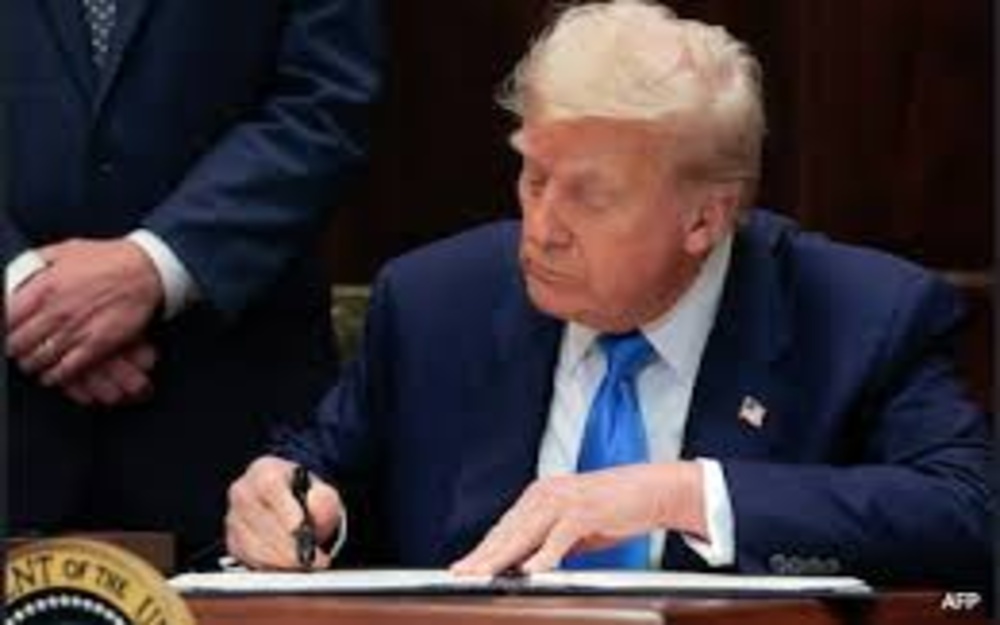
When US President Donald Trump announced that he would raise the worldwide tariff rate from 10% to 15%, it was not merely a trade policy tweak. It was a political counterpunch — delivered just a day after the Supreme Court of the United States ruled 6–3 that his earlier sweeping tariffs were illegal and an overreach of presidential authority.
Trump’s response was swift and defiant. Posting on Truth Social, he declared the new 15% rate would be “fully allowed, and legally tested,” framing it as both compliant and confrontational. The subtext was unmistakable: if the Court shuts one door, he will find another.
For India, the announcement injects fresh uncertainty into an already volatile trade landscape.
A Courtroom Blow — And a Political Rebound
The Supreme Court verdict, authored by Chief Justice John Roberts, held that Trump exceeded his authority when he imposed sweeping global tariffs under emergency powers. It was a direct challenge to one of the pillars of Trump’s second-term economic strategy.
Rather than retreat, Trump doubled down.
He praised Justices Brett Kavanaugh, Clarence Thomas and Samuel Alito in a social media post, while calling the opposing justices “fools and lapdogs.” The rhetoric was vintage Trump — combative, theatrical and aimed as much at his political base as at global markets.
But beneath the bravado lies a serious question: Is the United States now shaping trade policy around political defiance rather than economic calibration?
Where India Stands
For India, led by Prime Minister Narendra Modi, the tariff recalibration arrives at a delicate moment.
Earlier this year, under a February 20 proclamation, Washington had imposed a temporary 10% ad valorem import surcharge for 150 days beginning February 24. This replaced the earlier 25% reciprocal tariff on Indian goods. The reduction followed negotiations on an interim trade framework between New Delhi and Washington — an attempt to steady bilateral ties.
The 10% levy applied over and above existing Most Favoured Nation (MFN) duties. Now, Trump’s declaration of a 15% global tariff raises the possibility that Indian exports could face an even steeper burden.
Though detailed implementation guidelines are still awaited, the signal is clear: tariffs are once again a central tool of American economic diplomacy.And India is not exempt.
Agriculture and Industry: Who Feels the Pinch?
Indian agricultural exports could be among the most vulnerable. While certain items are exempt, others may face higher duties, making Indian goods less competitive in the US market. For farmers and exporters already navigating price pressures and logistical costs, even a 5% jump can shrink margins significantly.
Manufacturing sectors could also feel the squeeze. In August, the US had imposed a reciprocal tariff of 25% on India. Later, an additional 25% was imposed in response to India’s purchase of Russian crude oil, pushing the total to 50% at one stage.
These moves were not just economic decisions — they were geopolitical messaging.
With Trump’s new 15% global tariff layered on top of existing frameworks, exporters in textiles, engineering goods, auto components and specialty chemicals are watching closely. The unpredictability itself may deter investment decisions.
“We Did a Flip”
At a news conference following the Supreme Court verdict, Trump insisted that ongoing trade arrangements with India remain intact.
“Nothing changes,” he said. “They’ll be paying tariffs, and we will not be paying tariffs… We did a little flip.”
The remark captures Trump’s worldview succinctly: trade is a scoreboard. If the US pays less and collects more, it is winning.
But global trade is rarely that simple.
India and the US are working to finalise the first phase of a bilateral trade agreement, with talks scheduled in Washington. Both sides have invested diplomatic capital into portraying the relationship as strategic, stable and future-oriented.
Yet repeated tariff shocks complicate that narrative.
The Political Optics
Trump’s tariff escalation comes at a politically sensitive moment. The Supreme Court ruling was a visible institutional check on executive power. By announcing a higher tariff almost immediately, Trump reframed the story — from legal defeat to economic assertiveness.
It is a classic Trump maneuver: shift the battlefield.
However, critics argue that such rapid policy pivots undermine global confidence. International trade agreements depend on predictability. When tariff rates fluctuate in response to courtroom outcomes and political messaging, partners may question the durability of commitments.
For India, which balances relations between Washington and Moscow while safeguarding domestic economic priorities, this volatility presents strategic challenges.
Beyond Numbers: The Strategic Equation
India-US trade is not just about tariffs. It is about technology cooperation, supply chain realignment, defence partnerships and geopolitical balancing in the Indo-Pacific.Yet tariffs have a way of overshadowing the bigger picture.
If Indian exporters face higher duties, pressure will mount domestically for reciprocal responses or stronger negotiation stances. At the same time, India may weigh whether deeper concessions in a bilateral trade agreement could secure greater tariff stability.
The Commerce Ministry has said it is studying the implications of both the Supreme Court ruling and Trump’s new announcement. That cautious phrasing reflects the moment: nothing is settled yet.
A Gamble with Global Consequences
Trump’s approach has always treated tariffs as leverage — tools to extract concessions and signal strength. His supporters argue that this muscular strategy forces partners to the table. Critics counter that it risks tit-for-tat escalation and damages long-term credibility.
The 15% global tariff is, in many ways, a gamble. It tests not only legal boundaries but economic resilience.
For India, the challenge is to navigate this shifting terrain without sacrificing growth or strategic autonomy. For the United States, the question is whether tariff escalation delivers durable gains — or merely temporary political victories.
As the dust settles from the Supreme Court’s rebuke and Trump’s counterstrike, one thing is certain: the India-US trade equation has entered another unpredictable chapter. And in this chapter, economics and politics are inseparable.
