
Top relief official warns millions left homeless in Pakistan floods, needs are huge

By Anjali Sharma
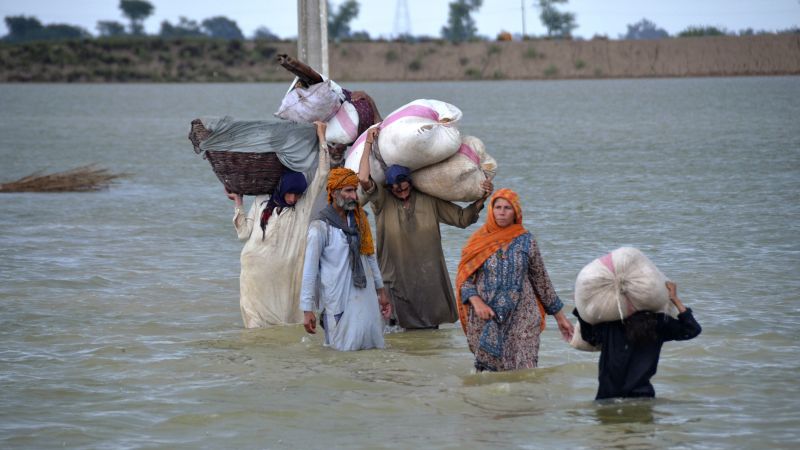
UNITED NATIONS – Head of the UN aid coordination office in Pakistan Carlos Geha on Tuesday has warned that “the needs are huge” as massive floods across Punjab, Khyber Pakhtunkhwa and Gilgit-Baltistan continue to leave millions homeless, destroying vital crops and pushing fragile communities to the brink.
OCHA said that over 6 million people have been affected by heavy monsoon rains began in late June, with 1,000 lives lost – 250 of them children.
Over 2.5 million people have been displaced, many sheltering in Government-run camps or with host families who are already stretched to their limit.
Geha said that “From the field, we are only seeing the tip of the iceberg,”.
He added that many displaced families have yet to return home and may find their houses and livelihoods wiped out when water levels finally recede.
OCHA reported the monsoon deluge, riverine flooding has inundated large parts of Punjab province Pakistan’s food basket where over 4.7 million people have been impacted after India released water from upstream dams, leading to rivers bursting their banks.
Indian authorities had informed Pakistan ahead of the release, which was triggered by massive rains that caused rivers in northern India to overflow.
UN relief agency said that in Khyber Pakhtunkhwa, 1.6 million people have been affected, while flash floods triggered by glacial lake overflows have devastated parts of Gilgit-Baltistan, cutting off entire valleys. Sindh province remains on high alert for potential “super floods.”
Geha said “The Government has done a tremendous job evacuating 2.5 million people, something we did not see in 2022.”
He recalled the devastating floods that killed over 1,700 people and caused an estimated $40 billion in economic losses.
“But when water levels reach 25 feet, swallowing whole villages, there is little anyone can do.”
The National Disaster Management Authority reported that over 8,400 houses, 239 bridges and 700 KMS of roads have been damaged or destroyed.
Over 2.2 million hectares of cropland much of it in Punjab lie under water, wiping out harvests and pushing food prices higher. Wheat flour prices alone rose 25 percent in the first week of September.
“These are farming families who feed the nation,” Mr. Geha said. “Now their land is submerged, their animals are gone, and they are left with nothing.”
UN and its partners are struggling to match the scale of the disaster.
OCHA has released $5 million from the UN’s Central Emergency Response Fund with an additional $1.5 million channeled to local NGOs.
UNICEF, WFP and other agencies are trucking safe water, providing health and nutrition supplies, and setting up temporary learning centers for children.
The aid workers warned that this is far from enough. Many communities remain cut off by collapsed bridges and submerged roads, with food and medicines reaching them only by boat or helicopter.
UN agencies said that waterborne diseases such as malaria and dengue are already on the rise, with fears of cholera outbreaks in the weeks ahead.
“The immediate needs are food, healthcare, shelter, water and sanitation,” said Mr. Geha.
“But the next phase will be even more difficult – helping millions of people stand back on their feet after losing everything.”
Pakistan has endured repeated climate disasters in recent years, from the record-breaking 2022 floods to heat waves and drought. Humanitarians warn that each shock pushes already vulnerable families further into poverty.
“This is not Pakistan’s fault it is one of the most nation exposed to climate change,” Mr. Geha emphasized.
He concluded “The international community must stand with Pakistan not just in this emergency, but in helping to rebuild resilience and restore livelihoods for the long term.”
