
Top official says ‘diplomatic momentum’ at risk as Russia strikes intensify

By Anjali Sharma
UNITED NATIONS – UN Assistant Secretary-General for Europe, Central Asia and the Americas, Miroslav Jenča on Friday briefed the members of the UN Security Council in an emergency session as the attacks by Russia against civilians in Ukraine intensify and the any hopes of a lasting peace deal rapidly fading.
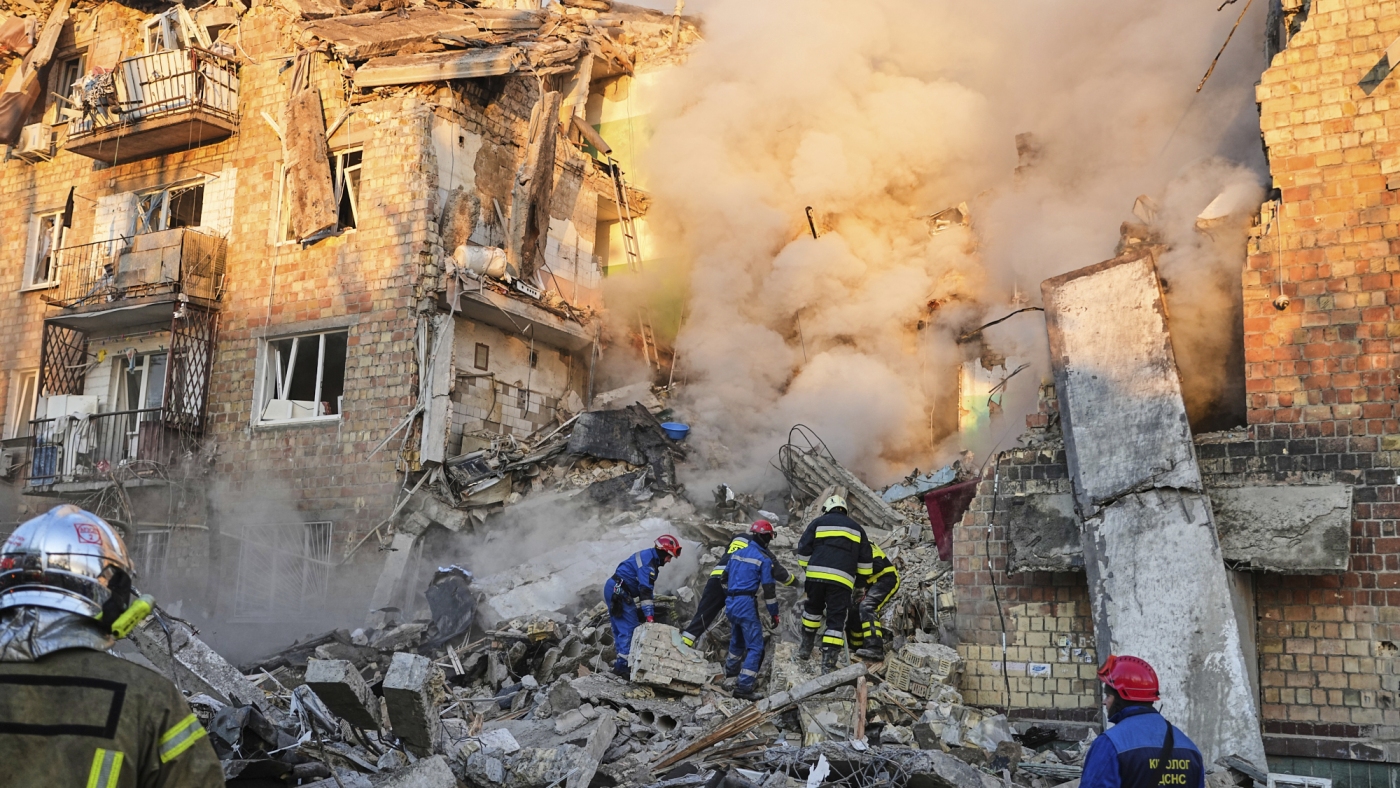
Miroslav Jenča, spoke a day after the latest wave of Russian airstrikes across the country, with at least 23 people killed in the capital, Kyiv.
“The mounting death toll and devastation caused by the intensifying fighting over the summer, run counter to the significant efforts over the past few months to give diplomacy a chance,” he said.
According to Ukrainian officials, Russia launched 598 drones and 31 missiles across Ukraine overnight between 27 and 28 August.
The authorities stated that 4 children aged between 2 and 17 were among those killed in Kyiv and 64 people were injured.
Several buildings were damaged in 33 locations across all 10 districts of the city.
“Most of the fatalities occurred in the Darnytskyi district of Kyiv, where a missile reportedly struck a five-story residential building, demolishing it from the first to the fifth floor,” he said.
He noted that civilian casualties also were reported in five other regions – Chernihiv, Kharkiv, Zaporizhzhia, Donetsk and Kherson and a train depot in Vinnytsia region was reportedly hit.
Mr. Jenča said these strikes “are only the latest in the brutal escalation of country-wide aerial attacks.”
He said “set a new, tragic record for monthly casualties”, with 286 killed and 1,388 injured – the highest number since May 2022.
The impact of the conflict has been felt by civilians in Russia.
Local authorities have reported casualties there, including in the border regions of Belgorod, Kursk and Bryansk.
Russian officials also reported that a fire broke out after a Ukrainian drone was shot down near the Kursk Nuclear Power Plant.
UN is unable to verify these reports, the growing impact of the conflict on civilians in Russia is of concern, he said.
Jenca reiterated UN condemnation of attacks against civilians and civilian infrastructure.
“We are also concerned about the impact of the expanding and escalating fighting on the humanitarian situation in Ukraine as we are entering the fourth winter of the full-scale war,” he added
He underlined the UN’s full commitment to supporting civilians, adding that targeted winter support preparations are underway for 1.7 million people, though more donor funding is urgently needed.
Mr. Jenca said that on the diplomatic front the Secretary-General has welcomed recent efforts led by the US President. This includes separate meetings this month between Donald Trump and Vladimir Putin, in Alaska, and another between the Presidents of the US and Ukraine and European leaders in Washington.
UN has welcomed earlier rounds of direct talks between senior Ukrainian and Russian officials held in Istanbul between May and July, and commended prisoner exchanges that have continued to take place as a result.
He said “However, as large-scale attacks against civilians persist and civilian casualties rise, the current diplomatic momentum is at risk of rapidly fading if the focus on the need to end the violence and engage in genuine peace talks is not maintained.”
“We therefore urge all concerned to urgently de-escalate the situation and to redouble efforts to create conditions for inclusive diplomatic efforts towards a cessation of hostilities and a just peace.”
Mr. Jenča concluded his remarks by renewing the Secretary-General’s appeal for a full, immediate and unconditional ceasefire.
Guyanese Ambassador to the UN calls the global community to build support confidence-Building Measures to bring parties closer to ceasefire.
Guyana envoy said “We commend the recent prisoner exchanges and the talks in Istanbul and hope that these can continue and will be matched by initiatives in other areas,”.
She noted “violation after violation of international law with numerous attacks against critical and civilian infrastructure, the abduction of children, the denial of humanitarian access and the killing of humanitarian personnel”, she demanded full adherence to international law, including international humanitarian law and international human rights law.
“We also underscore the need to prioritize the protection of children,” she said.
Representative of South Korea said “My Government is concerned about ongoing Russian-North Korean military cooperation that is exacerbating the severity and scope of this war and its bleak ramifications, not only for Ukrainian civilians but also for peace and security in both the European and Asian regions.”
He said all parties “must take swift and concrete steps towards an end of war agreement”, in line with the Security Council resolution 2774 (2025), to ensure lasting peace between the Russian Federation and Ukraine.
South Korea reaffirms its guiding commitment to “ending this war and standing with the Ukrainian people as they rebuild their country and chart a brighter, more secure future” he said.
British Ambassador to the UN Barbara Wood said “We are appalled by the suffering that Russia has inflicted on civilians, including a guard at the British Council office who was among those injured and hospitalized. We are equally outraged by the damage these strikes caused to the neighboring EU Delegation building.”
“But if Russia thinks it can intimidate us – it is wrong. It will only harden UK and Western resolve to support Ukraine,” she said.
They are the actions of a government that is “hell-bent on destroying Ukraine” and sabotaging international peace efforts, she added.
She stressed “This bloodshed must end. And there remains only one solution: Putin must, as Zelenskyy has done repeatedly, agree to a full and unconditional ceasefire – immediately.”
Slovenia’s representative said that “These are not military targets. Aerial attacks in massive waves on densely populated urban areas with explosive weaponry have no justification.”
She reiterated condemnation of intensified attacks “while peace in Ukraine is being discussed”, she said they represent a blatant violation of international humanitarian law and “must not go unpunished”.
“2025 is rapidly becoming the deadliest year of this war,” she said.
She stressed “We need to refocus our discussions on stopping the bloodshed. We need an immediate and unconditional ceasefire.”
Russian deputy ambassador to the UN said that such attacks targeted Ukraine’s military-industrial complex, including arms depots, airfields, and UAV factories, not civilians.
He said that civilian deaths resulted from Ukrainian air defences placed in residential areas.
Russian envoy stressed Kyiv is “shamelessly and criminally” using Ukrainians as human shields and such tragedies are “intentionally whipped up to blame the deaths of Ukrainian civilians on Russia,” to secure more Western arms and sanctions.
Moscow accused the West of hypocrisy, ignoring Ukrainian drone and missile attacks on Russian cities that, it said, killed and wounded scores of civilians in late August.
The West’s selective blindness undermines its credibility, while reiterating demands for security guarantees that address Russia’s concerns.
He also accused Kyiv of “skyrocketing human rights violations”.
He said that Russian Federation remains open to negotiations, but only on terms that exclude North Atlantic Treaty Organization expansion and recognize Russian interests, accusing Kyiv of blocking compromise and pursuing “PR over diplomacy”.
Ukrainian envoy to the UN Yulia Svyrydenko told the council members that the assault of “629 airborne weapons” killed 25 people including four children and wounded 63 more, including a girl “not yet three years old, born under Russian shelling in October 2022, and killed by Russian shelling in August 2025”.
She said that strikes also damaged the European Union Delegation and British Council premises – diplomatic sites, not military targets – “deliberate acts of terror.”
Ms. Yulia Svyrydenko demanded stronger air defence and long-range capabilities to protect civilians, alongside tougher sanctions to deprive Moscow of funds for its war.
She cited the Russian Federation’s systematic abduction of children, forced adoption and identity erasure.
“Russia kills children from a distance with missiles and drones, and those who fall under its control it steals”.
She urged the Council to act, insisting that peace requires both bolstering its defence and intensifying pressure on Moscow until it shows genuine willingness to negotiate, stressing: “Aggression must be punished, never rewarded”.
Polish delegate to the UN stated “If Russia hopes to break the spirit of resistance and solidarity, it is gravely mistaken. Recent strikes only strengthen our determination to support Ukraine.”
He called on allies to impose additional restrictions as the European Union prepares its nineteenth package of sanction
“We all know the truth: Russia is facing growing economic and social pressure. And because of this, it wants to force its maximalist goals on Ukraine — and it wants to do it fast,” he said.
“But let me be clear: Russia’s blatant disregard for peace cannot, and will not, go unanswered,” he said, “because only through our unity and resolve can we force Russia to abandon its terror tactics and engage in genuine negotiations”.
Estonia’s representative spoke on behalf of Latvia and Lithuania said that “Perpetrators must face justice, including through a Special Tribunal for the Crime of Aggression. There can be no lasting peace without accountability”.
She noted that on 24 August marked Ukraine’s Independence Day,.
Estonia envoy said it is “profoundly disturbing and utterly deplorable that in the 21st century, a European country a full member of the United Nations must celebrate its independence while almost one fifth of its territory remains brutally occupied by a permanent member of the Security Council.”
“The Baltic States stand with Ukraine for as long as it takes,” she said.
She added “Defending Ukraine means defending the sovereign equality of all the Member states, large and small – the core principle on which the United Nations was founded.”
