
The Voter List Battle: Why Mamata Banerjee Fears the SIR Drive
“As West Bengal braces for the Special Intensive Revision (SIR) of electoral rolls, Mamata Banerjee’s dramatic protest march reveals more than dissent—it exposes the deeper discomfort of a regime built on a fragile voter narrative.”

Paromita Das
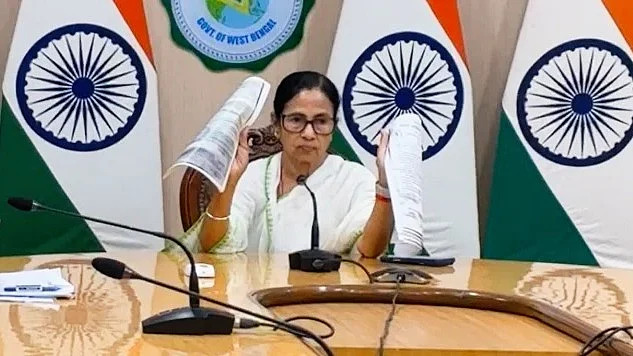
New Delhi, 3rd November: For a Chief Minister often praised for timing her political theatre to perfection, Mamata Banerjee’s latest street protest comes at a telling moment. On November 4, she and her nephew, Abhishek Banerjee, are set to lead a high-profile rally in Kolkata—framed as a resistance against the Election Commission’s Special Intensive Revision (SIR) of electoral rolls.
The march will commence from the B. R. Ambedkar statue on Red Road and conclude at Jorasanko Thakurbari, the residence of Rabindranath Tagore—an attempt to lend symbolic moral weight to a political gripe. But make no mistake: this is not just about bureaucratic procedure. It’s about power.
The SIR exercise, a routine, law-backed revision meant to update and purify voter lists, has suddenly become the newest battleground of Bengal’s politics. Mamata Banerjee’s narrative of protest is less about procedural oversight and more about political survival.
The Bureaucratic Shuffle and the Timing Tangle

What adds intrigue to Banerjee’s agitation is the timing. Just days before the SIR began, her government executed a massive bureaucratic reshuffle—transferring 4 IAS officers and 457 WBCS officials, including 14 district magistrates. Several senior officers with direct access to voter data were moved, ostensibly for administrative efficiency.
Yet this move coincided with the Election Commission’s directive over the suspension of four state officials caught red-handed in voter registration fraud earlier this year. These officers, during random checks, were found facilitating forged voter applications under Form 6—an act the Commission treated as serious electoral malpractice. The overlap of these developments cannot be ignored. It paints a picture where the state administration appears more focused on controlling outcomes than ensuring transparency.
For Mamata, this bureaucratic shuffle is both defense and distraction: a shield against possible exposure, and a smokescreen to deflect growing suspicion about her government’s voter management legacy.
Fear-Mongering Disguised as Democratic Dissent

Banerjee’s campaign against SIR has echoed her earlier theatrics against other democratic institutions. During the Bihar SIR, opposition parties, including the TMC, tried to stall the exercise through slogans of “voter disenfranchisement” and “vote theft.” When the Supreme Court refused to stay the process—reiterating its legal backing—the political noise collapsed into silence.
But in Bengal, Mamata’s opposition is far shriller. Her statements warning of riots or social unrest if the roll revision proceeds reveal something deeper—a preemptive attempt to frame administrative cleansing as political persecution. The move reeks of fear-mongering, calibrated to create chaos and rally sympathy before the numbers start speaking for themselves.
If SIR is as neutral as designed—a system to detect duplicate or illegal entries—then one must ask: what exactly is the Chief Minister afraid of?
The Voter Math and the Uncomfortable Truth

Behind Banerjee’s rhetoric lies a statistic that could reshape Bengal’s politics. A 2024 demographic study titled “Electoral Roll Inflation in West Bengal: A Demographic Reconstruction of Legitimate Voter Counts” estimated that nearly 13.69 percent of the state’s voter list could be inflated. That translates to roughly one crore excess names—an astronomical figure that raises uncomfortable questions about the authenticity of the voter base.
Over the last three years, 2,688 Bangladeshi nationals were apprehended and deported—numbers that signal only a fraction of a larger, unchecked flow. The TMC government has long been accused of using illegal immigration to engineer vote banks, particularly in border districts like North 24 Parganas, Malda, and Murshidabad.
SIR, by design, threatens to unmask this silent arithmetic. A clean voter list could deflate inflated numbers that have long tilted Bengal’s poll equations. In that sense, Mamata’s protest isn’t defiance—it’s damage control.
The Real Agenda: Control the Narrative, Protect the Numbers

At the heart of Mamata Banerjee’s street protest is narrative management. By painting the SIR as a political vendetta, she shifts attention from the potential exposure of her government’s alleged complicity in voter manipulation. For the TMC, the fear is not of auditing but of accounting.
The bureaucratic reshuffle before the SIR, the exaggerated rhetoric, and the attempt to mobilize mass protest—all fit into a single pattern: control the levers of perception before the process controls the outcome. The optics of defiance help Banerjee rebrand her administrative vulnerability as democratic heroism.
Yet this strategy also betrays weakness. For a leader once seen as Bengal’s iron matriarch, descending into preemptive protests against a legal, impartial exercise suggests eroding confidence within her own fortress.
Politics of Paranoia or Preservation of Power?

Mamata Banerjee has built her political legacy on populist defiance. But the coming clash over the Special Intensive Revision is different. It isn’t about ideology or Centre-state friction—it’s about arithmetic integrity.
When a government resists transparency in something as basic as verifying voter lists, it signals anxiety, not strength. Banerjee’s opposition exposes her reliance on political ecosystems sustained by irregularities that the SIR threatens to dismantle.
Instead of treating voter list purification as administrative housekeeping, the TMC is reframing it as an assault on democracy. The irony, however, is that real democracy begins precisely with clean, legitimate electoral rolls.
Between Optics and Accountability
Mamata Banerjee’s November 4 march is a striking portrait of political optics in overdrive. While she invokes public sentiment and symbolism, the real battlefield lies in the voter database—where legitimacy meets exposure.
The SIR exercise is not a central intrusion but a constitutional obligation to uphold electoral integrity. By opposing it, the West Bengal Chief Minister risks standing against transparency itself.
For a leader who rose to power championing electoral purity against the Left’s alleged manipulations, Banerjee’s current resistance echoes hypocrisy. Bengal’s electorate deserves clarity, not chaos—and the truth, not theatrics, will eventually decide its future.
