
“The Subaltern Can Speak—And Society Must Listen”: CJI B.R. Gavai at Oxford

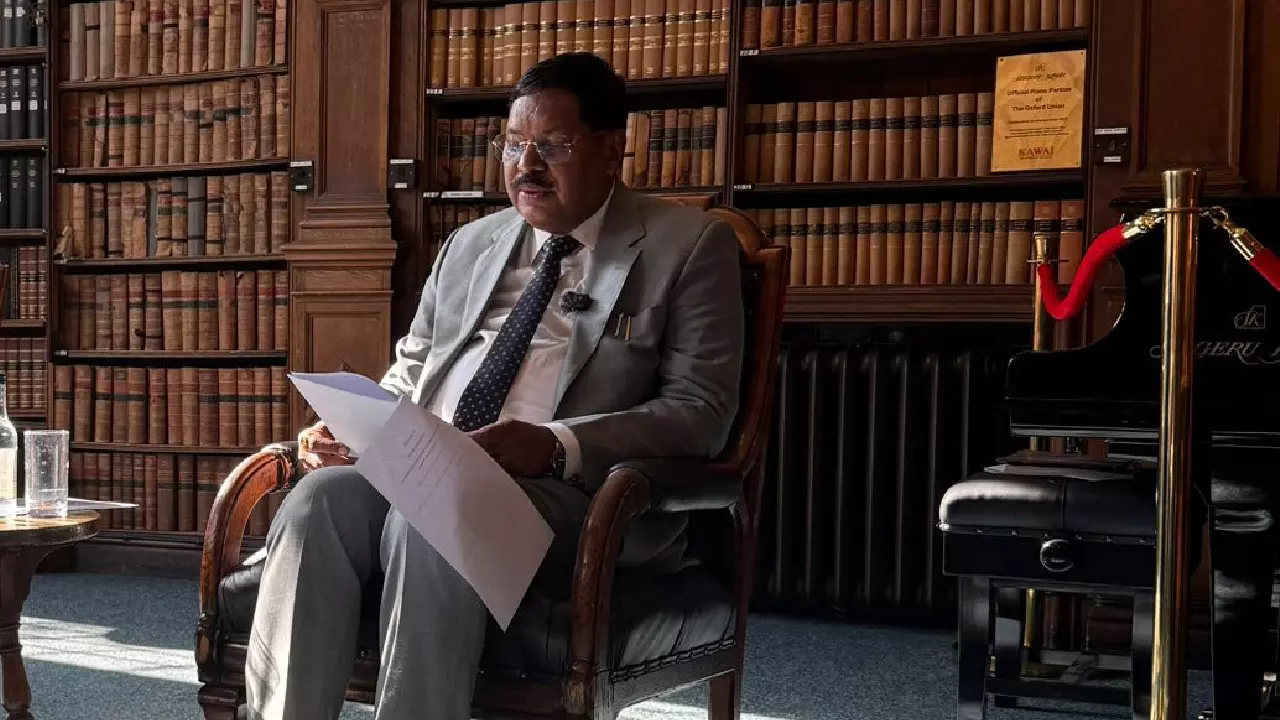
GG News Bureau
OXFORD, UK, 11th June: Chief Justice of India (CJI) B.R. Gavai delivered a powerful speech at Oxford University today, opening with a moving reflection on India’s historical injustices and the transformative power of its Constitution.
“Many decades ago, millions of Indian citizens were called ‘untouchables.’ They were told they were impure, that they didn’t belong, that they couldn’t speak for themselves,” CJI Gavai began. “But here we are today—where a person from those very communities is speaking openly, holding the highest judicial office in the country.”
Referencing Gayatri Chakravorty Spivak’s famous work, “Can the Subaltern Speak?”, CJI Gavai offered his compelling answer: “Yes, the subaltern can speak—and they have been speaking all along. The question is no longer whether they can speak, but whether society is truly listening.”
He praised the Indian Constitution for its pivotal role. “This is what the Constitution of India did. It told the people of India that they belong, that they can speak for themselves, and that they have an equal place in every part of society and power.”
A Social Document and a Lifeline
For India’s most vulnerable citizens, CJI Gavai asserted, “the Constitution isn’t just a legal charter or a political framework. It’s a feeling, a lifeline, a quiet revolution etched in ink.” He shared his own journey, from a municipal school to the Office of the Chief Justice of India, as proof of the Constitution’s guiding force.
CJI Gavai described the Constitution as a “social document—one that doesn’t shy away from the brutal truths of caste, poverty, exclusion, and injustice.” He emphasized that it doesn’t pretend everyone is equal in a land marked by deep inequality. Instead, it “dares to intervene, to rewrite the script, to recalibrate power, and to restore dignity.” He added that the Constitution holds the “heartbeat of those who were never meant to be heard” and envisions a country where equality isn’t just promised, but actively pursued. It compels the State not only to protect rights but to actively “uplift, to affirm, to repair.”
“At its core, it’s a moral declaration that the lives of the oppressed aren’t accidents of fate, but souls entitled to justice, worthy of representation, opportunity, and voice,” he stated.
Active Participation in Constitution’s Making
CJI Gavai highlighted a crucial, often overlooked, fact about the Constitution’s creation: many of India’s most vulnerable social groups weren’t just subjects of concern but active participants in its making. He noted that Dalits, Adivasis, women, minorities, persons with disabilities, and even those once unjustly labeled ‘criminal tribes’ were present in the Constituent Assembly. Their inclusion was a collective demand for recognition, dignity, and protection in the new India. “To be seen in the Constitution was to be seen by the nation. To be included in its text was to be included in its future,” he affirmed.
Praising Dr. B.R. Ambedkar’s immense contribution, CJI Gavai quoted Ambedkar’s belief: “In an unequal society, he believed, democracy cannot survive unless power is also divided among communities, not just among institutions. Representation, therefore, was a mechanism of redistributing power…”
CJI Gavai concluded by echoing Dr. Ambedkar’s final address to the Constituent Assembly on November 25, 1949: “We must make our political democracy a social democracy as well. Political democracy cannot last unless there lies at the base of it social democracy. What does democracy mean? It means a way of life which recognises liberty, equality, and fraternity as the principles of life.”
