
The Justice Swaminathan Flashpoint: How a Festival Ritual Shook Tamil Nadu Politics
“DMK impeachment Justice G.R. Swaminathan: A Political Overreach Threatening Judicial Independence.”

Paromita Das
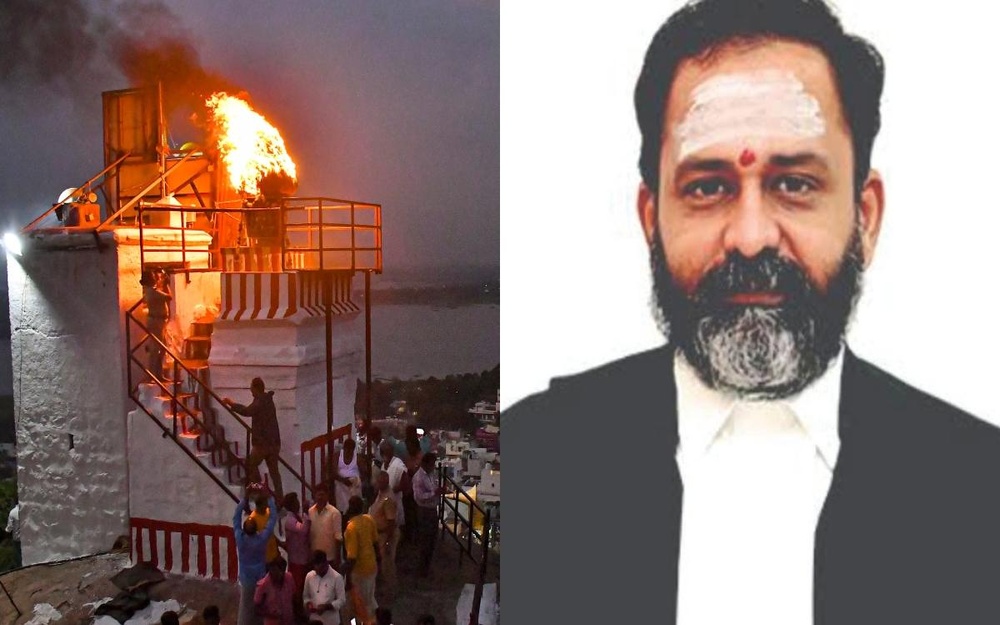
New Delhi, 12th December: Some political crises ignite from scandals; others from sudden controversies. But in Tamil Nadu, it was a simple flame on a hilltop — the Karthigai Deepam ritual at Thiruparankundram — that stirred one of the most defining debates of this season. A ritual older than the state itself suddenly became the focal point of a national dispute when Justice G.R. Swaminathan of the Madras High Court directed that the festival lamp must be lit and that a small group of devotees be escorted to perform the tradition without obstruction.
Within hours of this verdict, the political air crackled. Instead of appealing through established judicial channels, the DMK-led alliance leapt toward something far more confrontational: a move to impeach Justice Swaminathan. What could have remained a legal disagreement escalated into an institutional standoff — one that now raises unsettling questions about political overreach and the safety of judicial independence.
How a Centuries-Old Ritual Became a Constitutional Battle
The Karthigai Deepam ceremony is not a new controversy. For years, devotees have argued that state machinery has repeatedly interfered with the ritual despite legal clarity supporting its observance. Justice Swaminathan’s order simply acknowledged this history and directed compliance with precedent.
His judgment wasn’t emotional, ideological, or improvised. It was grounded in law. And when a division bench upheld his ruling, the judicial clarity became even harder to dispute. Yet instead of seeing this as a reaffirmation of a lawful tradition, the ruling party treated it as a challenge to its political authority.
That reaction marked the shift from legal disagreement to political retribution.
Justice Swaminathan’s Legal Reasoning: Clear, Measured, and Precedent-Based
Reading the order reveals nothing that indicates bias or impropriety. The judge acknowledged previous violations, recognized the rights of devotees, and ensured state supervision to maintain safety. This was textbook constitutional balancing — not activism, not theological commentary, and certainly not a breach of judicial ethics.
The two-judge bench’s concurrence further cements its legitimacy.
DMK’s Impeachment Move: Reform or Retaliation?
If DMK believed the judgment was flawed, there were established avenues of appeal. Instead, they chose the nuclear option: impeachment. Curiously, allegations about bias, favoritism, and “anti-secular tendencies” surfaced only after the verdict. Not before. Not during earlier years of Justice Swaminathan’s service. Only after he ruled in favor of a Hindu ritual.
The timing speaks louder than the allegations themselves.
What critics fear — and rightly so — is that this impeachment attempt is not about judicial integrity, but political intimidation aimed at warning the judiciary:
Rule in a way the ruling party approves, or face consequences.
Can Political Power Police the Judiciary?
A democracy survives on its pillars — executive, legislature, and judiciary — each functioning independently. When one branch tries to discipline another for issuing a lawful ruling, the balance wobbles.
Impeachment is a constitutional mechanism, but one intended for serious ethical or structural violations — not displeasure over verdicts. If used recklessly, it becomes a tool of coercion rather than accountability. And when a government threatens a judge for enforcing tradition in accordance with the law, it redefines the relationship between political power and judicial duty in the most dangerous way possible.
A Pattern of Weaponised Secularism?
Critics have long accused the DMK of deploying “secularism” selectively, often in ways that undermine Hindu cultural practices while leaving others untouched. Whether or not one agrees with this characterization, the sequence of events fits the pattern:
- Court allows a Hindu ritual based on law.
- Government expresses displeasure.
- Government challenges verdict.
- Government loses.
- Government moves to impeach the judge.
When the process looks like political vengeance dressed in constitutional language, trust in the intent behind it naturally erodes.
The Consequences: A Judiciary That Fears Its Own Shadow
The most worrying part is not this impeachment motion itself, but the precedent it sets. Judges may begin quietly calculating political repercussions before writing a verdict. The moment fear enters the judiciary, justice becomes distorted.
A democracy cannot afford a judiciary that second-guesses its own independence.
This Moment Is Bigger Than One Judge or One Festival
This isn’t about a lamp on a hill. It isn’t about one judge. And it certainly isn’t only about one political party. This episode tests the resilience of Bharatiya democracy. If judges can be threatened for lawful rulings, constitutional morality collapses. Citizens must understand the gravity: attacking judicial independence is not governance — it is governance slipping into authoritarian instinct.
The Fight for Judicial Integrity Cannot Be Compromised
The move to impeach Justice Swaminathan over a legitimate ruling is a step too far. It threatens the very fabric of democratic separation of powers. Judicial independence is not optional, negotiable, or subject to political mood. The nation must reject any attempt to punish judges for verdicts delivered in good faith and uphold the principle that justice must remain free from fear — and free from political wrath.
