
The Indus Waters Treaty: Bharat’s Second Partition and Its Undoing
How a one-sided agreement signed without Parliament’s consent continues to shape Bharat-Pakistan relations—and why today’s leadership calls it a “second partition.”

Paromita Das
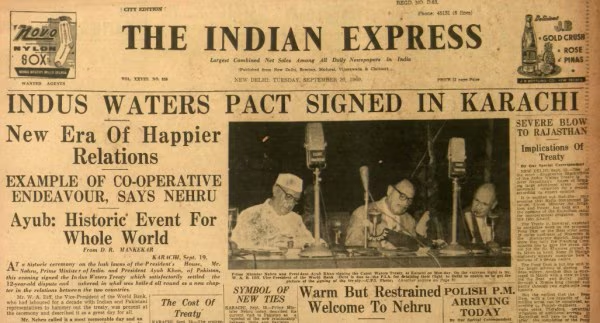
New Delhi, 23rd August: When the history of Independent Bharat is written, Jawaharlal Nehru’s statesmanship is often weighed against the shadows of his missteps. Among his many controversial decisions, one stands out for its audacity and its enduring consequences—the Indus Waters Treaty (IWT) of 1960. Lauded at the time as a triumph of diplomacy, the treaty has since been criticized as one of Nehru’s gravest blunders. Signed without parliamentary consensus, the agreement handed over control of the majority of Indus basin waters to Pakistan while leaving Bharat with a fraction of its rightful share.
Today, decades later, Prime Minister Narendra Modi has called the IWT “unjust and one-sided,” vowing to correct the course of history. His government’s move to scrap or fundamentally revise the treaty represents not just a policy change but also a symbolic undoing of Nehru’s legacy.
The Indus Waters Treaty: A Second Partition?

The treaty, brokered by the World Bank and signed on 19th September 1960 in Karachi, divided the six rivers of the Indus basin into two groups. Bharat received control over the eastern rivers—Ravi, Beas, and Sutlej—while Pakistan was awarded the western rivers—Indus, Jhelum, and Chenab. The flaw was simple but monumental: the western rivers carried nearly 80 percent of the total water flow, while Bharat was left with just 20 percent.
For a nation still grappling with food shortages and agricultural dependency, this meant generations of Bharatiya farmers—especially in Punjab, Rajasthan, and Jammu & Kashmir—would suffer water scarcity while Pakistan prospered. Critics immediately dubbed it a “second partition”, as Bharat had effectively partitioned its rivers in favor of its adversary.
Parliament’s Protest and Nehru’s Audacity

Perhaps more shocking than the terms of the treaty was the way Nehru handled it. He signed the agreement without taking Parliament into confidence, a move that angered even members of his own Congress party. When the treaty was debated in Parliament weeks later, the discussion was restricted to a mere two hours—an astonishingly small window for a decision of such magnitude.
Atal Bihari Vajpayee, then a young parliamentarian, condemned the treaty as a “dangerous concession to Pakistan.” He pointed out the contradiction between Bharat’s earlier stand of cutting off water to Pakistan and Nehru’s sudden generosity in granting permanent rights. Similarly, MP Harish Chandra Mathur warned that Rajasthan alone would lose water worth ₹70–80 crore annually due to the treaty, while Ashok Mehta likened it to reopening the wounds of 1947.
Yet, Nehru remained unmoved. In a speech that still echoes with arrogance, he dismissed these concerns as “loose, meaningless language” and even mocked critics by asking, “Partition of what? A pailful of water?” His defence of the treaty revealed his belief that complex international agreements could not be dictated by Parliament—a view that ran directly against democratic accountability.
The Fallout: Pakistan’s Betrayal

If Nehru had hoped to buy peace with Pakistan through water, history proved him wrong. Barely five years after the treaty, in 1965, Pakistan launched its first full-scale war against Bharat. Subsequent decades saw repeated conflicts, cross-border terrorism, and betrayal from Islamabad.
What angered many in Bharat was that even as Pakistan continued to wage hostility, it enjoyed the benefits of the Indus Waters Treaty. With control over 80 percent of the basin, Pakistan turned the Indus into its lifeline, while Bharatiya farmers downstream were left to manage with far less.
Why Modi Government Moved to Scrap It

Prime Minister Narendra Modi’s decision to revisit the treaty stems from both practical and symbolic concerns. On the practical side, the increasing water needs of Bharatiya farmers and the pressures of climate change have made the treaty’s restrictions unsustainable. Bharat’s growing population and expanding agricultural footprint require better access to its own river waters.
On the symbolic side, the treaty has long been seen as a reminder of Nehru’s misplaced idealism and disregard for national interest. By scrapping or renegotiating the agreement, the Modi government signals a break from the past and a shift toward a more assertive policy—one that prioritizes national sovereignty, agricultural security, and fairness over misplaced diplomatic gestures.
The government also argues that Pakistan, by sponsoring cross-border terrorism and waging hybrid wars against Bharat, has forfeited the goodwill on which the treaty was based. Why, many ask, should Bharat continue honoring a one-sided deal with a neighbor that consistently undermines its peace and security?
A Lesson in Leadership and Accountability

The story of the Indus Waters Treaty is not just about rivers; it is about leadership, accountability, and foresight. Nehru’s unilateral decision, taken without parliamentary consent, reflects a style of governance where the executive overshadowed democratic institutions. His arrogance in dismissing legitimate concerns as “narrow-minded” exposed a leader unwilling to listen, even when the stakes involved national security and livelihoods.
By contrast, the Modi government’s stance resonates with the contemporary mood of strategic realism. In a world where resources are weapons of power, no nation can afford to handicap itself with outdated compromises. Scrapping the treaty is less about punishing Pakistan and more about reclaiming Bharat’s right to chart its own future.
From Blunder to Correction
More than sixty years after its signing, the Indus Waters Treaty remains a cautionary tale. What was once celebrated as a diplomatic breakthrough has long since been exposed as a costly miscalculation. Nehru’s audacity in bypassing Parliament and yielding Bharat’s waters continues to haunt the nation, while Pakistan reaped the rewards of his idealism.
The Modi government’s move to end or renegotiate the treaty represents not just a correction of history but also an assertion of Bharat’s right to control its resources. In many ways, it is the closing of a chapter Nehru wrote hastily, without consultation, and without foresight.
As Bharat steps into a future shaped by water scarcity, climate challenges, and regional rivalries, one thing is clear: national interest must flow stronger than misplaced idealism.
