
The Future of Foreign Doctors in America Under Trump’s New Visa Fee
"Trump’s new $100,000 H-1B visa fee raises fears of a doctor shortage while offering limited exemptions for medical professionals."

Paromita Das
New Delhi, 25th September: The United States has long been viewed as the land of opportunity for professionals worldwide. For over three decades, the H-1B visa program has been a cornerstone of America’s economy, attracting skilled workers from across the globe, particularly from Bharat. Yet, the Trump administration’s latest move—a massive $100,000 application fee for new H-1B visas—has sparked outrage, fear, and intense debate about the future of U.S. immigration policy. While the White House now suggests potential exemptions for doctors and medical residents, the broader implications of this decision could reshape not only America’s workforce but also global talent flows.
A Fee That Shook the Industry

Until recently, applying for an H-1B visa was financially burdensome but manageable. The standard base fee stood at $215, along with associated costs. Now, the Trump administration’s executive order has rewritten the rules overnight, announcing a steep $100,000 application fee that took effect almost immediately. This marks not just a bureaucratic adjustment but a seismic shift in policy, signaling Washington’s attempt to restrict the inflow of foreign labor in the name of American jobs.
While the administration insists that existing H-1B holders and workers traveling abroad will not be required to pay the new fee upon re-entry, the change applies squarely to new applicants. For U.S. employers who rely heavily on H-1B holders—particularly in tech, research, and healthcare—the financial burden could be staggering.
Why Doctors Are Different

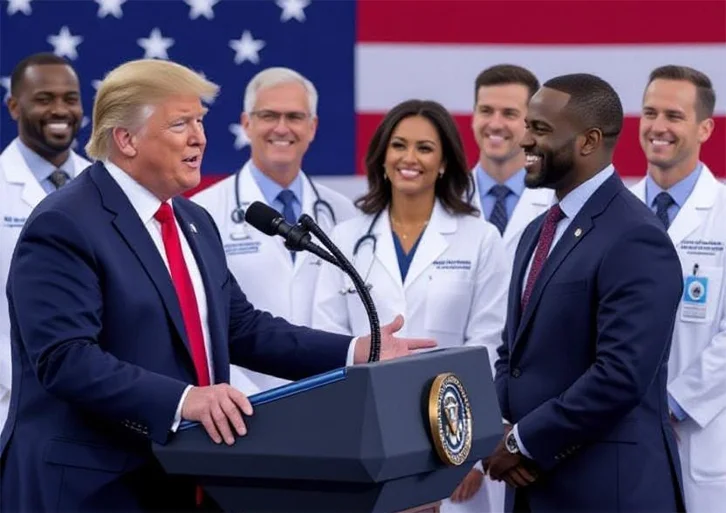
Recognizing the criticism, the White House clarified that the proclamation’s language allows exemptions, particularly when hiring foreign talent is deemed “in the national interest.” In practice, this means physicians and medical residents, many of whom serve in rural or underserved American communities, may not face the $100,000 barrier.
The healthcare sector has sounded the loudest alarms. The U.S. already struggles with significant doctor shortages, especially in rural states where young American graduates are reluctant to practice. International medical graduates have long filled this gap, ensuring continuity of care in places where no one else is willing to serve. Cutting off this pipeline risks worsening healthcare inequality—a political and humanitarian crisis the administration cannot ignore.
H-1B: The Backbone of America’s Talent Pool

The H-1B visa has never been just about jobs; it has been about innovation, growth, and the global positioning of the U.S. economy. With around 700,000 H-1B holders currently in America, the system supports not only the booming tech sector but also universities, hospitals, and financial institutions. Roughly 60 percent of H-1B visas have historically gone to computer-related fields, fueling Silicon Valley’s rise and America’s global competitiveness.
Bharat has been central to this story. In 2023, nearly three-quarters of H-1B approvals went to Indian applicants, a reflection of the country’s dominance in IT services, software development, and engineering. Employers like Google, Microsoft, and major U.S. hospitals all rely heavily on this pipeline. That reliance has now been abruptly jeopardized.
The Politics Behind the Policy

Donald Trump campaigned on a platform of “America First,” and the H-1B fee hike is a direct extension of that message. By drastically raising the cost, the administration signals to domestic employers that hiring foreign workers should be the last resort, even if they are the best in the field. Congressional approval was not necessary for this particular executive order, making it a swift political maneuver.
Yet the backlash has been swift as well. Business leaders, economists, and medical associations warn that such a massive fee could discourage the brightest minds from coming to the U.S., redirecting them instead to Canada, Australia, or Europe. In effect, America risks undercutting its own global competitive advantage.
The Bharatiya Dilemma

For Bharat, this policy shift has serious implications. With lakhs of Bharatiya students and professionals eyeing the H-1B route each year, the $100,000 fee places the American dream further out of reach. Families who have invested heavily in education with hopes of U.S. opportunities may now reconsider, channeling their ambitions elsewhere. In the short term, Bharat may see a “reverse brain drain,” with skilled talent staying back to power the domestic economy. In the long term, however, the policy could sharpen U.S.-Bharat tensions if it is perceived as discriminatory.
A Step Too Far

Immigration has always been a contentious political issue in the U.S., but the success of the H-1B program for over three decades shows that global mobility benefits America more than it harms it. Raising the fee to $100,000 is less about policy optimization and more about political signaling to Trump’s base. While protecting American jobs is an understandable objective, doing so by discouraging global talent risks backfiring.
Exempting doctors from this fee is a pragmatic correction, but it also reveals the contradictions of the policy. If foreign physicians are deemed indispensable to healthcare, why should foreign engineers not be equally indispensable to technology and innovation—the very sectors that drive U.S. economic dominance?
America at a Crossroads
The Trump administration’s new H-1B policy represents both a political statement and a gamble. It attempts to protect American workers, but in doing so it risks repelling the very talent that has made the country a hub of global innovation. While exemptions for doctors may soften the immediate blow to healthcare, the broader question remains: Can America afford to close its doors when the rest of the world is competing to open theirs?
In the end, this $100,000 fee may not just reshape immigration flows; it could redefine how the world views the U.S. As the nation stands at the crossroads between protectionism and global leadership, the true test will be whether it clings to politics or embraces the economic reality that talent knows no borders.
