
Telangana in Turmoil: Congress’s Gamble with a Fallen Cricket Icon
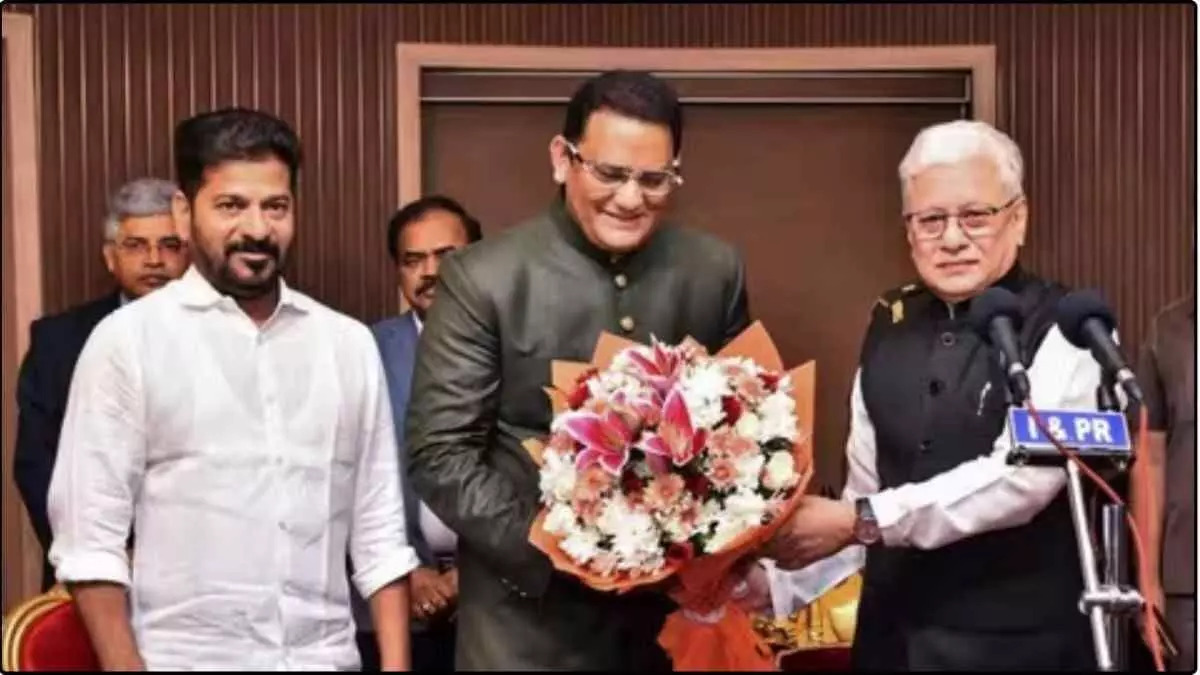
“The Telangana Congress government’s controversial decision to induct Mohammad Azharuddin into the cabinet, a Political Tempest in Telangana.”

Paromita Das
New Delhi, 3rd November: The corridors of Telangana’s political power were shaken on October 31 when the Congress government inducted former Bharatiya cricket captain Mohammad Azharuddin into its cabinet. What should have been a moment of celebration for the party turned instead into a storm of outrage and disbelief. For a government that has built its image around “moral politics” and “ethical governance,” this appointment smacks of opportunism — a decision guided less by principle and more by electoral arithmetic.
The Return of a Fallen Star

Once a name that evoked elegance and excellence on the cricket field, Azharuddin’s legacy has long been overshadowed by scandal. His involvement in the match-fixing episode of 2000 — one of Bharatiya cricket’s darkest stains — led to a lifetime ban that stripped him of dignity and trust. Though the Andhra Pradesh High Court overturned the ban in 2012, public perception never truly forgave him. His integrity, once his strength, became a permanent question mark.
Yet, decades later, the Congress government in Telangana, under Chief Minister A. Revanth Reddy, has chosen to bring him back into public office — this time, not as a sportsman, but as a lawmaker. Reports indicate that Azharuddin might even be entrusted with key portfolios like Home Affairs, Minorities Welfare, or Sports. The irony is cruel and unmistakable: a man once banned for betraying the spirit of cricket could now oversee governance in areas that demand unimpeachable ethics.
Moral Politics or Moral Amnesia?

Congress has long projected itself as the custodian of Bharat’s moral and secular fabric. However, Azharuddin’s induction challenges that claim at its very core. The move reeks of moral amnesia — a willingness to erase history for political convenience. Even within the party, murmurs of dissent have grown louder. Telangana Pradesh Congress Committee president Mahesh Kumar Goud’s admission that he was blindsided by the decision reveals more than just poor communication; it exposes a deepening culture of unilateralism and internal disarray.
Senior leaders are reportedly disillusioned, some even furious, particularly with the timing of the decision. With the Jubilee Hills by-election looming, many see this as a blatant attempt to appeal to Muslim voters — a short-term gamble that risks long-term credibility.
The Perils of Tokenism

To justify Azharuddin’s appointment, Congress has argued that his induction enhances minority representation. But this reasoning falls flat. Telangana boasts numerous Muslim leaders who have earned respect through integrity and grassroots work. Elevating a tainted figure under the guise of inclusivity reduces representation to mere tokenism. It sends a damaging message — that notoriety can masquerade as legitimacy if it serves the party’s vote-bank strategy.
This cynical calculus does more harm than good. It alienates honest leaders, corrodes public trust, and reinforces the perception that politics is a game of expediency, not ethics.
The Opposition’s Fury and Public Outrage

Predictably, opposition parties have seized upon the controversy. The Bharatiya Janata Party (BJP) and the Bharat Rashtra Samithi (BRS) have both accused the Congress of exploiting religious identity for electoral gain. The BJP has gone a step further, filing a complaint with the Election Commission, alleging a violation of the Model Code of Conduct.
While partisan outrage is par for the course, in this instance, it resonates with public sentiment. Ordinary citizens, weary of corruption and disillusioned by broken promises, see this as yet another example of political decay — where moral bankruptcy is disguised as strategic brilliance.
Congress’s Defensive Spin

Faced with mounting criticism, senior Congress figures have rushed to defend the decision. Deputy Chief Minister Mallu Bhatti Vikramarka dismissed the backlash as a “BJP-BRS nexus,” while Mahesh Kumar Goud, in an awkward reversal, echoed the same line, claiming the move “corrects a long-overdue imbalance.”
But these defenses sound hollow. They fail to address the central question — can a government committed to ethical politics justify elevating someone whose past is steeped in allegations of deceit? No amount of rhetorical gymnastics can conceal the contradiction.
A Symbol of Political Opportunism

Azharuddin’s induction is more than a political misstep — it is a moral statement. It declares that in today’s Bharat, rehabilitation can be earned not through redemption, but through utility. Despite his tarnished record and repeated electoral failures, Azharuddin’s value lies in his symbolic appeal, his celebrity status, and his religious identity — a trifecta irresistible to a party chasing votes in a competitive political landscape.
Ironically, he isn’t even an elected representative. To remain in the cabinet, he must be inducted into the Legislative Council within six months — yet another procedural workaround that exposes the haste and cynicism underlying the decision.
When Principles Are Sacrificed on the Altar of Politics

Telangana deserves better. Its people have placed their trust in a government that promised transparency, integrity, and reform. Instead, they are witnessing the re-emergence of an old pattern — where loyalty and symbolism outweigh merit and ethics. The Congress party’s willingness to overlook Azharuddin’s controversial past underscores a deeper malaise: the decay of accountability in Bharatiya politics.
This episode is not just about one man’s appointment; it is about the erosion of moral authority in governance. It forces us to confront an uncomfortable truth — that political convenience has become the new morality.
The Cost of Forgetting
The Congress government’s decision to rehabilitate Mohammad Azharuddin is more than an act of political opportunism; it is a symptom of a larger ethical crisis. By normalizing scandal and rewarding notoriety, it chips away at the public’s already fragile faith in the political system.
The party of Nehru and Patel once prided itself on integrity and ideals. Today, it appears to have lost its compass, navigating instead by the winds of short-term gain. Telangana’s political storm is, therefore, not just about Azharuddin — it is a mirror held up to Bharat’s declining standards of political morality.
