
Tejashwi Yadav Faces the Heat as Bihar’s Politics Shifts Gear

Paromita Das
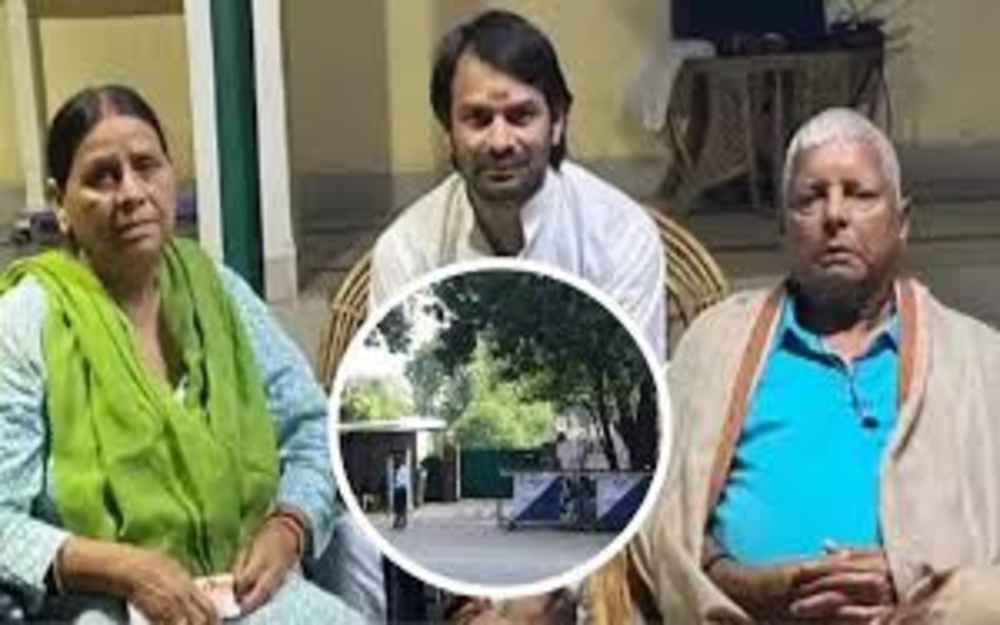
New Delhi, 3rd December: Bihar rarely witnesses political calm, but the last few weeks have produced a storm that even seasoned observers didn’t see coming. What began as a routine administrative decision has snowballed into a full-scale debate on legality, privilege, political accountability, and the new power equations shaping the state. Tejashwi Yadav, who once styled himself as the face of Bihar’s young leadership, now finds himself in the center of a controversy that has uprooted a two-decade-old arrangement tied to his family’s political legacy.
A government accommodation, occupied for nearly 20 years by the former Chief Minister’s family, is now at the heart of a heated political narrative. And whether Tejashwi likes it or not, his own political trajectory and legal burdens have played a decisive role in triggering this unraveling.
The Two-Decade Story of a Bungalow That Became Political Real Estate
The state bungalow at 10 Circular Road was more than just a residence. For years, it symbolized the uninterrupted political influence of the Lalu–Rabri family—even during periods when they weren’t in power. The roots of this continued privilege can be traced back to 2010, when Chief Minister Nitish Kumar amended the rules to allow all former Chief Ministers lifetime access to government housing and security. It was a gesture born partly out of political courtesy, partly out of Bihar’s culture of informal understandings among veterans.
When the Grand Alliance came to power in 2015, the rule expanded further: deputy chief ministers were also allotted their own government residences. This allowed Tejashwi Yadav, then Deputy CM, to enjoy a separate property in addition to the family’s long-held occupancy.
But political tides change faster than rules do. When alliances shifted again, the legal basis for such lifetime privileges began to crumble. By 2019, the Patna High Court had already declared this entire system unconstitutional, arguing that taxpayer-funded lifetime benefits to former CMs violated the principles of public accountability.
Yet, the family continued to stay.
Until now.
The Pressure Point: Legal Troubles and Administrative Realignment
The immediate trigger behind the order to vacate is not simply that the NDA has returned to power. Rather, it’s the convergence of two pressing issues:
Tejashwi Yadav’s ongoing legal scrutiny in land-for-jobs cases, and the administration’s renewed emphasis on enforcing judicial decisions.
With multiple family members—including Tejashwi—named in corruption investigations, the Bihar government has little political incentive to continue offering the privilege of state property. The optics alone would be politically damaging for a newly formed NDA government that wants to project administrative strictness and zero tolerance for irregularities.
The shift is also symbolic: a message that political power can no longer shield anyone from institutional rules.
Nitish 2.0 and the Re-Emergence of “Administrative Muscle”
The new NDA government, especially with Samrat Choudhary overseeing home affairs, is presenting itself as an administration determined to replicate the “law-and-order-first” model seen in other BJP-led states. Bulldozer-driven actions against illegal properties, strict enforcement against organised crime, and swift police responses to public order challenges have already become talking points.
The message is loud and clear:
The era of political immunity is over.
Against this backdrop, Tejashwi’s family losing government accommodation becomes more than a bureaucratic formality—it becomes a headline symbol of a changing political culture.
Rahul Gandhi’s Parallel Struggle and the Cracks Within Congress
Around the same time, Congress was attempting to understand its own electoral setbacks. Rahul Gandhi reportedly accepted partial responsibility for the Bihar loss in an internal review session—a rare moment of acknowledgment. But this admission also exposed the deeper organizational confusion within the party.
For many Congress workers, the alliance with RJD proved more costly than beneficial. The combination of mixed messaging, contradictory narratives, and the lack of a unified strategy weakened the coalition from within. The BJP’s clear, consistent communication on development, governance reform, and law-and-order helped it consolidate even further.
In this context, Tejashwi’s political challenges are no longer limited to Bihar—they reflect a national opposition struggling with coherence.
Tejashwi’s Political Future Depends on Reinvention, Not Resistance
Tejashwi Yadav undoubtedly remains one of Bihar’s most recognizable young leaders. But recognizability is not enough. His political setbacks reveal a deeper challenge—his struggle to separate his own identity from the weight of his family’s controversies.
The bungalow story isn’t just about property.
It’s about perception.
It signals how the state views privilege.
How the administration views accountability.
And how voters view political dynasties that no longer resonate with Bihar’s aspirational electorate.
Instead of resisting the order or framing it as an act of political vengeance, Tejashwi needs to demonstrate proactive leadership—clarity on governance, integrity in public life, and a break from the decades-old political grammar that Bihar is rapidly outgrowing.
Bihar’s Political Landscape Is Changing—and So Must Its Leaders
Bihar today is standing at a crossroads. A state once synonymous with political stagnation is witnessing an emerging culture of institutional enforcement and competitive governance. The removal of lifetime privileges, the tightening of administrative norms, and the assertiveness of the NDA government all indicate a shift toward accountability-oriented politics.
Tejashwi Yadav’s challenge is more than electoral—it is existential.
To remain relevant in this new Bihar, he must evolve faster than the political currents reshaping the state.
The era of unquestioned political entitlement is ending.
A new chapter—one of accountability, competition, and public-centric governance—has already begun.
