
Tejashwi Yadav Caught In Voter ID Fraud ECI Launches Probe
In the political cauldron of Bihar, where every statement echoes with electoral implications, RJD leader Tejashwi Yadav’s latest outburst may have landed him in his most embarrassing controversy yet.

Paromita Das
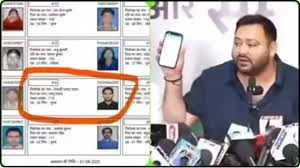
New Delhi, 4th August: As the state gears up for its upcoming Assembly elections, Yadav attempted to stir the pot by alleging that his name was missing from the state’s draft electoral roll. Framed dramatically as a sign of voter disenfranchisement and institutional bias, Yadav’s claim quickly made headlines—and just as quickly, unraveled. The Election Commission of India (ECI) hit back with a factual rebuttal, revealing that not only is Yadav’s name present on the list, but the entire episode might implicate him in a far graver scandal: possessing dual voter ID cards.
A Misstep That Shook His Credibility
Standing before reporters with visible indignation, Tejashwi Yadav declared that his name had been removed from the draft voter roll—a charge he positioned as part of a larger conspiracy to rig the elections. “My name is not there in the electoral roll. How will I contest the elections?” he asked rhetorically, while claiming that nearly 65 lakh voters across Bihar were mysteriously deleted—about 8.5% of the entire electorate.

What he failed to anticipate was the swift and meticulous response from the ECI. In a publicly released statement, the commission confirmed that Tejashwi Yadav is registered at Serial Number 416 on the electoral roll and called his allegations “factually incorrect.” Instead of boosting his image as a whistleblower, the entire episode exposed him to questions of credibility and political opportunism.
Suspicious EPIC Numbers and a Legal Boomerang
Yadav’s drama didn’t stop there. To lend weight to his accusations, he quoted an EPIC (Elector’s Photo Identity Card) number that he claimed couldn’t be traced on the ECI portal. However, as the Election Commission investigated the matter, it became clear that the EPIC number was invalid. Even more damning, preliminary findings suggest that Tejashwi may possess not just one, but two voter ID cards—a violation under Bharatiya election laws.

The implications are serious. Holding multiple voter IDs is a criminal offense, and the Election Commission has already launched a formal inquiry. If proven, it could lead to a First Information Report (FIR) and legal consequences. In a twist of fate, Yadav’s attempt to portray himself as a victim may have backfired dramatically, casting him in the role of an alleged offender.
Rahul Gandhi Joins the Chorus—And Gets Dismissed
Interestingly, this political melodrama came hot on the heels of a similar controversy involving Congress leader Rahul Gandhi. A day before Yadav’s press conference, Gandhi accused the Election Commission of orchestrating “vote chori” (vote theft), and went as far as to say he had “open-and-shut” proof.

However, Gandhi’s accusations proved just as hollow. The ECI revealed that it had reached out to him via email and letter as early as June 12, 2025, requesting evidence to back his claims. Rahul Gandhi, to date, has not responded. The Commission condemned his baseless remarks and reaffirmed its commitment to impartiality, warning against attempts to discredit Bharat’s electoral institutions.
The SIR Exercise: Transparency, Not Tampering
The root of this controversy lies in the Special Intensive Revision (SIR) of Bihar’s electoral rolls, launched to streamline and update the voter list. The ECI clarified that this process was conducted with full transparency and legal compliance. The removal of duplicate entries, deceased voters, and those who had moved away is a standard electoral exercise.

The claim that 65 lakh names were “vanished” deliberately was termed misleading. The Election Commission reiterated that any eligible citizen could verify or update their name on the electoral roll, and that political parties were provided access to both draft and final versions of the list. Tejashwi Yadav, like any other citizen, had ample opportunity to raise concerns through legal channels—but chose not to.
Melodrama Can’t Replace Accountability
It’s not uncommon for politicians to make sensational claims in the heat of elections. But what makes this episode particularly troubling is the ease with which facts were twisted, institutions were maligned, and the public was misled. In trying to craft a narrative of victimhood, Tejashwi Yadav and Rahul Gandhi have demonstrated a worrying disregard for accountability and truth.

Public trust in electoral institutions is the backbone of democracy. When leaders attempt to erode that trust for political mileage, the damage extends beyond one election—it strikes at the very soul of democratic governance.
Election Commission Holds the Line
Despite the storm of unfounded allegations, the Election Commission of India has stood firm. Its prompt and transparent responses have not only dismantled false narratives but also reaffirmed its role as a neutral and credible guardian of Bharatiya democracy.
As Bihar moves closer to a crucial electoral test, one thing is clear: misinformation may grab headlines, but truth—backed by data and due process—will always stand the test of time. And for leaders like Tejashwi Yadav, this misadventure should serve as a cautionary tale—one where theatrics met truth, and lost.
