
Tariff Politics Draw Boundaries, Needonomics Drives Shared Prosperity: Prof M.M. Goel

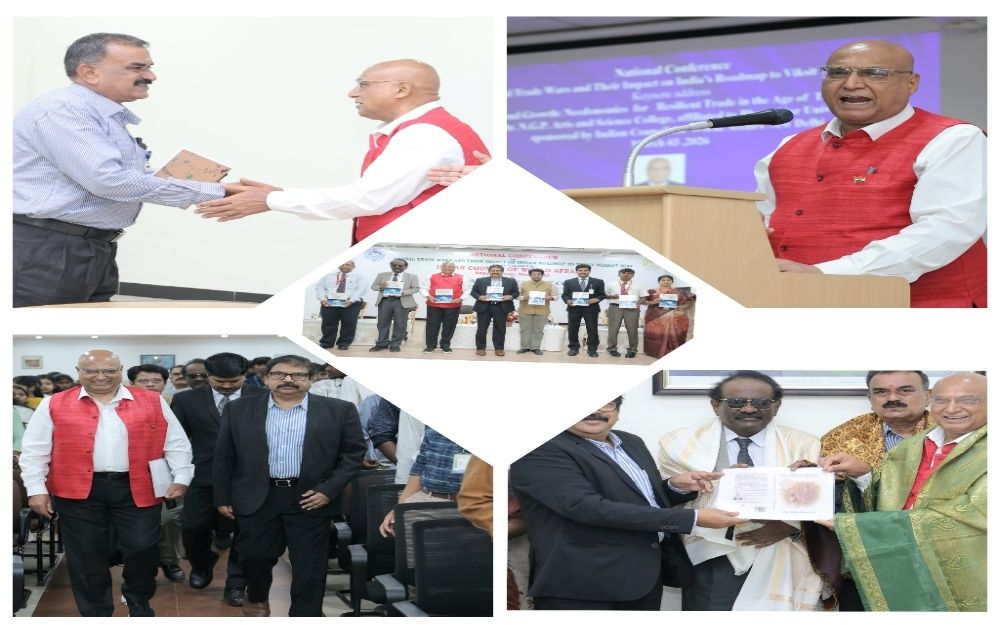
Coimbatore, March 3- Prof. Madan Mohan Goel, Propounder Needonomics School of Thought and Former Vice-Chancellor (Thrice) and superannuated Professor Kurukshetra University, delivered the keynote address at the National Conference on “Global Trade Wars and Their Impact on India’s Roadmap to Viksit Bharat 2047” held at Dr. N.G.P. Arts and Science College, affiliated to Bharathiar University sponsored by Indian Council for World Affairs New Delhi. His address was titled “Beyond Growth: Needonomics for Resilient Trade in the Age of Trade Wars.”
The programme commenced with a welcome address by Dr.S.Saravanan Principal. Dr. N Panchanatham Vice-Chancellor Gandhigram Rural Institute presided over the function as chiefguest . Conference convener Dr. M. Kalimuthu HoD Commerce formally introduced the keynote speaker Prof M. M. Goel, while the vote of thanks was proposed by Dr S.Mohan HoD Management Studies. Dean Dr PB Banudevi, Dr Sripathi Narayanan of ICWA , Prof R.K.Singh ,Delhi School of Economics, Prof Ramesh Sallian ,JNU also spoke on the occasion.
Speaking in the context of negotiated globalization marked by tariff contests, carbon border taxes, and supply-chain securitization, Prof. Goel noted that India, now the world’s fourth-largest economy with a GDP of $4.3–4.5 trillion and growth of 6–7 percent, stands at a decisive trade juncture. With January 2026 exports crossing $80 billion and services exports reaching record highs, India’s digital and knowledge sectors are gaining global prominence.
Referring to the India–US Trade Reset (February 2026) and the emerging India–EU trade framework covering a €16–17 trillion market, he emphasized that trade agreements must move beyond volume to values.
Under the vision of Viksit Bharat 2047, trade should generate dignified employment, empower MSMEs, promote green production, and protect vulnerable sectors, believes Prof Goel.
Politics of tariffs by Trump may draw boundaries, but economics guided by Needonomics dissolves them by nurturing shared prosperity, stated Prof Goel.
Prof. Goel asserted that, from a Needonomics perspective, trade is a means to ensure need-based prosperity, ethical growth, and social harmony. “Growth without well-being is excess; growth aligned with real human needs is true progress,” he remarked, underscoring that resilience is moral before it is economic in India’s journey toward inclusive and sustainable development.
