

Poonam Sharma
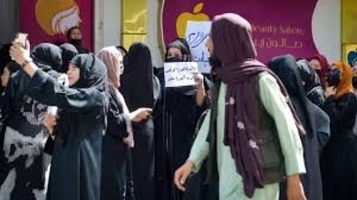
September 1, 2025, again brought word that the Taliban regime has resumed its vicious campaign against Afghan women through an attack on one of their few remaining clandestine sources of sustenance and solidarity — beauty salons. For decades, these small facilities functioned clandestinely, earning not only money but also a safe arena of social engagement for women confined within an oppressive patriarchal system. The Taliban’s ultimatum to shut them down or face imprisonment is no singular edict. It is instead the further extension of centuries of domination, suppression, and elimination of Afghan women from the public sphere.
This most recent installment is representative of the Taliban’s dogged war against women’s freedom. But to appreciate its significance, one must follow the curve of women’s status in Afghanistan over the past century — from slow emancipation in the early 20th century, through struggles earned during times of modernization, and into repeated degenerations into authoritarian conservativism.
Early Struggles for Liberation (1919–1970s)
Afghanistan’s recent history of women’s rights started in the reign of King Amanullah Khan (1919–1929). Spurred by enlightened reforms in Turkey and other places, Amanullah promoted female education, discouraged child marriage, and even advocated the denuding of veils. His queen, Queen Soraya, became an icon of women’s empowerment. But the reforms unleashed bitter opposition from tribal elders and conservative theologians, resulting in Amanullah’s downfall and decades of rollback.
Nevertheless, by the mid-20th century, urban Afghanistan, and particularly Kabul, saw improvement. Women went to schools and universities, joined civil service careers, and had relative freedoms. Under the Soviet-supported regime (1979–1989), women were increasingly integrated into employment and education, although the reforms were discredited by linkage with foreign occupation and brutal suppression. For rural Afghan women, everyday lives continued to be determined by traditional structures, which were hardly touched by state reforms.
The Taliban’s Initial Dark Period (1996–2001)
The actual breakdown occurred with the Taliban’s initial ascension to power in 1996. Positioning themselves as guardians of Islamic piety, the Taliban denied women nearly every privilege. Schools for girls were shut down, women were excluded from employment, and even venturing outside the home without a male chaperone summoned savage punishments. Public floggings, whippings, and killings of women for supposed “moral transgressions” became routine spectacles.
Beauty parlors — symbols of self-expression and economic survival — were outlawed as “immoral.” Many women resorted to underground teaching, secret tailoring, or hidden salons, risking torture or death if discovered. This era created a lasting scar, not only by crushing women’s lives but also by normalizing systemic violence against them.
The Post-2001 Window of Hope
Following the U.S.-led invasion in 2001, the fall of the Taliban was followed by two decades of uneasy progress. Women returned to public life, entering schools, universities, parliaments, and even security forces. The 2004 Afghan Constitution provided legal equality and quotas for women in politics. Beauty salons thrived openly, frequently acting as community centers where women exchanged politics, gossip, and networks of solidarity.
Afghan women, especially in cities, seized opportunities with remarkable courage. Activists like Fawzia Koofi and Malalai Joya became global voices for Afghan women’s rights. Yet, this progress was uneven and fragile. Rural areas remained bound by tribal codes and Taliban influence. Moreover, the dependence on Western military presence meant that women’s rights were always precariously tied to geopolitics rather than deep-rooted cultural change.
Taliban’s Return and Renewed Suppression (2021–Present)
When the Taliban regained control in August 2021 after the U.S. withdrawal, they promised a “softer” stance on women. That illusion quickly evaporated. Girls’ secondary schools were closed, women were banned from most workplaces, universities became inaccessible, and even NGOs faced restrictions if they employed female staff.
In July 2023, the Taliban formally prohibited beauty parlors — one of the last remaining jobs still available to women. Now, in 2025, enforcement has been stepped up: clandestine parlors raided, shop owners threatened with imprisonment, and customers harassed. These restrictions are more than mere esthetic prohibitions. They are deliberate acts to wipe out areas where women had exercised agency, however slight, beyond patriarchal control.
Historical Pattern: Control of Women as Political Legitimacy
Throughout the history of Afghanistan, women’s status has been a political thermometer. Reformist leaders attempted to gain legitimacy by liberating women, whereas conservative leaders consolidated authority by controlling them. The Taliban, however, employ the regulation of women as a display of ideological virtue. By repressing female independence, they are able to reinforce to their base that they remain custodians of an unyielding Islamic order.
In this regard, beauty parlors are not just shops. They are sites of resistance — centers of silent defiance where women’s dignity and solidarity find purchase. Their shutdown is intended to cut one of the remaining umbilicals of women’s public lives.
The Human Cost
Behind each policy lie ruined real lives. The shut down of beauty parlors takes away the only means of livelihood for thousands of women and drives families into poverty. Widows, whose husbands passed away in decades of war, lose their survival strategies. Adolescent girls, deprived of education and now left without vocational prospects, are subjected to forced marriages.
Psychologically, these prohibitions deepen despair. In a society that already makes women invisible, to cut off small havens of self-expression is to lead to stifling isolation. International observers note climbing rates of depression and suicide among Afghan women — a silent epidemic under the Taliban regime.
The World’s Silence
Noteworthy, however, is the subdued international reaction. Afghan women’s rights were a staple of headlines throughout the U.S. occupation, serving as a rationale for sustained military involvement. Now that regional strategic interests lie elsewhere, Afghan women’s suffering does not make front-page news. Global assistance has declined, sanctions constrain humanitarian support, and all too often, negotiations with the Taliban do not give women’s rights high priority.
This abandonment underlines a dark lesson: Afghan women have been mere pawns in greater struggles for power, prized only when it is convenient.
Resilience Amid Erasure
This stifling situation notwithstanding, Afghan women still resist — in hidden schools, clandestine businesses, online activism, and sheer survival. Their resilience serves as a testament to the fact that no regime, no matter how repressive, can completely suppress the human need for freedom and dignity.
The Taliban’s war against beauty parlors is not a war against make-up. It is a war against eliminating spaces of identity, unity, and self-determination. It is the latest installment in Afghanistan’s sad saga in which women’s bodies, voices, and ways of earning a living are treated as battlegrounds of political struggle.
History, though, also indicates that Afghan women have consistently emerged from oppression with unshakable strength. The world cannot now look away, lest become guilty of complicity in the soft erasure of half a country’s population.
