
Syeda Hameed Faces Heat for ‘Bangladeshis Welcome’ Remark
“Hameed’s comments defending the presence of Bangladeshi migrants in Assam have sparked a major political and public backlash, with critics questioning whether her Padma Shri honour is justified given her controversial stance on sensitive national issues.”

Paromita Das
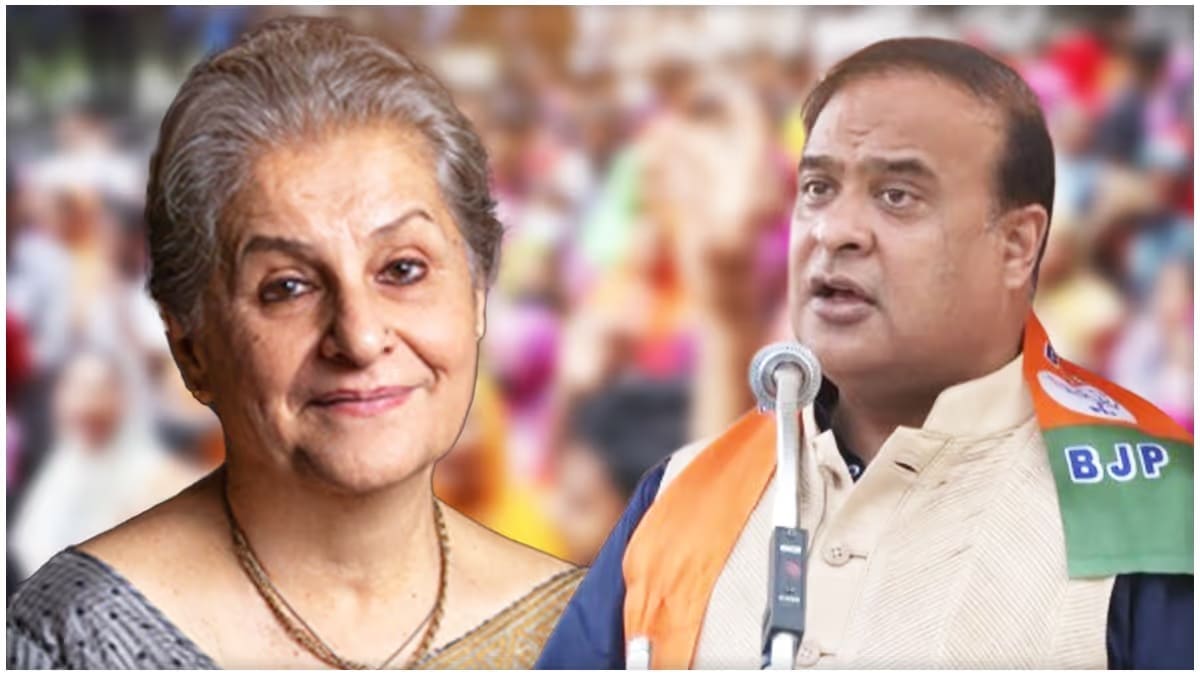
New Delhi, 28th August: When Bharat honors someone with the Padma Shri, it isn’t just a recognition of individual achievement—it is also a public endorsement of character, balance, and sensitivity to national concerns. That is why Syeda Saiyidain Hameed’s recent remark in Assam—“What’s wrong if they are Bangladeshis? Bangladeshis are also humans. Bangladeshis can also live here”—has sparked outrage across the nation.
And this is not the first time. Hameed has a long history of making anti-Bharat statements, painting the nation as intolerant, divisive, and oppressive, whether it was about nationalism, minorities, or our neighbors. Earlier too, she has consistently spoken in tones that align more with Bharat’s detractors than with its own people. By repeating the same pattern today, she has shown that her disdain for the idea of Bharat is not new—it is habitual.
For many, her words are not the voice of humanitarian compassion but a dangerous trivialization of a decades-old struggle that has cost Assamese lives, culture, and identity.
A Padma Shri From Congress Rule – Political Intentions Behind Recognition?

Hameed was awarded the Padma Shri in 2007, during the Congress-led UPA regime. At the time, the Congress government was accused of minority appeasement at the cost of national security and demographic stability. Today, it is hard not to see her award as part of a larger agenda—pushing Islamisation under the mask of pluralism, while deliberately ignoring the real fears of Hindus in border states like Assam.
For a Padma Shri awardee to undermine Bharat’s sovereignty with such arrogance is nothing less than a national insult. She has dragged one of the nation’s highest civilian honors into disgrace by using it as a shield to promote anti-Bharat narratives.
Silent on Hindu Genocide in Bangladesh

What makes Hameed’s hypocrisy even more shameful is her silence on the horrific persecution of Hindus in Bangladesh. For decades, Hindus have been slaughtered, their temples destroyed, their homes burnt, their women paraded nude, raped, and set ablaze. These are not stories from the distant past but ongoing atrocities—yet Hameed has never once spoken against them.
Why? Why does her so-called “humanity” vanish when it comes to Hindus? Why is her compassion reserved only for Muslim Bangladeshis, while Hindus who are tortured, murdered, and forced to flee get nothing but silence? This is not humanism—it is bigotry dressed up as virtue.
The Remark That Struck Assam’s Nerve

Illegal immigration is not a drawing-room debate in Assam; it is a brutal reality. Since 1971, waves of Bangladeshi migrants have flooded the state, drastically altering its demography. Indigenous Assamese now live with the existential fear of being reduced to a minority in their own homeland. The Assam Agitation (1979–85) cost more than 800 lives and led to the Assam Accord, which set March 24, 1971 as the cut-off for citizenship.
Against this backdrop, Hameed’s dismissive remark—that “Bangladeshis are also humans” and hence can live here—is not just reckless, it is treacherous. Nobody questions their humanity. The question is: do they have the right to invade our land, eat away our resources, and destroy Assamese identity?
Worse, she deliberately twisted facts by claiming evictions were happening “because Bangladeshis are Muslims.” This is a brazen lie. Even indigenous natives also have been evicted in Assam those are having illegal possession of land . Her attempt to communalize a decades-long issue shows her real agenda: to inflame divisions and whitewash the crimes of illegal migrants.
Selective Outrage: Silence on Hindu Suffering

If Hameed truly stood for universal compassion, she would be the loudest voice against the plight of persecuted Hindus and the genocide of Hindus in Bangladesh. But no—when Hindus are slaughtered and their women brutalized, she stays quiet. Yet when illegal Bangladeshi Muslims face eviction for violating our sovereignty, she calls it “inhuman.”
This double standard exposes her moral bankruptcy. Her compass does not point to justice or humanity—it points only to her ideological convenience.
A Clash of Ideologies: Humanism vs. National Survival

Hameed’s worldview is not compassion—it is anarchic borderless utopianism. Assam’s history, its struggles, its sacrifices—she sweeps it all under the carpet to deliver her hollow sermons. But for Assamese people, this is not theory—it is about their land, their culture, and their very survival.
The real question is: Should Bharat destroy its sovereignty and identity to accommodate an endless flood of illegal migrants, just because Hameed and her ilk want to posture as “humanists”? Or should we protect our citizens, our history, and our nation first? The answer is obvious.
Words That Betray Responsibility

As a former Planning Commission member and Padma Shri awardee, Hameed is not an ordinary citizen. Her words carry influence. But instead of using that influence responsibly, she has weaponized it to insult Assamese people and undermine Bharat’s fight against illegal migration.
Chief Minister Himanta Biswa Sarma said it plainly: “We are the sons and daughters of Lachit Barphukan. We will fight till the last drop of our blood to save our state and our identity.” His words resonate with every Assamese heart. Hameed’s words, on the other hand, resonate only with those who want Bharat weakened.
Illegal Migrants and the Taxpayer’s Burden

Beyond identity and culture, there is cold, hard economics. Every illegal migrant puts unbearable pressure on Bharat’s welfare system—ration, healthcare, education, subsidies. While citizens bleed taxes, illegal Bangladeshi Muslims siphon off benefits meant for Bharatiya.
Calling this “compassion” is an insult. It is exploitation, plain and simple. And Hameed’s refusal to acknowledge this reality shows that she has no connection to the ground truth of Bharat.
Compassion Without Accountability Is Betrayal

Syeda Hameed’s words are not slips of the tongue; they are the repetition of a pattern—always anti-Bharat, always against the majority, always selective in outrage. And when this comes from a Padma Shri awardee, it is not just disgraceful—it is unforgivable.
Compassion without accountability is not virtue—it is betrayal. Asking Assam to bear the burden of more illegal migrants in the name of humanity is not kindness—it is cruelty to the people of Assam who have already suffered for decades.
Yes, Bangladeshis are humans. But humanity does not grant anyone the right to violate Bharat’s borders, loot Bharat’s resources, and destabilise Bharat’s culture.
The Responsibility of Influence
The Padma Shri is not simply a medal—it is the nation’s faith. Syeda Hameed has betrayed that faith. Instead of standing for balance, responsibility, and truth, she has misused her stature to insult Bharat and side with infiltrators.
Her words have poured salt on Assam’s wounds and exposed her as a mouthpiece of propaganda. Her selective silence on Hindu suffering, her communal lies, and her reckless support for illegal immigration make her “humanism” nothing but hollow rhetoric. Her award It must be scrapped she does not deserve it.
If this is compassion, it is compassion against Bharat. And that is not compassion—it is complicity.
