
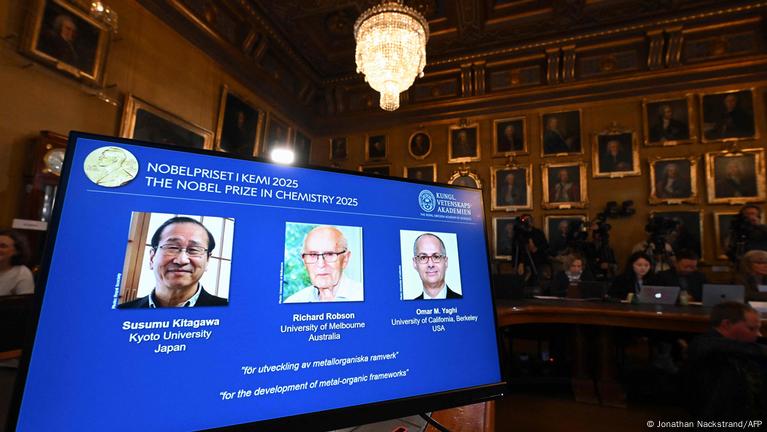
Susumu Kitagawa, Richard Robson, Omar M Yaghi won 2025 Nobel in Chemistry for metal-organic frameworks

By Anjali Sharma
WASHINGTON – The Royal Swedish Academy of Sciences ON Wednesday announced 2025 Nobel Prize winners in Chemistry has gone to Susumu Kitagawa, Richard Robson, and Omar M. Yaghi, three scientists who turned chemistry into architecture that celebrates imagination at the atomic level.
The Royal Swedish Academy of Sciences honoured them “for the development of metal-organic frameworks,” or MOFs, a discovery that could change how we clean air, store energy, and even collect water from desert skies.
Imagine a sponge so small it exists at the molecular level, capable of trapping gases, filtering toxins, and releasing clean water. That’s what these scientists made possible.
The laureates’ creation, metal-organic frameworks are crystal-like structures.
They are metal ions and carbon-based molecules. Together these form a grid filled with countless tiny cavities. This allows other molecules to pass in and out.
These spaces act like storage units for different substances from carbon dioxide to hydrogen. But this depends on how the MOF is designed.
Heiner Linke, Chair of the Nobel Committee for Chemistry, said “Metal-organic frameworks have enormous potential. They bring previously unforeseen opportunities for custom-made materials with new functions.”
The story of this discovery began back in 1989. Then Richard Robson took a leap into unexplored territory. He mixed copper ions with a four-armed molecule that was chemically attracted to them.
The experiment produced a crystal full of empty spaces. The structure collapsed easily. But it opened the door to a new world of chemistry.
Susumu Kitagawa refined the idea. In the early 1990s, he discovered that gases could flow in and out of these frameworks, proving that MOFs could “breathe.”
He also predicted that these structures could be flexible..
Omar Yaghi who gave the concept strength and stability and between 1995 and 2003, Yaghi built the first customizable MOFs.
His designs allowed scientists to alter the frameworks. And now they could tailor them for different purposes such as capturing pollutants, storing energy, or conducting electricity.
The chemists have created thousands of MOFs drawing inspiration from their work.
These materials are now being explored to solve some of the planet’s toughest challenges. This ranges from capturing carbon emissions to filtering “forever chemicals” out of water and producing clean hydrogen fuel. Some versions can even draw water directly from dry desert air.
