

Anjali Sharma
GG News Bureau
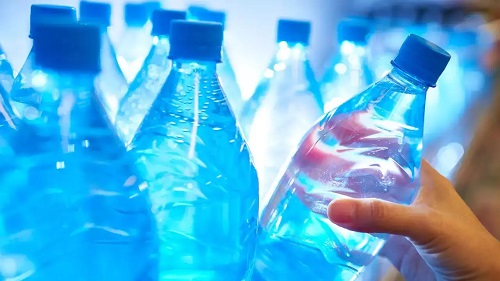
NEW YORK, 10th Jan. A recent study released on Tuesday found out that bottled water contains thousands of identifiable fragments unknown nanoplastics in each container, pose significant health risk.
There has been rising concern that tiny particles known as microplastics are showing up basically everywhere on Earth from polar ice to soil, drinking water and food.
The study published in the journal Proceedings of the National Academy of Sciences, the researchers focused on nanoplastics and microplastics that have broken down even further.
The team from the Columbia University could count and identify these minute particles in bottled water using newly-refined technology.
They found that on average, a litre contained some 240,000 detectable plastic fragments 10 to 100 times greater than previous estimates, which were based mainly on larger sizes.
Nanoplastics are so tiny that, unlike microplastics, they can pass through intestines and lungs directly into the bloodstream and travel from there to organs including the heart and brain.
They can invade individual cells and cross through the placenta to the bodies of unborn babies, the stusy said.
Beizhan Yan, environmental chemist at Columbia University’s Lamont-Doherty Earth Observatory said that “Previously this was just a dark area, uncharted. Toxicity studies were just guessing what’s in there,”.
“This opens a window where we can look into a world that was not exposed to us before.”
The technique used called stimulated Raman scattering microscopy, which involves probing samples with two simultaneous lasers that are tuned to make specific molecules resonate, the researchers tested three popular brands of bottled water sold in the US, analyzed plastic particles down to just 100 nanometers in size.
They spotted 110,000 to 370,000 particles in each litre, 90 per cent of which were nanoplastics; the rest were microplastics.
They determined the specific plastics — polyethylene terephthalate or PET, polyamide a type of nylon, polystyrene, polyvinyl chloride and polymethyl methacrylate all used in various industrial processes.
The plastic types the researchers searched for accounted for only about 10 per cent of all the nanoparticles they found in samples; they have no idea what the rest are.
The researchers said that if they are all nanoplastics, that means they could number in the tens of millions per litre.
The authors wrote that they could be anything, “indicating the complicated particle composition inside the seemingly simple water sample”.
“The common existence of natural organic matter certainly requires prudent distinguishment,” they added.
