
Strategic Crossroads: Taliban–Bharat Talks and U.S. Bagram Air Base Controversy
“Taliban’s New Delhi Visit and America’s Bagram Gambit: A Tightrope of Diplomacy and Dominance.”

Paromita Das
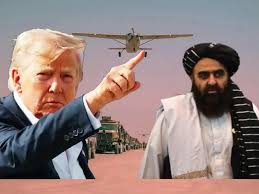
New Delhi, 14th October: The world is watching a paradox unfold. Afghanistan’s Taliban Foreign Minister Amir Khan Muttaqi setting foot in New Delhi signals not a thaw in Bharat’s old reservations but a measured recalibration of South Asia’s evolving power matrix. Meanwhile, across the oceans, President Donald Trump’s re-elected administration seems to have reignited Washington’s most ambitious military desire — to wrest back control of Afghanistan’s Bagram air base. These two developments, running parallel yet connected, illustrate a global disorder where diplomacy, defense, and dominance are colliding with renewed vigor.
The Symbolism Behind the Visit

Muttaqi’s visit to Bharat is nothing short of symbolic defiance wrapped in pragmatic diplomacy. A decade ago, such a scene would have been unimaginable — a Taliban leader holding formal discussions in New Delhi. Yet, Bharat, long a promoter of democratic forces in Afghanistan, now faces a stark geopolitical reality. Recognizing that Afghanistan, under Taliban’s grip, holds key to Central Asia’s connectivity and regional security, New Delhi’s engagement seems less about endorsement and more about influence.
Bharat’s policymakers appear to be taking a calculated leap — acknowledging Afghanistan’s de facto leadership without legitimizing it. By meeting Muttaqi, Bharat signals a willingness to engage, not embrace. It’s a subtle message to the international community that regional stability may require pragmatic partnerships, even with those once ostracized.
America’s Hidden Ambition

While New Delhi courts cautious engagement, Washington is playing a more overt and aggressive hand. Trump’s insistence on taking back the Bagram air base — Afghanistan’s largest and most fortified military facility — underscores the U.S.’s inability to relinquish its geopolitical outpost in Central Asia. Five years after withdrawing under the Doha Agreement, Trump’s open demand that the Taliban “return the base or face consequences” betrays a deeper ambition: re-establishing America’s footprint in China’s shadow.
Bagram’s geography renders it a diamond in the strategic chessboard. Situated just 800 kilometers from key Chinese nuclear sites and within striking range of Iran and Russia, it offers unparalleled surveillance and control over Eurasia. Trump’s fixation is not merely on reclaiming lost prestige but reasserting military reach into a region fast dominated by China’s Belt and Road and Moscow’s Eurasian alliances.
This is Bagram Air Base, and this is the legacy of the occupation… helicopters, armored vehicles, and tanks…
Trump dreams of reclaiming them, but we say: Come and add more equipment to our museums! ✊"#Afghanistan_Graveyard_of_Invaders pic.twitter.com/3QA8AOtnch
— Army of Afghanistan (@Army_of_Afghani) September 21, 2025
Global Resistance and Regional Solidarity

Yet, this second coming of American ambition has sparked rare unanimity among rivals. Bharat, China, Pakistan, Russia, and Iran — often divided by history and ideology — have drawn a red line at any attempt by the U.S. to militarise Afghanistan again. Their joint stance during the “Moscow Format Consultations on Afghanistan” reflects not only shared security anxieties but also a collective rejection of American unilateralism.
The Taliban themselves, historically resistant to any foreign bases, have issued categorical refusals. “Afghanistan is free and will stay free,” Muttaqi declared — a statement that resonates with nationalist pride and diplomatic resolve. In this context, his presence in Delhi carries layered messaging. It gives the Taliban symbolic legitimacy while offering Bharat a new dialogue channel amid a rapidly changing geopolitical landscape.
Bharat’s Dilemma: Between Pragmatism and Perception

For New Delhi, the optics are delicate. On one hand, hosting the Taliban’s foreign minister risks misinterpretation — that Bharat is recognizing the Islamic Emirate as Afghanistan’s legitimate government. On the other, ignoring the Taliban would mean surrendering regional leverage to China, Pakistan, and Iran.
Bharat’s stand during the Moscow consultations — opposing foreign military installations while supporting Afghan-led stability — aligns closely with its long-term policy of strategic autonomy. But it also keeps Washington wary. The U.S. perceives Bharat’s engagement with the Taliban as an indirect resistance to its Central Asian designs. For a country balancing relations between Moscow, Tehran, and Washington, New Delhi’s diplomacy is walking a tightrope — mindful of American discontent, yet unwilling to surrender strategic ground to others.
Trump’s Geopolitical Calculus

Trump’s vision of “America First” has evolved into “America Everywhere” in his second term. From Greenland to Bagram, his administration views territorial assertiveness as a marker of global prestige. His rhetoric around reclaiming Bagram echoes nostalgia for a lost empire of influence. However, this push risks uniting long-standing adversaries — a strategic misstep reminiscent of Cold War overreach.
By attempting to re-enter Afghanistan militarily, Trump challenges not only the Taliban’s sovereignty but also the fragile equilibrium among regional powers. Any attempt to militarise that space again could destabilise the very order Washington claims to protect. For nations like Bharat, that prospect threatens both its investments and security ambitions across South and Central Asia.
How the World Reads New Delhi’s Gesture

Globally, perceptions are mixed. The West views Bharat’s outreach as a tilt toward accommodation with an autocratic regime. The Asian bloc, especially China and Russia, sees it as Bharat’s coming-of-age realism — a willingness to engage power, not ideology. For the Taliban, it is a diplomatic triumph — a move that lifts their isolation and compels the world to deal with them on equal terms.
But beneath these divergent interpretations lies a single truth — the international order is no longer about alignment but adaptation. Bharat’s calibrated diplomacy and America’s revived assertiveness are pieces of a larger shift where global influence depends on who can remain relevant in Afghanistan’s theatre of contest.
The Middle Path That Defines Modern Diplomacy

Bharat must tread this emerging path with both caution and conviction. Engaging with the Taliban does not mean endorsing their ideology; it reflects Bharat’s long-term strategic foresight in a region whose vacuum could otherwise be filled by adversarial powers. Washington’s aggressive rhetoric, meanwhile, shows an older world order struggling to retain dominance in a multipolar reality.
Muttaqi’s Delhi visit represents the politics of necessity, Trump’s Bagram obsession the politics of nostalgia. Bharat’s challenge — and opportunity — lies in balancing both.
A Shifting Power Equation
In the shadows of Bagram’s concrete airstrips and Delhi’s diplomatic corridors, the future of Asian power alignment is being written. Whether Trump’s America reclaims its lost base or the Taliban reinforce their defiance, one reality stands firm — Afghanistan remains the world’s geopolitical heart, and no superpower can dictate its rhythm without consensus.
New Delhi’s engagement signals that Bharat is not acknowledging Taliban rule but acknowledging reality — that diplomacy today is driven less by ideology and more by necessity. If the United States insists on reclaiming past dominance, it may find itself increasingly isolated. For now, the world’s gaze rests on Bharat — the only capital that still dares to balance ideals with intelligence in an age defined by ambition and upheaval.
