

Poonam Sharma
The clanking of iron gates in Kathmandu this September did more than reverberate through Nepal’s Parliament complex; it resonated across all of South Asia. Energetic protesters charging barriers, shattering windows, even sorting through the accoutrements of authority felt uncomfortably reminiscent. Only three years ago, it was this way in Colombo. A year thereafter, Dhaka. And now, Nepal.
Across nation after nation, South Asia’s Gen Z — digital-born, pandemic-surviving, economically-struggling young people — is rising up against settled elites. It is an analyst argument that the precipitating factors differ — a quota system for jobs in Bangladesh, economic meltdown in Sri Lanka, social media restrictions in Nepal — but that underlying current remains one and the same: a generation that refuses to be governed by structures that no longer serve its ideals.
A New Political Geography of Youth Revolt
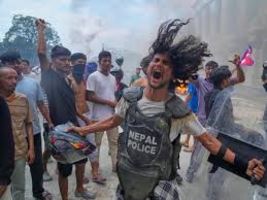
Nepal’s unrest this September started when the government banned social media sites, citing failure to regulate them. But the prohibition was only a match in a tinderbox of corruption, nepotism and inequality. Thousands of adolescents, many of them still clad in school uniforms, took to the streets. Police crackdowns by the third day killed over 70 people. The demonstrations escalated: Parliament buildings burned, homes of political leaders attacked, even Nepal’s biggest media house torched.
Prime Minister KP Sharma Oli, who had dismissed the agitators as “Gen Z kids,” quit days later. In an unthinkable move in earlier times, about 10,000 Nepali youth — many of whom were in the diaspora — elected an interim prime minister through an online vote on Discord, a site originally open only to gamers.
This scene mirrors Sri Lanka in 2022. The “Aragalaya” (The Struggle) movement arose from an economic freefall: 12-hour power cuts, fuel shortages, inflation over 50 percent. Protest camps with their own micro-economies sprang up in Colombo. The target was Gotabaya Rajapaksa, scion of a family that had ruled for nearly two decades. By mid-July, Rajapaksa fled his residence — and the country — as demonstrators took over.
Bangladesh soon followed in 2024. A student movement against job quotas turned into a national movement when police killed hundreds of young protesters. Prime Minister Sheikh Hasina, who had held power for over a decade, took a helicopter ride to escape to India.
Three nations. Three regimes overthrown or driven into hiding. And one generational force that holds them together.
From Street Power to Digital Power
Political scientists notice something different in these movements. Paul Staniland of the University of Chicago terms it a “new politics of instability.” Where South Asia used to see military coups or communal riots, now there is a wave of decentralized, youth-led revolutions.
The playbook is digital. Loose student blocs in Bangladesh issued ultimatums on encrypted apps. Discord was a voting booth in Nepal. Protesters in Sri Lanka made “GotaGoGama” a civic experiment, with rallies, art performances and live-streamed orations. Cutting off platforms or shutting down internet access has always backfired, fueling fury and compelling innovative workarounds.
This is not just mobilisation; it’s symbolism. Choosing Discord or TikTok isn’t only about reach, it’s about rejecting traditional channels of political participation that young people see as corrupt or closed.
Why Gen Z ? Why Now ?
The origin of these protests is deeper than any one issue. Meenakshi Ganguly of Human Rights Watch contends that socioeconomic inequalities and deep-seated corruption have built a “dissonance” among leaders and citizens. These leaders, the majority of whom are in their seventies, have policies, ways of life — foreign-educated offspring, multi-million-dollar mansions, exemption from economic stress — that are alien to citizenries whose median ages are below 28.
South Asian Gen Z matured through several shocks: the 2008 financial crisis, the COVID-19 pandemic, and the post-pandemic economic slowdowns. Pandemic lockdown accelerated their digital literacy. Their moral indignation is generational: they see their futures hijacked by the very elites tasked with protecting them.
Rumela Sen of Columbia University points to the authenticity behind the anger. “If one looks beyond the images of broken windows and slogans,” she states, “there is a very democratic desire for inclusion, economic justice and accountability.”
This is a significant departure from earlier unrest in the country, which was frequently based on ethnicity, secession or coup d’etats. Gen Z uprisings today are socio-economic in essence, enabling them to transcend ethnic, religious and regional boundaries.
Nepotism as a Flashpoint
Nepotism has been a rallying point, fueled by social media. Hashtags #NepoKid — which emerged in Indonesia — trended in Nepal as protesters criticized leaders’ offspring with Western educations and high-end lifestyles. The protests aren’t merely about corruption in the abstract sense; they’re about lived experience of contrast between elites’ privilege and precarity of youth who confront unemployment and migration.
Nepal’s dependence on remittances — a third of its GDP — underscores this difference. Tens of millions of Nepali youth labor overseas as ruling families in Nepal bask in power and riches at home. In Sri Lanka, the Rajapaksa clan’s extended reign made them an obvious target. In Bangladesh, Sheikh Hasina’s firm control over state institutions fed a similar the dynasty storyline.
Learning Across Borders
Jeevan Sharma, a Kathmandu-based political anthropologist, writes Nepali youth closely observed Sri Lanka and Bangladesh. Their strategies — decentralised leadership, hashtag campaigns, international media outreach — were adapted and borrowed. Staniland refers to it as a new “playbook of digital protest” across South Asia and beyond.
This cross-pollination tracks with global youth movements in Indonesia, the Philippines and Hong Kong. But South Asia’s crowdedness, young population and explosive politics make it especially fertile ground.
Demographics as Destiny
Nearly 50 percent of Nepal, Bangladesh and Sri Lanka’s populations are under 28. Literacy rates exceed 70 percent, yet per capita GDP lags far behind the global average. Such a mix — educated but underemployed youth in societies dominated by ageing elites — has historically been a recipe for unrest.
Governments under pressure from protests have fewer strings to pull, Staniland adds, particularly in an era of slow growth and inequality. Repression fails, internet shutdowns fail, and economic incentives are limited. The very nature of these societies amplifies Gen Z’s bargaining power.
A Democratic Underpinning
In spite of the disorder, a lot of onlookers perceive hope more than despair. These rebellions are not nihilistic. They are oriented toward the future, motivated by dreams of equality, jobs and future. They demand accountable government and not secession or religious government. In that respect, they’re nearer to pro-democracy or civil-rights movements than to coups or insurgencies.
Digital technology provides them with speed and spectacle, but also vulnerability. Without the leadership of a center, movements can splinter. Without institutional mechanisms, wins can be fleeting. Nepal’s web-voted interim PM can be a sign of innovation, but at the expense of raising questions regarding legitimacy and durability.
What Next for South Asia’s Gen Z?
Will the contagion ignite? Specialists identify possible flashpoints around the region — Pakistan’s youth bulge, India’s emerging student movements — but no one knows where the next spark will take hold. One thing is certain: the political balance in the region has changed. Governments can no longer count on compliant, obedient youth populations.
Rumela Sen contends that “the tech-savvy slogans about fairness, future, jobs, together with fairness, are providing these movements an advantage over the old elites.” That advantage will be put to the test, though, as those nations transition from protest to power, from deconstruction to construction.
The Generational Reckoning
Finally, what unites Nepal, Bangladesh and Sri Lanka’s Gen Z revolutions is not merely discontent but a new political awareness. South Asia’s youth are no longer mere recipients of policy but active players remolding their region’s futures. They’re forming alliances across national borders, employing memes and hashtags as political projectiles, and boycotting a political elite that gets spoken to in a different language — both literally and metaphorically.
The moral indignation is real, as Sen observes: a generation that believes its future is being sold down the river by leaders of its grandparents’ generation. Whether or not that outrage can be translated into sustained political change will decide the region’s stability for decades to come.
For the time being, South Asia is one big, live laboratory for change made by young people. From Discord surveys to presidential palace takeovers, Gen Z has reconfigured the limits of protest. The rest of the world is observing — and even learning, possibly.
