

Poonam Sharma
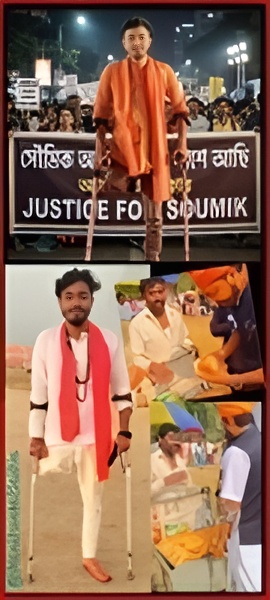
West Bengal’s political landscape has long been shaped by strong personalities, ideological battles, and mass mobilisations. From the days of communist street power to Mamata Banerjee’s grassroots populism, symbols have often mattered as much as structures. In recent months, one name has emerged sharply in this tradition—Soumik Mukherjee, a physically disabled young man who, despite lacking a leg, has come to represent defiance, religious assertion, and political resistance for a section of Bengal’s Hindu society.
A Leader Without a Limb, But Not Without Resolve
Soumik Mukherjee is described by supporters as a Divyang—physically challenged, yet mentally unyielding. In a state where political leadership has often relied on organisational might or inherited influence, Soumik’s rise is strikingly different. His disability has not reduced his public presence; instead, it has amplified his symbolic power.
Among Sanatani Hindu youth in West Bengal, Soumik is increasingly seen as proof that physical limitation cannot justify social or political surrender. Social media narratives portray him as a living rebuke to passivity, repeatedly asking: if a man without a leg can stand up, why should an entire community remain on its knees?
The December 7 Incident: A Spark That Lit a Fire
The episode that propelled Soumik into the public spotlight occurred on December 7 at Kolkata’s Brigade Ground, where a massive Geeta recitation programme involving around five lakh participants was organised. According to the narrative, a vendor selling patties at the venue was found to be using chicken meat—an act that offended religious sensibilities in a deeply sacred setting.
Soumik confronted the vendor, and the situation escalated into physical violence, with the vendor reportedly being slapped. This incident became the turning point. The state administration, led by Chief Minister Mamata Banerjee, responded by arresting Soumik.
Arrest, Resistance, and the Street Response
What followed the arrest transformed a local incident into a political flashpoint. Large numbers of people reportedly gathered at the police station. Groups of lawyers intervened, and Soumik’s bail became possible directly from the police station. The speed and scale of the response indicated that the issue had moved beyond law enforcement into the realm of mass politics.
For Mamata Banerjee’s government, Soumik quickly turned into a persistent problem. His detention did not weaken his image; instead, it reinforced it. To supporters, he became a victim of state overreach. To critics of the government, he emerged as a symbol of selective enforcement and political intimidation.
The ‘Second Gopal Patha’ Narrative
On social media, Soumik has been branded the “Second Gopal Patha,” a label that signals his elevation from individual activist to ideological icon. Such titles thrive in Bengal’s political culture, where martyrdom, resistance, and symbolic suffering often translate into mass appeal.
This framing places Soumik not merely as a protester, but as a representative figure in what supporters describe as a “religious war”—a broader struggle over cultural space, identity, and political power in the state.
Religion, Constitution, and Political Contestation
At its core, the Soumik Mukherjee episode raises constitutional questions. The Indian Constitution guarantees freedom of religion, freedom of expression, and equality before law. It also empowers the state to maintain public order. When religious sentiment, law enforcement, and political authority collide, the outcome is rarely neutral.
Supporters argue that Soumik’s actions reflect a larger Hindu assertion that has been suppressed in Bengal’s political environment. Critics, though not addressed in this narrative, would likely frame the issue as law and order. What is undeniable is that Soumik’s case has become a lens through which many view the state’s governance.
Electoral Undercurrents and the Road Ahead
According to the political arithmetic circulating among supporters, Mamata Banerjee’s position appears increasingly vulnerable. The Election Commission’s actions against online narratives are interpreted as signs of a tense and closely watched political environment.
For the BJP and allied Hindu groups, Soumik represents an opportunity and a warning. If momentum is sustained, Bengal could witness a historic shift. If not, supporters fear that such a chance may not come again.
More Than a Man
Soumik Mukherjee today is no longer just an individual. He is a mirror reflecting Bengal’s unresolved tensions—between faith and governance, protest and authority, disability and determination. Whether he becomes a lasting political force or a fleeting symbol, his rise has already altered the conversation in West Bengal.
