
Sonia Gandhi’s West Asia Editorial Triggers Fierce Political Storm

Poonam Sharma
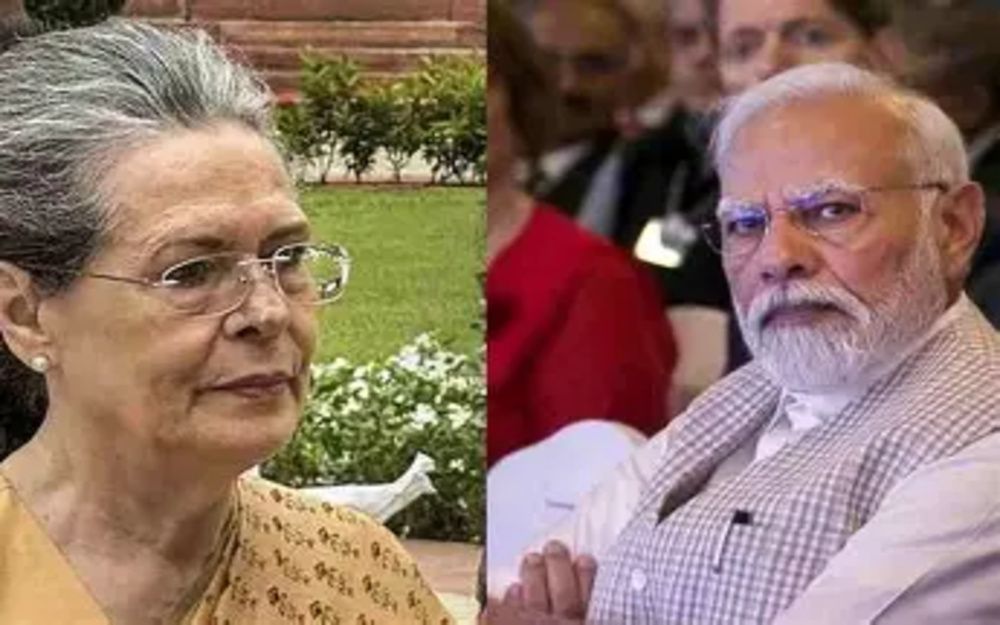
A sharp political confrontation has erupted between the BJP and the Congress after Congress Parliamentary Party chairperson Sonia Gandhi questioned the Modi government’s response to the escalating West Asia conflict, including the reported assassination of Iran’s Supreme Leader.
The controversy intensified after BJP leader Prakash Reddy termed Sonia Gandhi’s opinion piece “ridiculous” and accused the Congress party of indirectly supporting forces hostile to India’s interests.
Congress Questions Government’s Silence
In her editorial, Sonia Gandhi criticised the government’s “silence” over the targeted killing of Iran’s Supreme Leader, Ali Khamenei. She argued that New Delhi’s lack of an explicit condemnation signalled a departure from India’s traditional position on sovereignty and international law.
She wrote that when a sitting head of state is killed amid ongoing negotiations, it represents a rupture in international norms. According to her, India’s restrained response raises questions about the direction and credibility of its foreign policy.
Sonia Gandhi also flagged Prime Minister Narendra Modi’s recent visit to Israel and his visible support for Prime Minister Benjamin Netanyahu, suggesting that the timing of diplomatic gestures and subsequent developments warranted scrutiny.
BJP Hits Back Strongly
The BJP responded aggressively. Prakash Reddy dismissed Sonia Gandhi’s remarks as misplaced and politically motivated. He asserted that India’s foreign policy under Prime Minister Modi is “clear and interest-driven.”
According to Reddy, India maintains friendly relations with all nations, including Iran, Israel, and Arab countries, but ultimately acts in accordance with national interest. He pointed out that when Hamas attacked Israeli civilians in October 2023, killing and kidnapping many, the Congress party’s stance was not sufficiently firm.
Reddy accused Congress of selectively invoking principles of sovereignty and international law while failing to condemn terrorist actions unequivocally. “Were they in favour of Hamas?” he asked, suggesting that Congress’s line weakens India’s global positioning.
The Broader Strategic Context
The West Asia crisis escalated after coordinated US-Israel airstrikes targeted Iranian military infrastructure. Iran retaliated with missile and drone strikes across the region, expanding the conflict’s footprint and raising global security concerns.
India finds itself in a complex diplomatic space. It has strong strategic ties with Israel, including defence cooperation. At the same time, Iran remains crucial for India’s energy security and connectivity projects such as Chabahar Port. Furthermore, millions of Indian expatriates live across the Gulf region.
Against this backdrop, the Modi government has emphasised de-escalation, dialogue, and diplomacy. Official statements have been cautious, avoiding direct alignment with either bloc.
Political Debate or Diplomatic Sensitivity?
The core of the dispute lies in interpretation. For Congress, silence equals moral abdication. For the BJP, silence represents strategic restraint.
Sonia Gandhi’s intervention reflects the Congress party’s attempt to project itself as a guardian of traditional non-alignment principles and international law. The BJP, however, portrays her remarks as undermining India’s calibrated diplomacy during a sensitive geopolitical crisis.
As tensions in West Asia continue, the domestic political battle underscores how foreign policy has increasingly become a subject of partisan debate. The coming parliamentary session may see sharper exchanges, as Congress has demanded discussion on what it calls the government’s “disturbing silence.”
Whether this episode reflects democratic accountability or political opportunism will depend largely on how events unfold globally — and how India navigates its delicate diplomatic balancing act.
