
SC Flags Legal Vacuum in Striking Personal Laws
Supreme Court says Uniform Civil Code may be needed while hearing plea on Muslim women’s inheritance rights

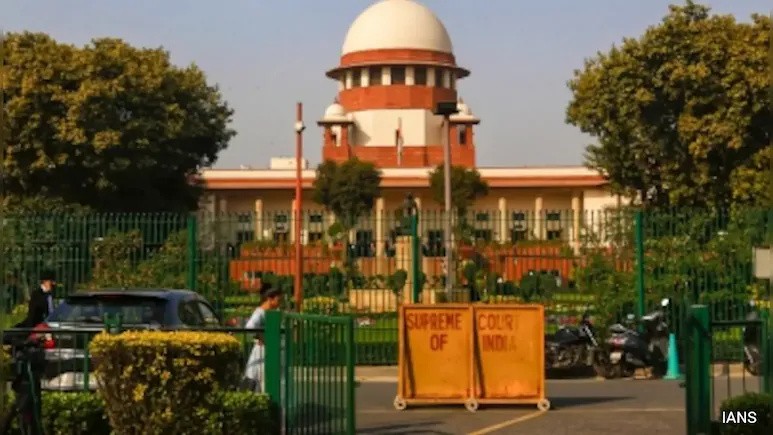
- Supreme Court hears plea challenging Muslim women’s succession rights under Shariat law
- Court says scrapping all personal laws at once could create legal vacuum
- Bench notes many Indian women face inequality under different personal laws
- Suggests broader debate and possible legislative action on Uniform Civil Code
GG News Bureau
New Delhi, 10th March: The Supreme Court on Tuesday observed that while a Uniform Civil Code (UCC) could help restore rights for a large section of Indian women, striking down all personal laws at once could create a serious legal vacuum with wide-ranging consequences.
The observation came during the hearing of a petition challenging alleged discrimination in succession rights for Muslim women under the Muslim Personal Law (Shariat) Application Act, 1937.
A bench comprising Chief Justice of India Surya Kant and Justice Joymalya Bagchi noted that inequality affecting women is not confined to a single community and exists across various personal law systems in India.
The court said that if succession rights under Sharia law are subjected to judicial scrutiny, similar examination could also extend to provisions in other personal law frameworks, including aspects of the Hindu Undivided Family system under Hindu personal law.
However, the bench cautioned that invalidating entire personal law systems could create a legal void in society.
“Striking down an entire personal law can create a vacuum. This will have multifarious and large consequences not only for Muslims but also for Hindus,” Justice Bagchi observed.
He added that such a move might ultimately fall within the domain of the legislature.
“To declare personal laws void and create a vacuum… it may be best to defer the issue to legislative wisdom so that Parliament can bring about a law on a Uniform Civil Code,” he said.
Chief Justice Surya Kant agreed with the observation, indicating that the broader solution to such issues could lie in a comprehensive Uniform Civil Code applicable to all citizens irrespective of religion.
Currently, different religious communities in India follow separate personal laws governing matters such as marriage, divorce, adoption and inheritance.
During the hearing, senior advocate Prashant Bhushan, appearing for the petitioner, argued that Muslim women should not receive inferior inheritance rights compared to Muslim men.
Referring to the Supreme Court’s 2017 judgment in the Shayara Bano case, which struck down the practice of triple talaq, Bhushan said the court had the authority to examine discriminatory provisions recognised under the Shariat Act of 1937.
The bench, however, suggested that the petitioner expand the scope of the plea and propose alternatives in case personal laws are struck down.
“Why don’t you amend the plea and think of some alternatives so that more credence can be given,” the Chief Justice said.
He cautioned that reforms must be carefully considered to avoid unintended consequences.
“In our over-anxiety for reforms, we may end up depriving them, and they might end up getting less than what they are already getting,” the CJI remarked.
The court also pointed out that certain practices under personal law systems, including unilateral divorce, raise complex legal questions about the status of relationships formed under those frameworks.
After hearing the arguments, the Supreme Court granted the petitioner time to file an amended plea highlighting discrimination faced by women under personal laws and suggesting possible solutions.
The matter has been listed for hearing on a later date.
